When Aly was 10 years old, walking was no longer something she could take for granted.
She had once moved through the world like any other child—running, playing, growing, and imagining what her future might look like.
Then cancer changed everything.
In 2013, Aly was diagnosed with osteosarcoma, an aggressive form of bone cancer that often requires intense treatment and major surgery. For her, fighting the disease meant chemotherapy and an operation that would permanently change the way she moved.
The damaged bone was removed and replaced with an expandable internal prosthesis.
The surgery helped save her life.
But surviving cancer was only the beginning.
After the operation, Aly’s body was exhausted. She was extremely thin and weak, and even simple movements became difficult. Her artificial knee did not move the way a healthy knee would, and something as ordinary as bending her leg required tremendous effort.
Physical therapy became part of her everyday life.
Again and again, she had to work on the same movements.
Bend the knee.
Straighten it.
Stand.
Take a step.
Try again.
For most people, walking across a room requires almost no thought. For Aly, every step represented work, patience, pain, and determination.
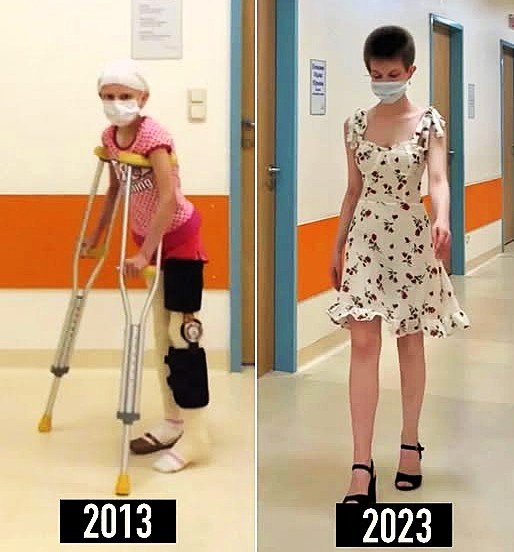
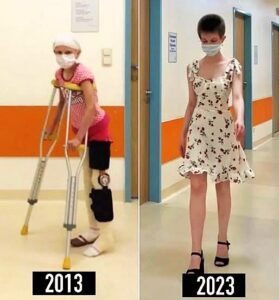
At one point during her recovery, a photograph captured her walking down a hospital hallway on crutches.
She was only 10.
Her small body looked fragile against the long corridor, but there was something powerful about the image.
She was moving forward.
Maybe slowly.
Maybe painfully.
But she was moving.
That photograph became a reminder of a chapter of her life that she would never forget.
Years passed.
Aly grew older.
Her childhood battle with cancer became part of her history rather than the entirety of her identity. She continued moving forward, adapting to the changes her treatment had left behind and learning what her body could do.
Then, in 2023, she returned to the hospital.
It wasn’t because she had returned to the beginning.
Quite the opposite.
She was there for a routine appointment with the surgeon who had treated her years earlier.
And this time, Aly wanted him to see something.
She didn’t arrive on crutches.
She didn’t arrive as the frightened 10-year-old girl who was struggling to learn how to walk again.
She arrived wearing a dress.
And high heels.
It was a small choice that carried an enormous meaning.
Those heels represented something far greater than fashion.
They represented ten years of progress.
Ten years of rehabilitation.
Ten years of learning to live with an artificial joint.
Ten years since she had first walked through that hospital corridor struggling to put one foot in front of the other.
Now she wanted the doctor who had helped her through the darkest part of her childhood to see what had happened since.
She walked into that familiar hallway in heels.
And her surgeon saw her.
Aly later recalled his reaction as one of the most beautiful moments of the entire experience.
He smiled at her.
Not just a polite smile.
Aly remembered it because she said she had never really seen that kind of smile from him before. There was even a glimpse of his teeth—something she found surprisingly meaningful.
Perhaps he understood exactly what that moment represented.
He had seen the little girl before the operation.
He had seen what cancer had done to her body.
He had seen her recovery.
He had watched her struggle.
And now, years later, he was looking at the same person standing confidently in front of him.
The little girl with the crutches had grown into a young woman walking in high heels.
The hallway hadn’t changed nearly as much as she had.
Two years later, in 2025, Aly brought the story back to life by placing the two photographs side by side.
One showed her at 10 years old, moving through the hospital on crutches after cancer treatment.
The other showed her years later, walking through that same environment in high heels.
Same girl.
Same hospital.
Same hallway.
But an entirely different chapter.
The contrast was impossible to miss.
The first photograph showed how much she had struggled just to walk.
The second showed how far she had come.
Her story reached more than 140,000 people online, many of whom celebrated the remarkable distance between those two moments.
But perhaps the most important part of Aly’s story wasn’t the number of people who saw the photographs.
It was what the photographs meant to her.
By the time she shared them, Aly had been cancer-free for nearly 12 years.
Nearly 12 years since a disease had entered her childhood and forced her to confront things that most children never have to think about.
Nearly 12 years since chemotherapy, surgery, rehabilitation, and uncertainty became part of her life.
And nearly 12 years since she began learning how to walk again.
Looking back, the difference between those two photographs tells a powerful truth about recovery.
Progress is not always obvious when you’re living through it.
When you’re struggling through physical therapy, you may not notice that you’re becoming stronger.
When you’re taking one painful step at a time, you may not realize how many thousands of steps are waiting for you in the future.
When you’re exhausted, scared, or uncertain about what tomorrow will bring, it can be difficult to imagine the person you will eventually become.
Sometimes you only recognize your progress when you look backward.
That’s what Aly’s photographs capture so beautifully.
The little girl in the first picture could not have known exactly where life would take her.
She couldn’t have known that one day she would return to that same hallway.
She couldn’t have known that she would someday walk there confidently.
And she certainly couldn’t have imagined that she would one day stand in front of the doctor who helped save her life wearing high heels.
But she kept going.
Step after step.
Day after day.
Year after year.
And eventually, she became the proof that the hardest chapter of your life does not have to become the final chapter.
Her story isn’t simply about cancer.
It is about rebuilding.
It is about patience.
It is about learning to trust your body again after it has been through something devastating.
And it is about understanding that sometimes the greatest victories are hidden inside ordinary moments.
A child taking her first difficult steps.
A teenager learning to live beyond treatment.
A young woman putting on a pair of heels and walking back into the place where her journey once seemed so uncertain.
That hallway witnessed both versions of Aly.
The girl who needed crutches.
And the woman who no longer needed them.
The photographs remind us that healing doesn’t always erase what happened.
The scars may remain.
The artificial joint may remain.
The memories may remain.
But so does the person who kept moving forward.
And perhaps that is the most beautiful part of Aly’s journey.
She didn’t go back to that hospital to prove that cancer had never happened.
She went back to show how much life had happened since then.
Sometimes, the strongest way to honor the person you used to be is simply to keep walking.
Even when the road is difficult.
Even when every step hurts.
Even when you cannot yet imagine where the road will lead.
Because one day, you may look back and realize that the person who once wondered whether they would ever walk normally again was already taking the first steps toward a future they couldn’t see.
And maybe that is what Aly’s two photographs say without words:
You may not realize how far you’ve come until you finally turn around and look. ❤️