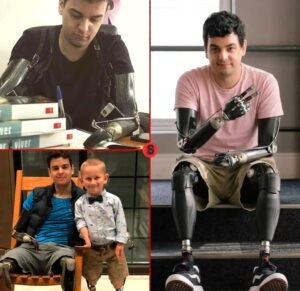
At just 18 years old, his life changed in a way no teenager could ever imagine.
He was young, full of plans and possibilities, when a severe bacterial infection suddenly placed his life in serious danger. What began as an illness rapidly developed into meningococcal sepsis, a devastating condition that can spread through the bloodstream and cause catastrophic damage to the body.
He survived—but survival came at an unimaginable cost.
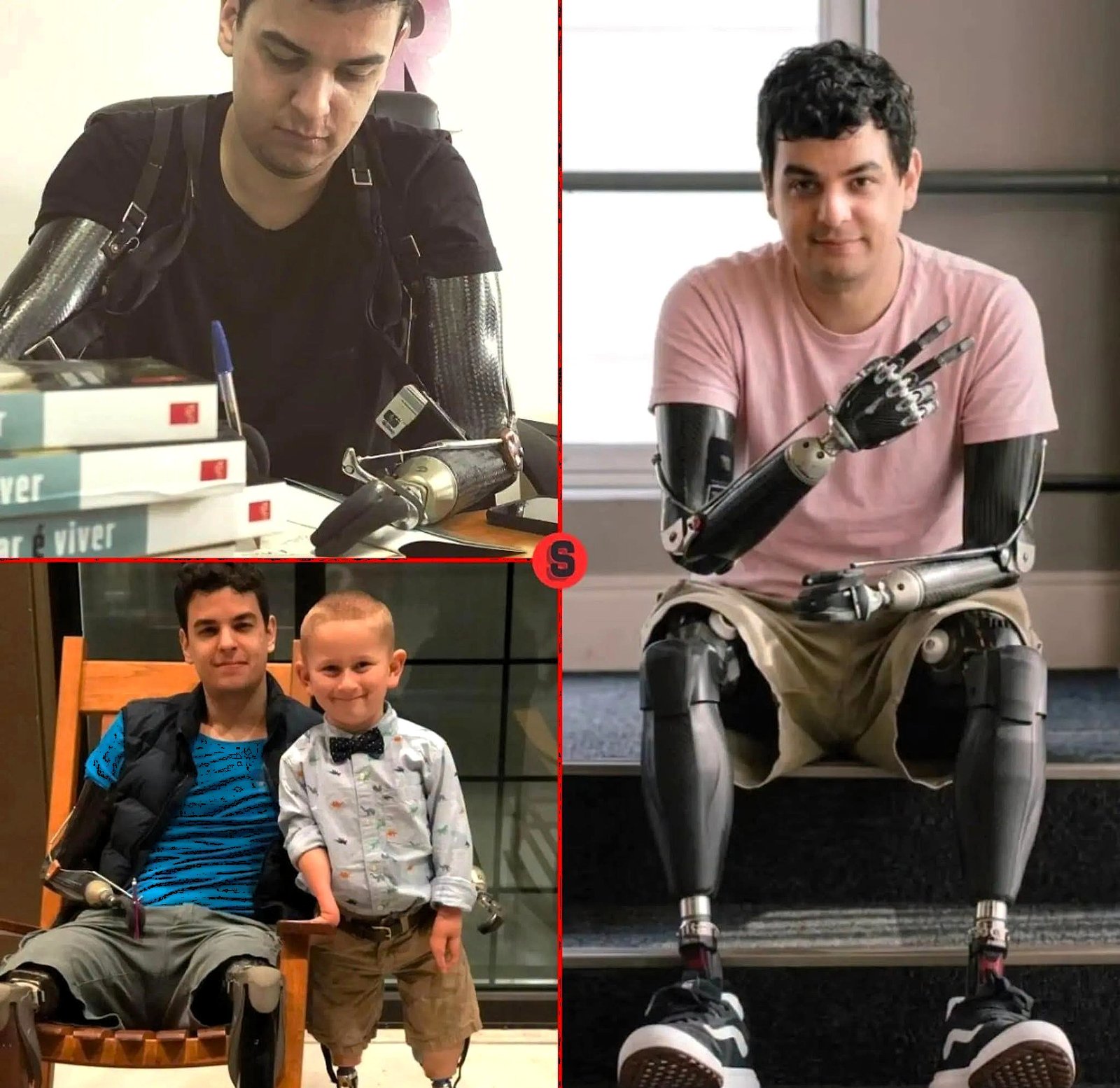
The infection caused such severe damage that doctors were forced to amputate all four of his limbs: both arms and both legs.
In a matter of weeks, the young man went from imagining his future to learning how to rebuild his entire life.
For many people, losing a limb would be enough to make the future feel impossible. Losing all four could seem like the end of everything familiar—independence, education, career ambitions, and the ordinary routines most people never think twice about.
But for him, it became the beginning of a different kind of journey.
Learning to Live Again
Recovery was not simply about healing physical wounds.
It meant discovering how to navigate a world that had suddenly become completely different.
Simple daily activities required new methods. Familiar movements had to be replaced by unfamiliar ones. Independence had to be relearned, step by step.
There was also the emotional side of recovery.
At 18, he had to confront questions that most people do not face until much later in life. What would his future look like? Could he continue his education? Would he be able to work? Could he travel? Could he build a meaningful career?
Instead of allowing those questions to define him, he began searching for answers.
His recovery became a process of adaptation, determination and education.
He eventually traveled to the United States, where he studied Economics. Continuing his education after such a life-changing experience was more than an academic achievement—it represented his refusal to allow his circumstances to determine the limits of his future.
He continued moving forward.
From Survivor to Storyteller
As the years passed, his personal experience began to take on a larger meaning.
He realized that his story could help people who were facing their own seemingly impossible circumstances.
He began sharing his experiences with audiences, eventually becoming an international speaker.
His message was shaped by something deeply personal: life can change without warning, but a changed life does not necessarily mean a life without purpose.
Speaking publicly gave him an opportunity to discuss resilience, adaptation and the importance of continuing to search for possibilities even after tragedy.
His journey also became the foundation for his book, Superar é Viver—a title that reflects the central idea behind his experience: overcoming is part of living.
His story reached beyond the physical loss of his limbs.
It became a story about identity.
A person can lose abilities they once considered essential and still discover new abilities. A future can look completely different from what was originally imagined and still contain purpose, achievement and meaningful relationships.
Turning Personal Experience Into Help for Others
Perhaps one of the most powerful parts of his journey is that he did not stop with his own recovery.
He eventually became a co-founder of the Da Vinci Clinic, a specialized center focused on prosthetics and rehabilitation for amputees.
The work connects directly with the experience that changed his own life.
Someone who once had to learn how to adapt to life without all four limbs now helps create opportunities for other amputees who are beginning their own journeys.
The importance of that work goes far beyond prosthetic technology.
For an amputee, receiving a prosthesis can represent more than mobility. It can mean returning to school, going back to work, traveling independently, participating in sports, meeting friends, or simply regaining confidence in everyday life.
Rehabilitation can also help people understand that recovery is not about returning to exactly who they were before an accident or illness.
Sometimes, recovery means discovering who they can become afterward.
A Different Definition of Strength
His story challenges the way many people think about strength.
Strength is not always about being fearless.
Sometimes it means being afraid and continuing anyway.
It can mean waking up after a devastating diagnosis and choosing to begin another day. It can mean learning something that once seemed impossible. It can mean asking for help when help is needed and eventually becoming the person who helps someone else.
He experienced one of the most dramatic physical transformations imaginable at an extremely young age.
Yet his life did not end with the loss of his limbs.
He studied.
He traveled.
He wrote.
He spoke to audiences around the world.
And he helped establish a clinic dedicated to supporting people living with limb loss.
None of those accomplishments erase what happened to him. They do something different: they demonstrate what he built afterward.
A Message That Goes Beyond Amputation
His journey also carries a broader message for people who have never experienced limb loss.
Life can change suddenly.
Plans can disappear.
The future we imagine at one moment may look completely different the next.
But sometimes, the most important question is not, “Why did this happen to me?”
It is, “What can I build from here?”
That question does not make suffering disappear. It does not make recovery easy. And it does not suggest that everyone must respond to tragedy in the same way.
Instead, it leaves room for something powerful: possibility.
His life became an example of how a person can experience enormous loss and still pursue education, develop a career, tell his story and dedicate part of his life to helping others.
At 18, a severe infection nearly took his life and left him without all four limbs.
Years later, the same person stands as an advocate for rehabilitation and a source of encouragement for amputees around the world.
His story is not simply about what he lost.
It is about what he chose to build afterward.
And perhaps that is the most important lesson of all: sometimes, surviving the hardest chapter of your life is not the end of the story.
It is the moment when a new one begins.