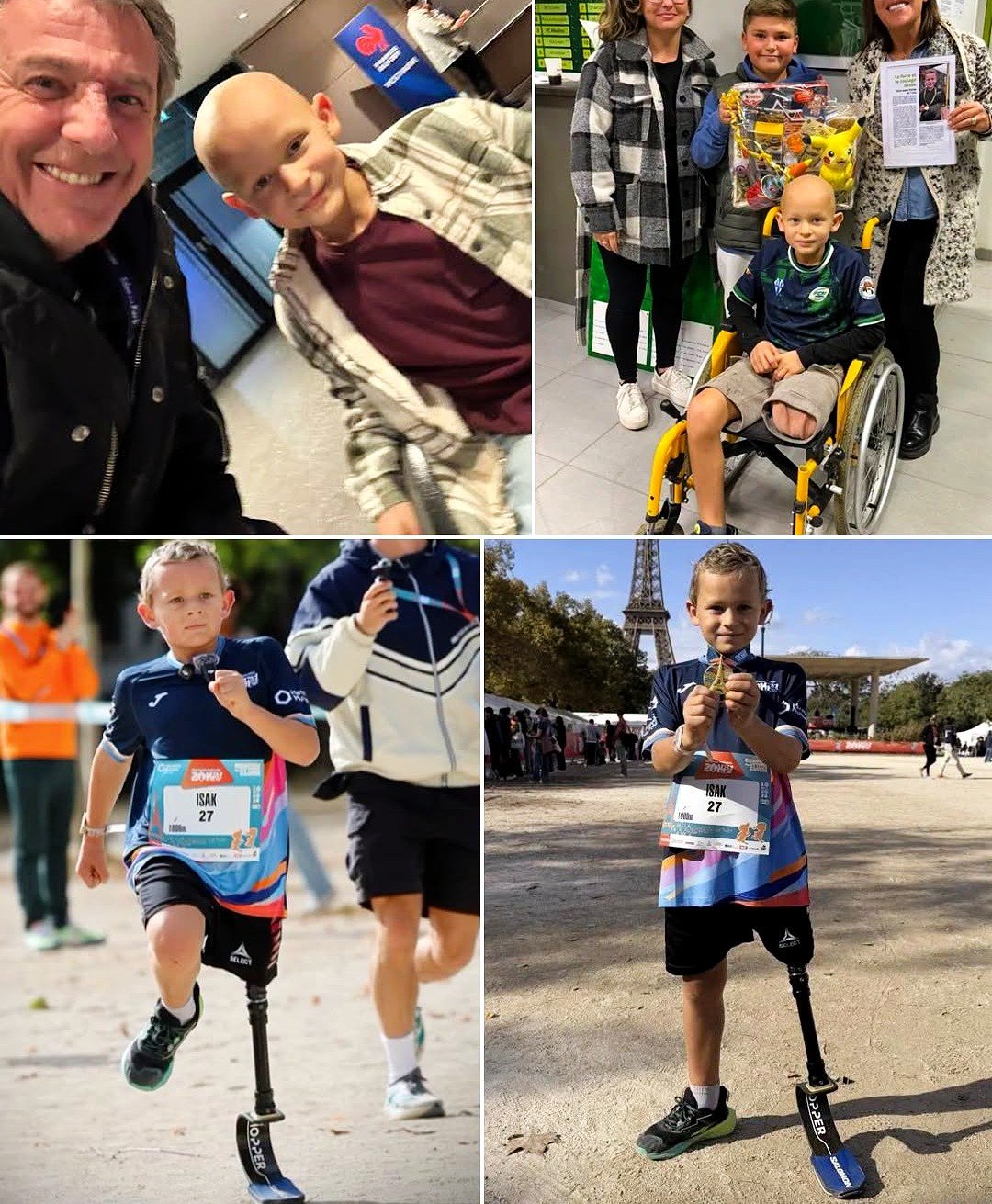
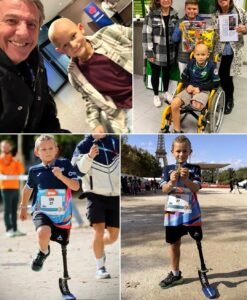
For most children, running a one-kilometre race is an exciting opportunity to spend time with friends, enjoy the atmosphere of a sporting event, and experience the thrill of reaching the finish line. For eight-year-old Isak, however, crossing that line represented something much deeper. It was a moment of courage, determination, and a new beginning after a year filled with challenges no child should have to face.
After losing his left leg to cancer, the young boy from France’s Allier region had to adjust to a dramatically different life. Everyday activities that many children take for granted required new approaches, patience, and support. Yet even after everything he had endured, Isak still wanted to run.
On October 10, 2026, he took an important step towards that dream when he participated in a children’s race held ahead of the 20 km de Paris. Beneath the shadow of the iconic Eiffel Tower, at the Champ-de-Mars in Paris, Isak joined other young runners for a one-kilometre event.
He was no longer simply a boy recovering from a major medical ordeal. On that day, he was a young athlete with a goal, a starting line to reach, and a finish line waiting ahead.
A childhood changed by cancer
Cancer can turn a family’s world upside down. Hospital visits, medical treatments, difficult decisions, and uncertain days can quickly replace the ordinary routines of childhood.
For Isak and his family, the battle against cancer eventually led to the amputation of his left leg. Losing a limb is a life-changing experience, particularly for a young child who is still growing, discovering new interests, and learning what his body can do.
Recovery involves much more than healing after surgery. A child must also adapt to changes in movement, balance, and everyday independence. Activities that once seemed simple may require new skills, specialist equipment, and considerable practice.
For families, the journey can bring emotional and practical challenges as well. Parents want their children to feel included, confident, and free to pursue their interests, but finding the right resources is not always easy.
Despite those difficulties, Isak continued to look towards the activities he enjoyed.
Sport remained something he wanted to experience. Running was not merely about speed or competition. It was an opportunity to participate alongside other children, challenge himself, and enjoy an activity on his own terms.
His determination to try was an important part of the story, but determination alone could not provide everything he needed. To take part safely and effectively, he required suitable equipment that would allow him to explore running after his amputation.
That is where a specialised running prosthesis became important.
The equipment that opened a new door
A regular walking prosthesis and a running prosthesis serve different purposes. Running places different demands on the body, including repeated impacts, changes in balance, and the need to move efficiently through each stride.
Specialised running blades are designed to help people with limb differences participate in running and other athletic activities. Their design can support forward movement by storing and releasing energy as the runner moves, although the right equipment depends on the individual and requires appropriate fitting and training.
For a growing child, gaining access to such equipment can be particularly challenging.
Children’s prosthetic needs change as they grow, and specialised sports equipment may require additional resources, professional support, and opportunities to practise. Even when a child is eager to participate, the cost and availability of suitable equipment can create significant barriers.
Isak’s family explained that obtaining these specialised prostheses for children is not always straightforward.
Fortunately, a running blade was loaned to him by Hopper, giving him the opportunity to prepare for the race.
That support helped turn an ambition into something he could begin working towards.
The loan of the blade was important because it gave Isak access to equipment that might otherwise have been difficult to obtain. Instead of having to abandon the idea of running, he could begin learning how to use the prosthesis and prepare for his first event.
It was a reminder that helping a child participate in sport sometimes begins with providing the right resources.
A supportive environment, appropriate equipment, and the chance to practise can help make an activity more accessible. For Isak, those elements came together at a moment when he was ready to try something new.
One month to prepare for a special race
Although receiving the running blade was an important milestone, it did not mean Isak could immediately run as though nothing had changed.
Using a specialised prosthesis requires adaptation. The runner must become familiar with the equipment, develop coordination, and learn how to move with it. For a child who has undergone an amputation, this process can involve both physical and emotional adjustments.
Isak had approximately one month to adapt to the blade and practise before the Paris event.
That was a relatively short preparation period for a young boy taking on his first race with this type of equipment.
Each practice session offered an opportunity to become more familiar with the blade and work towards the distance ahead. Learning to run again after losing a leg is not simply a matter of putting one foot in front of the other. It requires patience, appropriate guidance, and time to build confidence.
There may be moments when progress feels slow. New movements can take practice, and the equipment may initially feel unfamiliar. Children also need the freedom to learn without feeling that they must meet unrealistic expectations.
For Isak, the goal was to prepare for the experience rather than prove anything to anyone.
He wanted to participate.
And with the right equipment, time to practise, and encouragement from his family, the possibility of standing at the starting line became real.
His preparation also highlighted an important truth about adaptive sports: children with disabilities should have opportunities to explore their interests without facing unnecessary barriers simply because they need specialised equipment.
The desire to play, compete, run, or belong to a team does not disappear after a life-changing medical experience.
Sometimes, what changes is the kind of support needed to make those dreams possible.
A finish line beneath the Eiffel Tower
When race day arrived on October 10, 2026, Isak travelled to the Champ-de-Mars in Paris to take part in the children’s event held before the 20 km de Paris.
The setting offered a memorable backdrop. The Eiffel Tower rose above the surrounding area as children gathered to participate in a sporting experience of their own.
Among them was Isak, wearing his running blade and preparing to complete his one-kilometre course.
For many spectators, a children’s race might have seemed like a small part of a larger sporting weekend. For Isak and his family, it marked the culmination of weeks of preparation and a much longer journey through illness, surgery, and recovery.
His father was there to support him as he ran alongside the other children.
The significance of the moment was not that Isak had to be faster than anyone else. It was that he was able to take part in an event he wanted to experience.
He had reached the starting line despite the challenges of the previous year. Now, he had the opportunity to run towards the finish.
And he completed the course.
Crossing that line marked Isak’s first race using the running blade. It was a new experience after months of adjusting to life following surgery, and one that could become a foundation for future sporting adventures.
His parents were proud of what he had accomplished.
For those who had followed his journey, the event offered a powerful example of what can become possible when a child’s determination is supported by practical help.
The blade did not erase what he had experienced. It did not make the challenges of cancer and amputation disappear. Instead, it gave him a way to pursue something meaningful to him in the present.
That distinction matters.
Isak’s achievement was not about pretending that disability creates no obstacles. It was about recognising that the right support can help children participate in activities that might otherwise remain out of reach.
More than a race
For Isak, the one-kilometre course represented far more than a distance on a race map.
It was an opportunity to experience the excitement of a sporting event, share the course with other children, and celebrate something he had worked towards.
After a year shaped by cancer and the loss of his leg, he was able to spend part of his day concentrating on something he wanted to do.
That is an important part of childhood.
Children deserve opportunities to discover what interests them, develop their abilities, build friendships, and experience the satisfaction of working towards a goal. A medical diagnosis or physical disability should not automatically close the door on those experiences.
Sport can offer benefits beyond physical activity. It can create opportunities for social connection, confidence, teamwork, and a sense of belonging. For children adapting to major life changes, participating in an activity they enjoy can also help them establish new goals and discover interests they can continue developing.
Every child will have a different journey, and not every young person will want to participate in competitive sport. What matters is that they have a genuine choice.
For children who want to run, play football, swim, cycle, or try another activity, access to appropriate equipment and inclusive programmes can make a meaningful difference.
Isak’s experience shows why those opportunities should not depend solely on whether a family can afford expensive specialist equipment or find someone willing to lend it.
A child’s enthusiasm is important, but it should be matched with practical support.
How can more children access adaptive sports?
Isak’s story raises an important question: how many other children would love to participate in sports but cannot find the equipment, funding, or support they need?
Specialised prostheses and adaptive sporting equipment can be expensive. Families may also face difficulties finding suitable programmes, trained professionals, or facilities that understand the needs of children with disabilities.
There are several ways communities can help address these barriers.
Making adaptive equipment more accessible is an important starting point. Equipment-lending programmes, financial assistance, and partnerships between manufacturers, charities, hospitals, and sports organisations can help children try activities without facing the full cost of purchasing specialised equipment immediately.
Creating inclusive sporting events can also make a difference. Organisers can work with athletes with disabilities and their families to make events welcoming, provide appropriate accommodations, and ensure that participation is valued alongside competition.
Supporting specialist guidance and training helps children learn to use adaptive equipment in an appropriate environment. Access to qualified professionals and individualised preparation can make the experience more practical and enjoyable.
Encouraging schools and local sports clubs to offer inclusive activities can bring opportunities closer to home. Children should not have to travel long distances or rely entirely on their families to find ways to participate.
Finally, listening to children themselves is essential. Their interests, comfort, goals, and preferences should help guide the activities they pursue.
The objective should not be to make every child fit into the same sporting model. It should be to create more ways for children to experience the joy of movement, play, and participation.
A young runner with a future ahead
At just eight years old, Isak has already faced an experience that changed his life. Yet his first race with a running blade gave him a new milestone to celebrate.
Beneath the Eiffel Tower, he completed the one-kilometre course alongside other children, supported by his father and encouraged by the opportunity to use specialised equipment.
His accomplishment deserves recognition, not because he should be expected to overcome every obstacle, but because he was given the chance to pursue something he wanted to do.
His story is also a reminder that children with disabilities should be seen as children first: young people with interests, ambitions, personalities, and dreams that extend far beyond their medical histories.
For Isak, this race was one experience, one finish line, and one important step after a difficult year. What comes next is his to discover.
Perhaps he will run again. Perhaps he will find another sport that captures his imagination. Whatever he chooses, the opportunity to explore those possibilities matters.
No child should have to give up a beloved activity simply because the equipment needed to participate is unavailable.
Sometimes, a loaned piece of equipment, a supportive parent, and a welcoming sporting event can open a door that once seemed closed.
Isak crossed his first finish line with a running blade, but the deeper achievement was having the opportunity to stand at the starting line in the first place.
Every child deserves the chance to play, participate, and pursue the activities that bring them happiness. With greater access to adaptive equipment and inclusive sports programmes, more children like Isak could discover just how much is possible.
Read Next
- No words. No expectations. No conditions. Just a pair of gentle eyes looking at you as if you are the most important person in the world. 🐶❤️
- A Shot Destroyed Her Face—Then She Made Medical History With a Face Transplant
- Lisa and her son Nic both have Down syndrome, and their story shows the power of family support