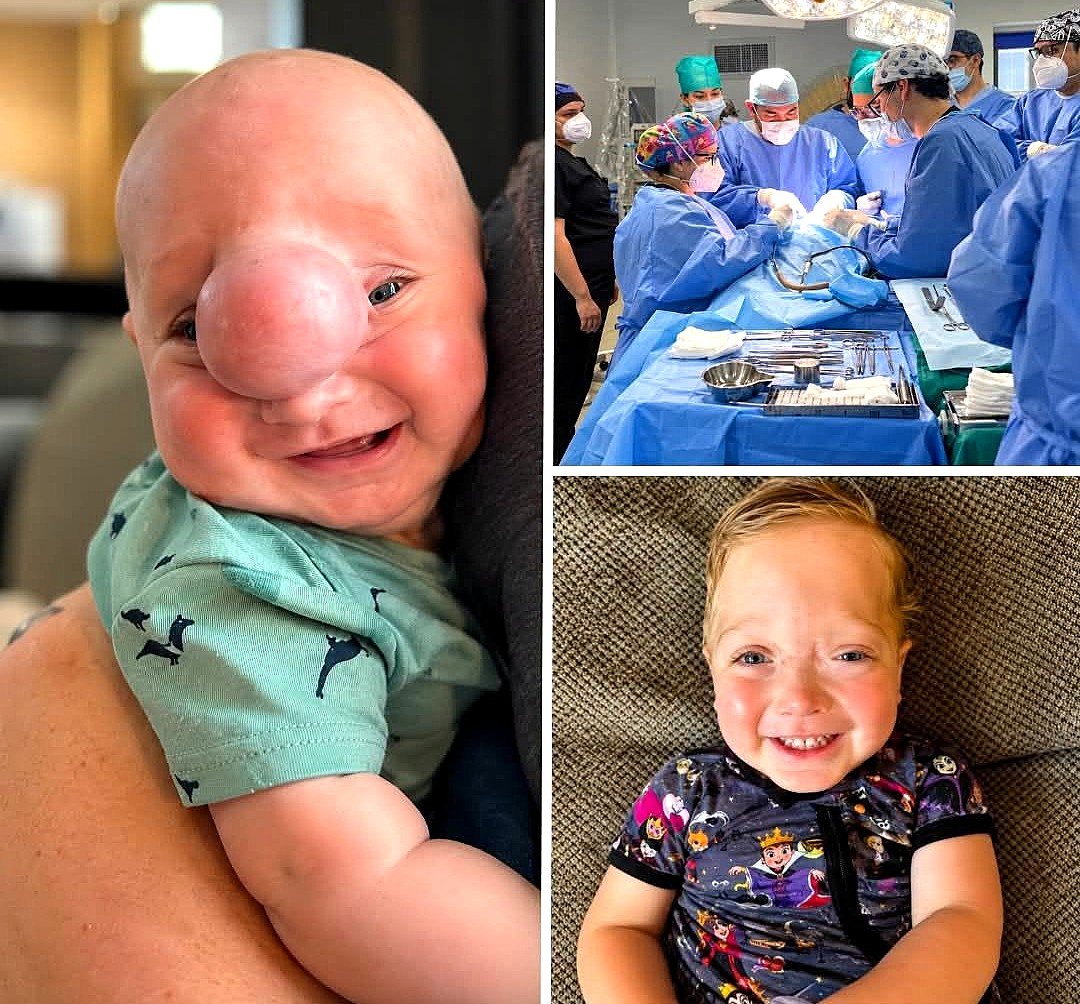
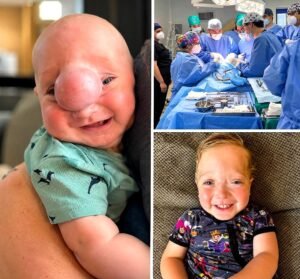
At just six months old, Liam Sachs faced an operation that would change the course of his young life. For 11 long hours, surgeons worked to remove abnormal tissue protruding from his skull and reconstruct the affected areas of his head and face.
For his parents, Hannah and Gabriel Sachs, it was a moment filled with fear, hope, and the uncertainty that had followed their family since before Liam was born.
But the surgery was only one chapter in a much longer journey. In the months and years that followed, Liam would face serious feeding difficulties, a diagnosis of cerebral palsy, and the challenge of learning skills that many children develop naturally.
His story would become one of perseverance, family love, and the importance of celebrating every step forward.
a diagnosis that changed everything
Liam’s medical journey began when his mother was approximately 20 weeks pregnant.
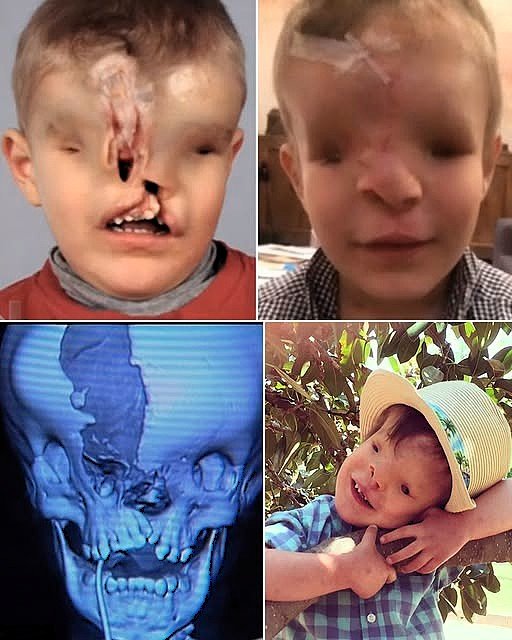
During a routine ultrasound, doctors discovered that her unborn baby had a rare congenital condition called frontonasal encephalocele.
The condition occurs when tissue surrounding the brain, and sometimes part of the brain itself, protrudes through an opening in the skull. In Liam’s case, the abnormality was located near his forehead and nose, making the situation especially complex.
Because the affected area was close to delicate brain structures and important facial features, correcting the defect would require highly specialized medical care.
Hannah and Gabriel suddenly found themselves preparing for a future filled with questions they could not yet answer.
They had not even held their son in their arms, yet they already knew he would need significant medical attention.
Liam was born by cesarean section in March 2023. Immediately after his birth, doctors transferred him to the neonatal intensive care unit, where he remained for nearly two weeks.
He also needed supplemental oxygen because his oxygen levels occasionally dropped.
Eventually, his parents were able to bring him home. For a little while, they could focus on caring for their newborn and getting to know the little boy they had waited so long to meet.
However, another serious complication soon emerged.
an unexpected medical emergency
When Liam was around one month old, Hannah noticed that the sac protruding from his forehead had become unusually hard and shiny.
It was a frightening change, and medical examinations revealed that Liam was also suffering from severe hydrocephalus.
Hydrocephalus occurs when cerebrospinal fluid accumulates inside the brain’s cavities, potentially increasing pressure on surrounding tissues. Without appropriate treatment, it can cause serious complications.
Liam needed urgent surgery.
Doctors implanted a ventriculoperitoneal, or VP, shunt—a small medical device designed to redirect excess fluid from the brain into the abdominal cavity, where the body can absorb it.
The procedure helped manage the dangerous fluid buildup. After spending several more nights in the hospital, Liam was able to return home.
But the shunt would require ongoing medical monitoring, and the congenital defect still needed to be addressed.
His family now faced two major concerns: controlling the hydrocephalus and preparing for the complex operation needed to reconstruct his skull and face.
Every decision required careful planning because Liam was still so young and his medical needs were complicated.
the 11-hour operation that brought new hope
Liam’s treatment eventually brought him to Cincinnati Children’s Hospital Medical Center, where specialists prepared for the delicate reconstruction.
The medical team included pediatric neurosurgeon Jesse Skoch and craniofacial surgeon Brian Pan.
Their goal was to remove the protruding tissue and reconstruct the affected areas while protecting the healthy structures surrounding Liam’s brain.
In September 2023, shortly before Liam reached six months of age, the operation began.
It lasted approximately 11 hours.
For Hannah and Gabriel, those hours must have felt incredibly long. Leaving their baby in the hands of the surgical team meant placing their trust in the specialists working to give him a safer future.
Hannah later spoke about how difficult it was to say goodbye to Liam before the procedure.
When a child is so small, even an ordinary hospital visit can be overwhelming for a parent. Knowing that your baby is about to undergo a major operation lasting nearly half a day brings an entirely different level of fear.
The surgery was successful.
Yet Liam’s recovery was far from immediate.
He remained in the hospital for another 11 days. His face became so swollen that his eyes stayed closed for much of the first week.
His parents spoke to him throughout his recovery, hoping that the familiar sound of their voices would bring him comfort.
Even when he could not open his eyes, they were there beside him, reminding him that he was not alone.
when even feeding became a challenge
After the operation, Liam developed vomiting, irritability, and difficulties with feeding.
His medical team needed to determine how he could receive enough nutrition without putting his health at risk.
For a period, he received nourishment through a tube inserted through his nose into his stomach.
His medical history also included intestinal rehabilitation surgery, although available accounts do not clearly explain the exact reason for that procedure.
For Liam’s family, everyday routines became complicated by medical equipment, appointments, and careful supervision.
Feeding, something many parents barely have to think about, became another milestone that required patience and professional support.
But Liam continued making progress.
Eventually, he learned to eat entirely by mouth and no longer needed the feeding tube.
It was an important achievement for a little boy who had already endured so much. It also offered his family a welcome reminder that progress could come even after difficult setbacks.
Still, another challenge would soon become part of his journey.
a new diagnosis at ten months old
At around ten months of age, Liam was diagnosed with cerebral palsy after clinicians noticed delays in his movement and mobility.
Cerebral palsy is a group of conditions affecting movement, muscle tone, posture, and coordination. Its effects differ from person to person, and children may need different forms of support as they grow.
The surgery had addressed Liam’s encephalocele, while the VP shunt helped manage his hydrocephalus. But these treatments could not guarantee that every developmental challenge would disappear.
His family now had to navigate another diagnosis while continuing to manage his existing medical needs.
Liam began occupational therapy, speech therapy, feeding therapy, aquatic therapy, and music therapy.
Each offered a different kind of support.
Occupational therapy helped him work toward greater independence with everyday activities. Speech therapy supported his communication development, while feeding therapy addressed the difficulties he had experienced with eating.
Aquatic therapy provided another environment for movement and physical activity, and music therapy offered opportunities for engagement and communication.
Progress did not happen overnight.
It came through repeated practice, professional guidance, and the everyday encouragement of the people who loved him.
the little words that meant so much
As Liam grew, his family began noticing encouraging changes in his communication.
He started saying “mama” and “dada.”
He also began babbling more frequently, sometimes sounding as though he were carrying on a long conversation with the people around him.
His mother described the way he would babble as if he had so much to say, even when his family could not always understand his words.
For parents who had spent months worrying about their child’s health and development, these moments carried special meaning.
They were reminders that Liam was continuing to discover ways to express himself and connect with the world.
His progress was not always easy to measure. Some milestones took longer than expected, and his needs did not simply disappear as he grew older.
But every new sound, every attempt to communicate, and every small improvement offered another reason to keep going.
Walking, however, remained a particularly important goal.
the milestone his family had waited for
Many children begin walking independently around their first birthday, although the timing varies widely.
For Liam, mobility required much more time, support, and practice.
His family continued helping him work toward greater independence while he participated in therapy and managed his ongoing medical needs.
Then, in an update published in October 2025, Liam’s family shared encouraging news.
Liam had begun walking independently at around two years old.
According to his mother, he was sometimes even close to running.
The milestone represented substantial progress for a child who had undergone major skull and facial reconstruction before reaching six months of age and had later received a cerebral palsy diagnosis.
He was also eating entirely by mouth, without relying on a feeding tube.
These achievements did not mean that cerebral palsy had disappeared or that every medical concern had been resolved. His VP shunt still required monitoring, and his developmental journey continued.
But Liam had reached milestones that once seemed especially challenging.
The little boy whose early life had been shaped by hospital rooms, complex procedures, and uncertain outcomes was now exploring the world on his own feet.
a journey that continues beyond surgery
For Hannah and Gabriel, Liam’s first years brought challenges no parent could fully prepare for.
They learned about his rare congenital condition during pregnancy. They watched him spend his first days in intensive care, faced an emergency operation when he was only a month old, and waited through an 11-hour reconstruction at six months.
They then navigated feeding difficulties, therapy sessions, and another diagnosis before Liam reached his first birthday.
Every successful procedure brought relief, but it also marked the beginning of another stage of care.
Their experience illustrates an important reality about complex congenital conditions: surgery can address a specific anatomical problem, but recovery and development may require years of additional support.
Liam’s story also shows why progress should not be measured against a single timetable.
For some children, learning to walk happens early and almost unnoticed. For others, it takes extensive therapy, repeated attempts, and enormous patience from both the child and the family.
Neither journey defines a child’s worth.
By October 2025, Liam was walking independently, sometimes almost running, communicating through growing sounds and words, and eating without a feeding tube.
His medical journey was not over. There would still be appointments, monitoring, and developmental goals ahead.
But the progress he had made was worth celebrating.
At six months old, Liam underwent an operation lasting 11 hours to address a rare birth defect. Before his second birthday, he was working toward greater independence one movement at a time.
And by around two years old, he was taking independent steps.
For his family, those steps represented more than a physical milestone. They reflected months of care, the dedication of medical professionals, and a little boy’s continuing journey through challenges that began before he was born.
Liam’s story is a reminder that progress does not always follow a straight line. Sometimes, it arrives one small victory at a time—and those victories can mean everything.
Read Next
- Lali Juárez Turned Her Burn Scars Into Beautiful Art and Found the Confidence to Show Her Skin Again
- The face she once tried to hide became the face she was proud to show
- No words. No expectations. No conditions. Just a pair of gentle eyes looking at you as if you are the most important person in the world. 🐶❤️