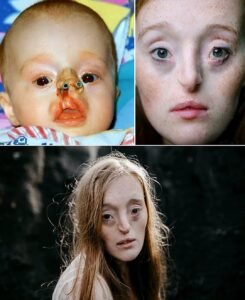
The first time Ilka Brühl agreed to stand in front of a professional camera, she was filled with a fear she had carried for most of her life.
She nearly turned around before she even arrived.
She wasn’t walking into a photo studio because she dreamed of becoming a model. She wasn’t looking for fame, attention or compliments. She was simply trying to do something that had once felt almost impossible—allowing herself to be seen.
For years, being seen had meant being stared at.
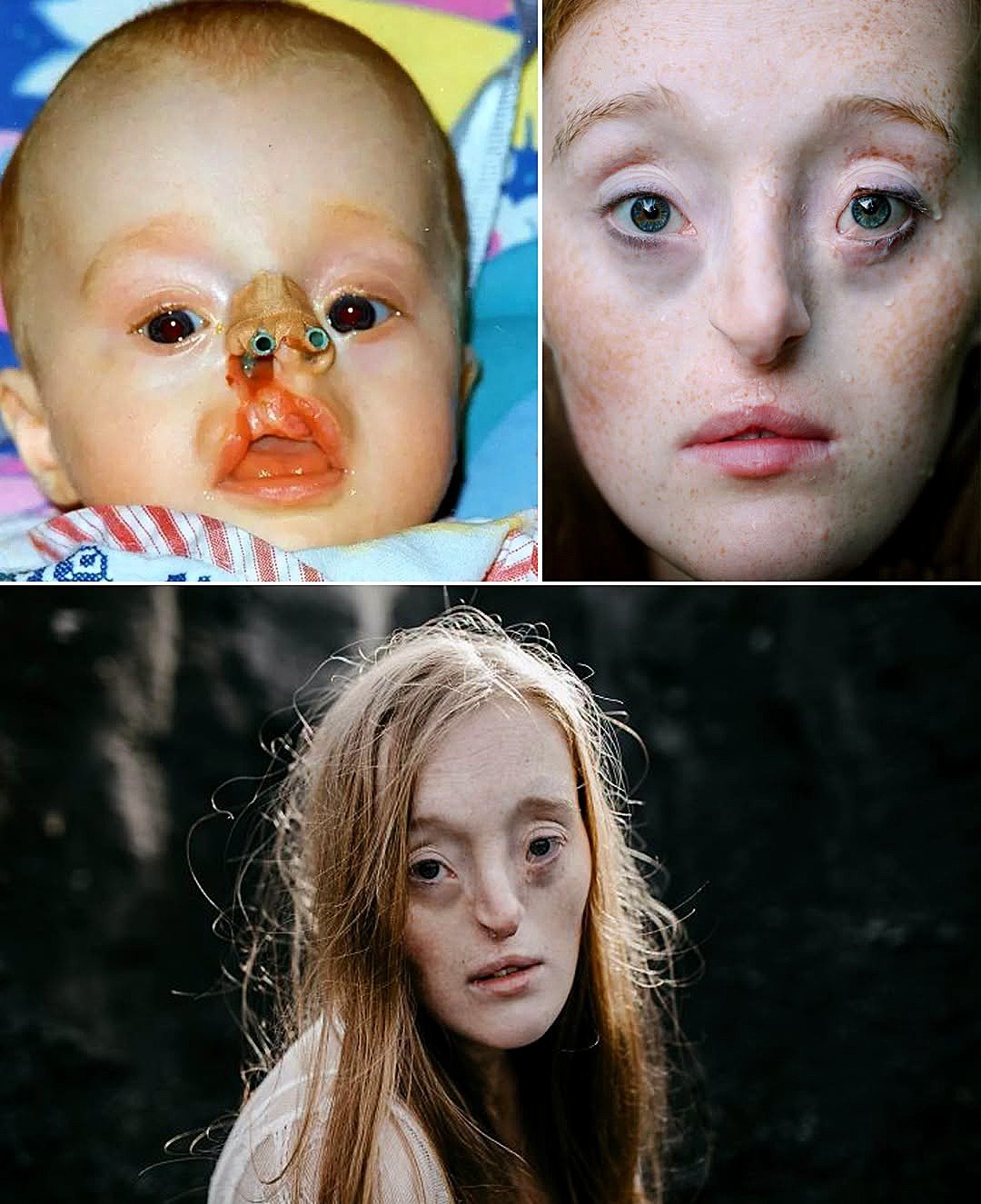
Ilka was born in Germany with a facial cleft, malformed nasal passages and a tear duct on the right side that did not function normally. From the beginning of her life, doctors and surgeons became part of her story. Her first operation took place when she was only a few months old, and as she grew older, she underwent around ten surgeries.
Some procedures were necessary to help her breathe more easily. Others focused on reconstructing parts of her face and improving her quality of life.
The doctors could operate on bones, tissue and breathing passages.
But there was something surgery could never completely repair—the pain caused by the way other people sometimes treated her.
Growing up, Ilka became familiar with the uncomfortable silence that often followed when someone noticed her face. She experienced staring, teasing and hurtful comments about her appearance.
For a child, those experiences can leave wounds that are difficult to explain.
Eventually, Ilka began to believe that there was something wrong with the way she looked.
She became increasingly self-conscious. Instead of wondering whether someone was simply looking in her direction, she began assuming they were judging her. A glance could feel like criticism. A whisper could feel like laughter. A photograph could feel like evidence of everything she wished she could change.
As the years passed, she learned to make herself smaller.
She avoided unnecessary attention. She became uncomfortable with photographs. And somewhere along the way, she began to associate beauty with people who looked different from her.
Beauty seemed like a world in which she wasn’t supposed to belong.
Then, in 2014, something unexpected happened.
A photographer invited Ilka to participate in a photo shoot.
For many people, such an invitation might have sounded exciting.
For Ilka, it was frightening.
She worried about what would happen when she arrived. Would the photographer regret inviting her? Would people laugh? Would she look uncomfortable in the photographs? Would the camera make every difference on her face even more noticeable?
At one point, she nearly cancelled.
But she went.
And that decision became a turning point.
Instead of seeing herself through the harsh lens she had developed over years of insecurity, Ilka began seeing another version of herself through the photographs.
She saw a woman who could be confident.
A woman who could be beautiful without hiding the features that made her different.
A woman who did not need to look like everyone else to deserve to be photographed.
The experience changed something inside her.
Ilka continued participating in photo shoots and eventually began sharing some of the photographs online. She wasn’t trying to erase her facial difference or pretend that her life had been easy.
She was doing something much more powerful.
She was allowing people to see her as she saw herself beginning to see herself.
The response encouraged her.
Photography became more than taking pictures. For Ilka, it became a form of self-discovery and, in many ways, self-therapy.
Every time she stood in front of the camera, she challenged an old belief.
She didn’t have to hide.
She didn’t have to apologize for her appearance.
She didn’t have to wait until she looked “perfect” before she could feel worthy.
Slowly, the camera that once represented judgment became a place where she could experience freedom.
Her journey eventually took her into modeling and public speaking. But her purpose became much bigger than simply appearing in photographs.
Ilka began using her story to talk about facial differences, confidence, acceptance and representation.
She wanted people with visible differences to understand that their faces did not make them less deserving of love, respect or opportunity.
She also wanted people without facial differences to think about the assumptions they make when they see someone who looks different.
A person may stare at a stranger for only a few seconds and forget the moment completely.
The person being stared at may remember it for years.
That is one of the difficult truths behind Ilka’s story.
Sometimes, the deepest scars aren’t created by surgery.
They are created by repeated messages telling someone that they are strange, unattractive or somehow less worthy because they don’t fit a familiar definition of beauty.
And sometimes, healing begins when that message is challenged.
Ilka’s photographs became part of that challenge.
She didn’t suddenly wake up one morning with a completely different face.
Her facial difference didn’t disappear.
Her history didn’t disappear.
The surgeries, difficult memories and painful experiences remained part of her story.
What changed was her relationship with herself.
She began to understand that acceptance does not necessarily mean loving every photograph or feeling confident every single day.
Sometimes acceptance simply means refusing to believe that your differences make you less valuable.
It means looking into the mirror and realizing that your face does not need permission from strangers to exist.
It means understanding that beauty isn’t a mathematical equation based on symmetry, flawless skin or conventional features.
There can be beauty in individuality.
There can be strength in vulnerability.
And there can be extraordinary courage in simply allowing yourself to be seen.
The irony of Ilka’s journey is that the girl who once wanted to disappear from photographs eventually became the woman who willingly stepped in front of the camera.
The face she once tried to hide became the face she proudly showed to the world.
Her story also raises a question that reaches far beyond her own experience.
How many things do we dislike about ourselves because we truly dislike them—and how many did we learn to dislike because someone else taught us to?
A careless comment from childhood can stay with a person for decades.
A laugh from a stranger can become an insecurity.
A cruel nickname can become a belief.
And a single judgment can sometimes become the voice we hear every time we look in the mirror.
But those voices don’t always tell the truth.
Ilka’s story reminds us that we are not obligated to spend our lives seeing ourselves through the eyes of people who failed to see our worth.
Sometimes, the greatest transformation isn’t changing the face in the mirror.
It’s changing the way we look at the person standing there.
Today, Ilka’s journey stands as a powerful reminder that confidence doesn’t always arrive before courage.
Sometimes, courage comes first.
You step into the room while you’re still afraid.
You face the camera while you’re still insecure.
You show your face while part of you still wants to hide.
And somewhere along the way, you discover something you never expected:
You were never required to become someone else to be worthy of being seen.
You only needed to give yourself permission to be seen as you are.
Read Next
- Ciera Swaringen: The Woman Who Learned to Embrace the Skin She Was Born In
- No words. No expectations. No conditions. Just a pair of gentle eyes looking at you as if you are the most important person in the world. 🐶❤️
- His Mother Couldn’t Look at Him for a Week. Years Later, He Chose to Keep the Face Everyone Else Noticed. ❤️