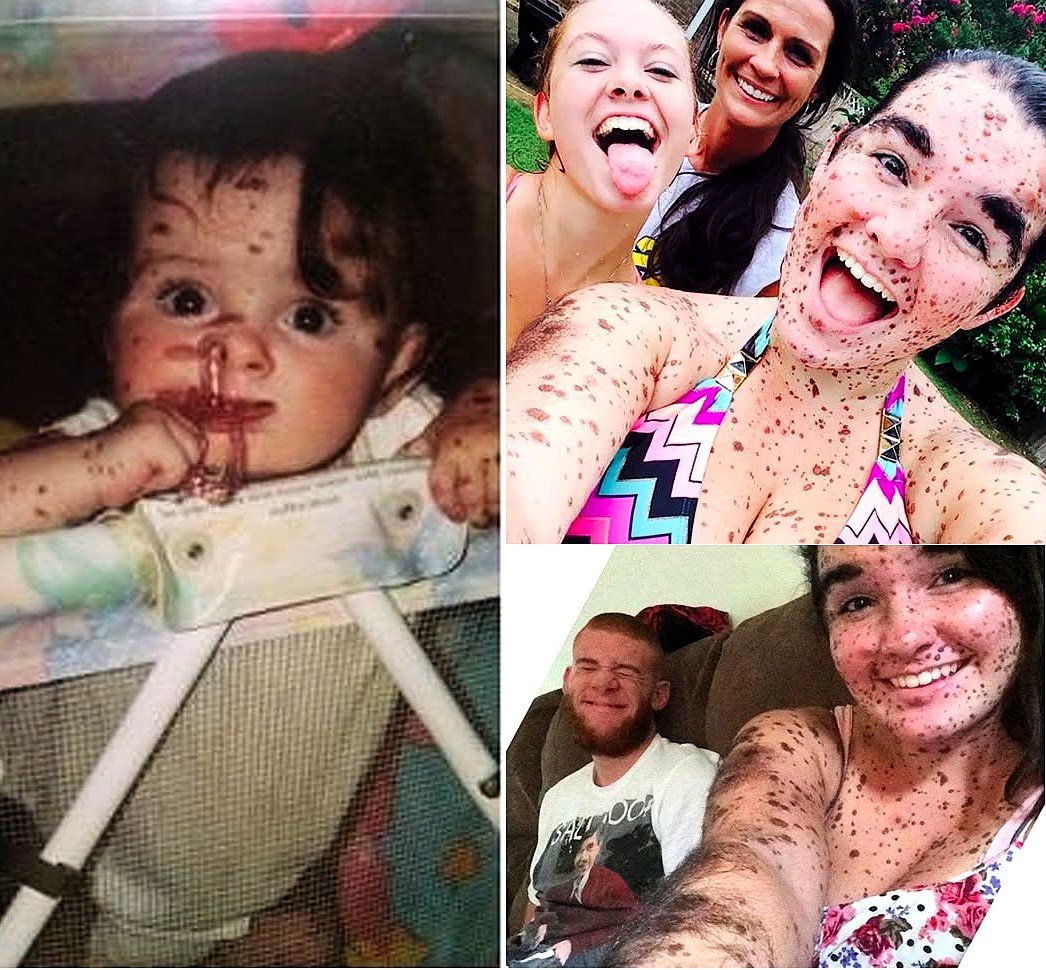
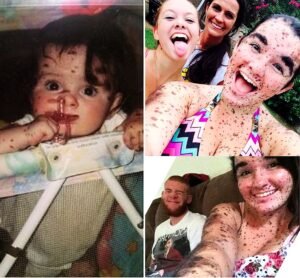
Some girls would rather pull their hands away than give Ciera Swaringen a high-five after a basketball game. For Ciera, moments like these could turn an ordinary day into a painful reminder that people sometimes judge what they do not understand. 🏀
But Ciera’s story is not simply about being different. It is about growing up under the weight of other people’s stares, discovering the truth about her own body, and gradually learning that she did not need to hide herself to deserve acceptance.
Ciera grew up in Richfield, North Carolina, with a rare skin condition called a giant congenital melanocytic nevus. Large, dark birthmarks covered significant portions of her body, making her appearance noticeably different from that of many other children.
Her mother offered her a loving way to understand those marks. She called them “angel kisses.”
Those words carried a message that Ciera would need to remember throughout her life: the things that made her different were not reasons to feel ashamed.
Unfortunately, the world outside her home did not always offer the same kindness.
Growing Up Under the Weight of Other People’s Stares
As a young child, Ciera gradually became aware that people noticed her skin before they noticed anything else about her.
By the age of eight, she was beginning to recognize the stares. People sometimes looked at her for longer than felt comfortable. Some seemed curious, while others reacted in ways that made her feel as though she did not belong.
At twelve, those experiences had become more painful.
Childhood is a time when many young people are trying to figure out who they are, where they fit in, and what makes them worthy of friendship. A casual comment, an uncomfortable look, or a moment of rejection can have a lasting impact on someone who is still learning to feel confident in their own identity.
For Ciera, the challenge was especially difficult because her birthmarks were visible. She could not simply leave them at home on days when she wanted to avoid attention.
Whether she was attending school, spending time with friends, or participating in everyday activities, she knew that someone might notice her appearance.
Even something as ordinary as a high-five after a basketball game could become an uncomfortable experience.
Imagine reaching out to celebrate a shared moment, only to have someone pull away because of the appearance of your hands. What should have been a simple expression of friendship can suddenly feel like rejection.
Experiences like these can make a person question something they should never have to question: whether they deserve to be treated like everyone else.
Yet Ciera’s story did not end with the judgments she encountered during childhood.
Over time, she began finding a different way to understand herself.
A School Project That Helped Her Understand Her Body
Sometimes, knowledge can change the way we see ourselves.
For Ciera, an important step came through a school assignment. As part of her graduation project, she researched neurocutaneous melanocytosis, a condition associated with her medical history.
Instead of avoiding the subject that had caused her so much worry, she decided to learn about it.
She wrote a ten-page paper and presented what she had discovered. The project gave her an opportunity to explore the medical side of her experiences and better understand the conditions affecting her life. 📚
Learning about her body helped her see that there was more to her story than the reactions of strangers.
Her skin was not something she needed to understand through other people’s opinions. There were medical explanations for her condition, information to discover, and experiences she could share with others who faced similar challenges.
Just as importantly, she began finding people who understood what it was like to live with a visible difference.
That sense of connection mattered.
When someone grows up feeling different, it can be easy to believe that nobody else could possibly understand what they are going through. Discovering others with similar experiences can challenge that belief.
For Ciera, learning and connecting with others helped her feel less alone.
She could begin to recognize that her appearance was only one part of who she was, not a definition of her worth or a limit on what she could accomplish.
Choosing to Be Seen Instead of Hidden
As Ciera grew older, she took another step toward accepting herself.
She began sharing photographs of herself wearing a bikini, showing her birthmarks openly from the front and the back.
For some people, posting a photograph might seem like an ordinary act. For someone who has spent years worrying about being stared at, judged, or misunderstood, choosing to share such personal images can carry a much deeper meaning.
Ciera was no longer waiting for her skin to look different before allowing herself to be seen.
She was not asking the world for permission to feel comfortable in her own body.
She was showing herself as she was.
Her message was captured in a powerful statement:
“I was born to stand out.” 📷
Those words represented more than a catchy caption. They reflected a change in perspective.
For years, being visibly different had exposed her to attention she did not always want. Now, she was choosing how to present herself and refusing to let embarrassment dictate every decision.
Her birthmarks had been part of her life since birth. She could not change the past, and she did not have to spend her future waiting for other people to become comfortable with her appearance.
She could live her life now.
She could take photographs, enjoy experiences, build relationships, and share her story without treating her skin as something that needed to be concealed.
That decision did not mean every difficult feeling disappeared. It meant those feelings no longer had to control the entire story.
Confidence Does Not Mean Every Day Is Easy
It is tempting to imagine that someone who speaks openly about self-acceptance has finally overcome every insecurity.
Real life is rarely that simple.
Ciera has acknowledged that unfamiliar places and situations can still make her anxious. Even after learning more about herself and becoming more comfortable sharing her appearance, she can still face moments when other people’s reactions are difficult.
And that is important to understand.
Confidence is not the absence of fear. Self-acceptance does not mean never feeling hurt. A person can be proud of who they are and still have days when they wish the world were kinder.
The difference is that discomfort does not have to become a reason to hide.
Ciera’s journey shows that personal growth can happen gradually. It can begin with understanding a medical condition, finding someone who shares a similar experience, or taking a photograph that once seemed too frightening to share.
Each step can help a person build a stronger relationship with themselves.
There is no requirement to feel brave every day. There is no rule that says someone must love every part of their appearance at every moment to deserve respect.
And nobody should have to become exceptionally confident simply to receive the basic kindness that everyone deserves.
What Children Can Teach Us About Acceptance
Ciera’s experiences also raise an important question about how children learn to treat people who look different from them.
Children are naturally curious. When they encounter something unfamiliar, they may ask questions or look for explanations. Curiosity itself is not necessarily cruel.
What matters is how adults guide that curiosity.
Children can learn that a visible difference is not an invitation to mock someone, exclude them, or treat them as though they are less deserving of friendship.
They can learn to ask respectful questions when appropriate, listen when someone shares their experience, and understand that not every personal characteristic needs to be explained to them.
Most importantly, they can learn that kindness should not depend on whether someone looks familiar.
Imagine a school where a child with visible birthmarks could walk into a classroom without wondering whether classmates would whisper about their appearance.
Imagine a basketball game where every player could celebrate together, without anyone hesitating to offer a high-five because of another person’s skin.
Imagine how different childhood might feel if children were taught to recognize people’s personalities, talents, humor, and kindness before making assumptions about their appearance.
These changes do not require every child to understand every medical condition. They require teaching a simple principle: being different is not the same as being less worthy.
Parents, teachers, coaches, and other trusted adults can help create that understanding through everyday actions. When children see adults responding to differences with respect rather than discomfort, they learn that inclusion is something to practice, not merely something to talk about.
And when hurtful behavior occurs, addressing it matters. Silence can leave a child believing that rejection is normal or that nobody will stand up for them.
A few thoughtful words or a welcoming gesture cannot erase every painful experience, but they can make a real difference in someone’s day.
Her Story Is Bigger Than Her Birthmarks
Ciera Swaringen’s life cannot be reduced to a skin condition, the reactions of strangers, or the challenges she experienced growing up.
She is a person with her own interests, ambitions, relationships, and future. Her story deserves attention not because she looks different, but because her experiences reveal something important about how people treat one another.
Her mother’s loving words, her determination to understand her medical conditions, and her decision to share photographs on her own terms all form part of a journey toward greater self-acceptance.
She did not have to change her appearance to begin changing her relationship with herself.
And she should never have had to prove her confidence to earn the respect of others.
Perhaps the most meaningful lesson from Ciera’s journey is that acceptance should not be a prize people receive after learning to ignore cruelty. It should be part of how we treat one another from the beginning.
Every child deserves to participate in games, make friends, celebrate victories, and walk into unfamiliar places without feeling that their appearance makes them less welcome.
Ciera’s story invites us to look beyond the first thing we notice about someone and consider the person standing in front of us.
Because a birthmark does not tell us whether someone will be a wonderful friend. A visible difference does not reveal someone’s character. And an unfamiliar appearance is never a reason to withhold kindness.
Ciera was born with birthmarks, but she was never born to carry the burden of other people’s judgments.
Perhaps the world becomes a little kinder every time we teach a child to reach out a hand instead of pulling it away.
And perhaps the most important question is not why someone looks different, but why we sometimes allow those differences to stand between us.
What if we taught children to understand differences before they learned to judge them? ❤️