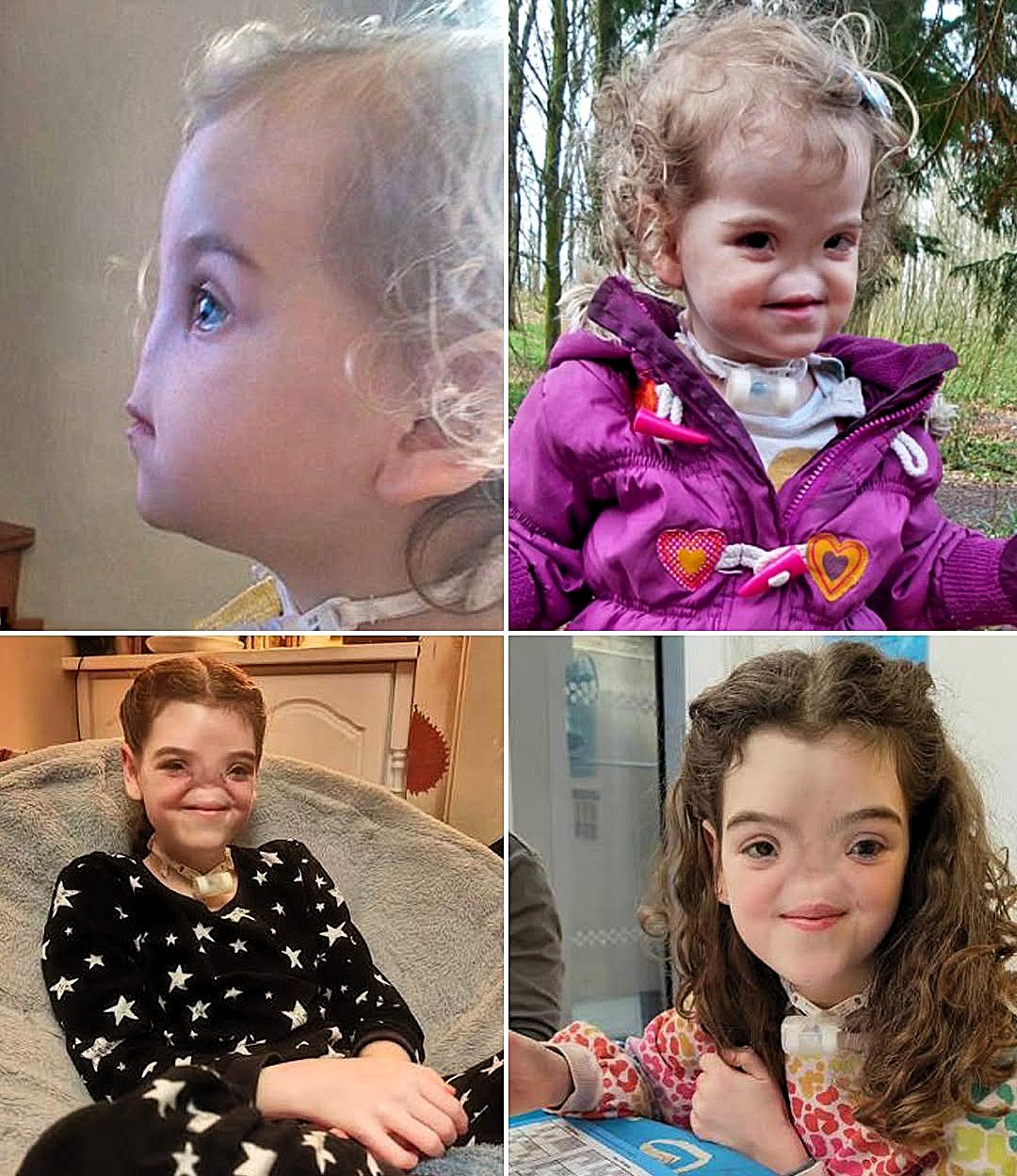
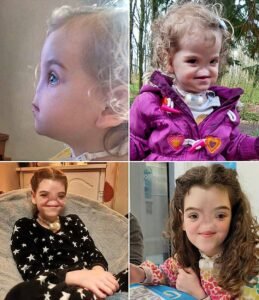
Tessa Evans was born with a condition so rare that it was difficult for many people to understand at first.
She was born without a nose.
For most people, the nose is simply something we take for granted. It helps shape the face, allows us to breathe normally, and gives us the ability to experience the world through our sense of smell. But for Tessa, none of those things developed in the usual way.
Tessa was born with complete congenital arhinia, an extraordinarily rare condition in which the external nose and the nasal passages fail to develop before birth. Because of her condition, she was also born without a sense of smell.
From the moment she entered the world, doctors knew that Tessa would face challenges that few children ever experience.
Just days after her birth, doctors performed a tracheostomy to help secure her airway and make breathing safer. It was an understandably frightening time for her family. Instead of experiencing the ordinary excitement that comes with welcoming a newborn, Tessa’s parents suddenly found themselves facing a medical condition they had likely never encountered before.
But something soon became clear.
Tessa was much more than her diagnosis.
As she grew older, her personality began to shine through. She laughed. She played. She interacted with her siblings. She went to school. She developed her own interests and personality and became an energetic little girl who wanted to experience life just like any other child.
Her appearance might have been different, but her childhood was filled with many of the same things that make childhood special—family, friendship, laughter, learning and curiosity.
And that became one of the most important parts of Tessa’s story.
Her condition did not determine who she was.
Instead, it became one part of a much larger story about resilience, medical innovation and learning to embrace differences.
Tessa’s rare condition also presented doctors with an extraordinary medical challenge. Because congenital arhinia is so uncommon, there was limited experience available to guide treatment. Doctors had to think creatively about how they could reconstruct a nose while allowing Tessa’s face to continue growing naturally.
When Tessa was around two years old, surgeons turned to advanced 3D technology to help plan her treatment.
A custom implant was designed specifically for her and placed beneath the skin of her face. The purpose was to gradually expand and shape the surrounding tissue as she grew. This would help prepare her face for future reconstructive procedures.
For a condition as rare as Tessa’s, the approach represented an important step into new territory for reconstructive medicine.
Rather than simply trying to create an immediate solution, doctors were able to use technology and careful planning to consider how Tessa’s face would change as she grew from a young child into an older girl.
The process required patience.
It also required courage—not only from Tessa, but from her family.
Her mother, Gráinne, has spoken publicly about the fear and uncertainty she experienced when Tessa was born. Like any parent, she wanted her child to be safe and healthy. Suddenly, however, her family was facing a condition they knew very little about.
There were questions about Tessa’s future.
Would she be able to live a normal life?
Would other children accept her?
Would people stare?
Would her differences prevent her from enjoying the experiences other children take for granted?
Those fears were understandable.
But as Tessa grew, something remarkable happened.
Her family began to see less of the medical diagnosis and more of the little girl herself.
They saw a child who laughed.
A child who played.
A child who enjoyed spending time with her family.
A child who was curious about the world around her.
And perhaps most importantly, they saw a child who did not spend every moment thinking about how different she looked.
Tessa’s story became a powerful reminder that children often learn how to see themselves through the reactions of the people around them.
When the world treats differences as something shameful, children can begin to believe they need to hide.
But when families teach children that being different does not make them less valuable, children can grow up with confidence and self-worth.
That is one reason Tessa’s family chose to share her story.
They did not want her appearance to become something that had to be hidden.
Instead, they wanted people to understand that there is a real person behind a rare medical condition.
Tessa was not simply “the girl without a nose.”
She was Tessa—a daughter, a sister, a student and a child with her own personality, dreams and future.
Her story also helped raise awareness about congenital arhinia and the complex challenges faced by people born with extremely rare conditions. For many people, seeing Tessa’s story may be the first time they have ever heard of arhinia.
And that awareness matters.
Rare conditions can often leave families feeling isolated because they may struggle to find others who have experienced something similar. Public stories can help create understanding and remind people that rare does not mean alone.
Tessa’s journey also shows how medicine continues to evolve.
Technologies such as 3D modeling and customized implants are giving surgeons new ways to approach complex reconstructive procedures. For patients with unusual or extremely rare conditions, innovative techniques can open possibilities that may not have existed for previous generations.
But perhaps the most powerful part of Tessa’s story has nothing to do with technology.
It is about acceptance.
A person’s worth cannot be measured by how closely their appearance matches everyone else’s.
Faces come in countless shapes, sizes and features. Some differences are visible immediately, while others are not. But underneath those differences are people who want the same basic things: to be accepted, respected, loved and allowed to live their lives without being reduced to what makes them unusual.
Tessa’s story challenges us to think about what we teach children about difference.
Do we teach them that they must change themselves to fit into the world?
Or do we teach them that they deserve to feel comfortable in their own skin, even when they look different from the people around them?
For Tessa, the answer has been clear.
Her life is not a story about something she was missing.
It is a story about everything she has.
She has a family who loves her.
She has a personality that shines beyond her appearance.
She has experienced childhood, school, laughter and friendship.
She has inspired medical professionals to explore new approaches.
And she has helped countless people understand that looking different does not mean being less.
Tessa Evans was born without a nose, but she was never born without the ability to smile, laugh, connect with others or be loved.
Her face may have challenged people’s expectations of what a child should look like.
Her life challenges something much deeper—the idea that being different means you do not belong.
Because in the end, belonging does not come from looking like everyone else.
It comes from knowing that you are valued exactly as you are.
And perhaps that is the most important lesson Tessa’s story can teach the world.
Every child deserves to grow up knowing that they do not have to look like everyone else to be beautiful, worthy and completely loved. ❤️