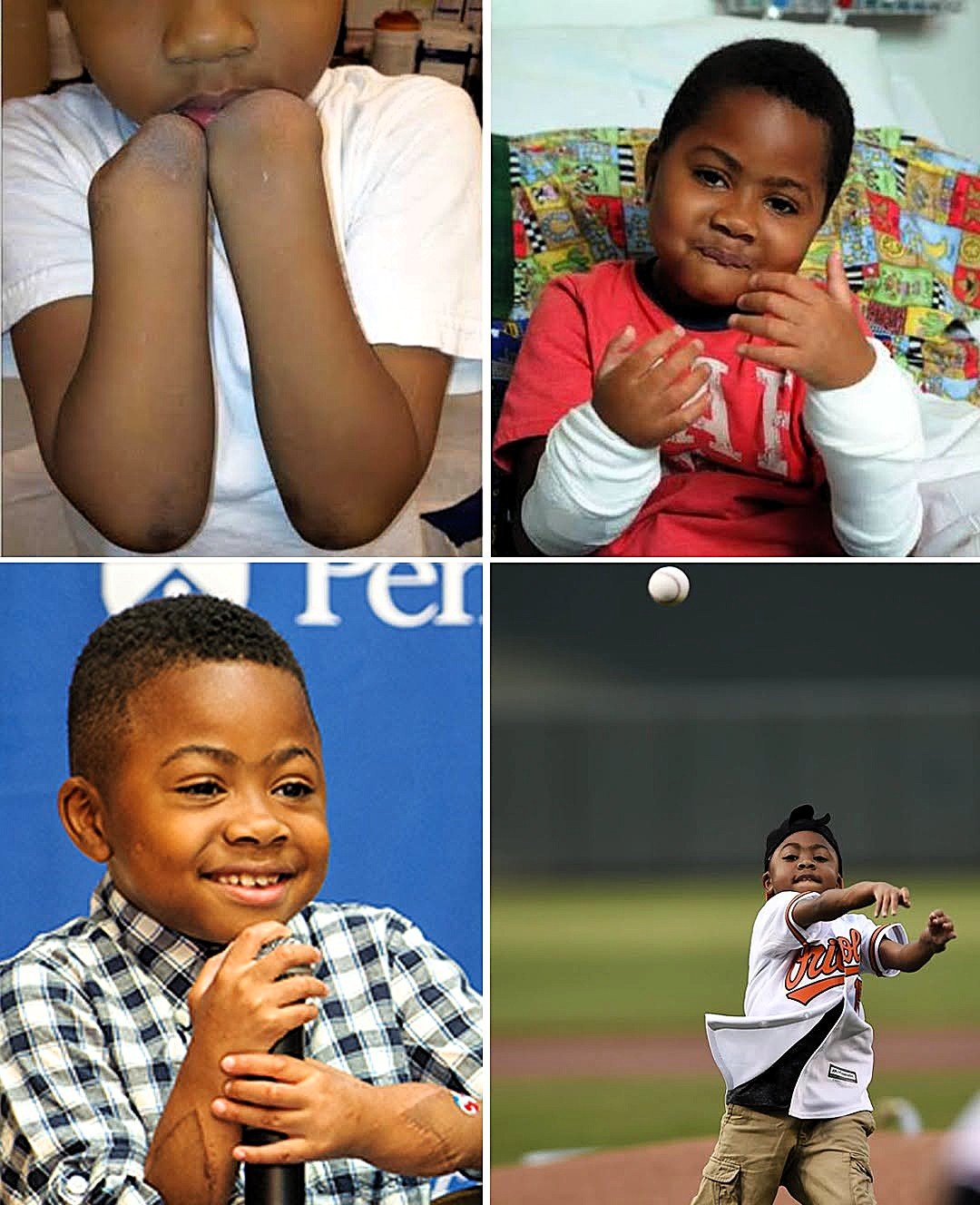
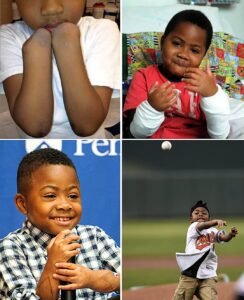
At just eight years old, Zion Harvey had already experienced more pain, uncertainty and hardship than most people encounter in a lifetime.
He had lost both of his hands.
He had lost both of his legs below the knees.
He had survived a life-threatening infection that nearly took his life.
He had undergone a kidney transplant.
And yet, despite everything that had happened to him, Zion continued to move forward.
Then, in 2015, something extraordinary happened.
Zion became the first child in the world to successfully receive a double hand transplant—a medical procedure that had never before been successfully performed on a child.
For Zion, the surgery wasn’t simply about receiving a pair of new hands.
It was about gaining possibilities he had once been told he might never have again.
A Childhood Changed by a Devastating Infection
Zion’s journey began when he was only two years old.
At that age, most children are learning to run around the house, play with toys and discover the world with endless curiosity. But Zion suddenly became critically ill with sepsis, a dangerous and potentially fatal response to infection.
The infection became so severe that doctors were forced to make an agonizing decision.
To save his life, they had to amputate both of his hands and both of his legs below the knees.
The procedure left Zion facing a completely different childhood.
He would have to learn how to live without the hands most people take for granted. Simple activities such as holding a spoon, picking up a toy, writing his name or opening a door would suddenly become complicated challenges.
But Zion’s story was never defined by what he had lost.
It was defined by what he learned to do despite those losses.
The illness had also severely damaged his kidneys, creating another serious health challenge for the young boy.
Two years after the devastating infection, Zion’s mother made an extraordinary sacrifice.
She donated one of her own kidneys to her son.
The transplant helped give Zion another chance at life and allowed him to continue growing and developing.
His family had already witnessed just how fragile life could be.
But they also knew something else about Zion.
He was remarkably determined.
Learning to Live Differently
Without hands, Zion had to find new ways to accomplish everyday tasks.
And he did.
He learned to use his arms in ways many people would never imagine.
He figured out how to eat.
He learned how to write.
He discovered ways to play video games.
He used prosthetic legs to stand, walk and eventually run.
Instead of allowing his circumstances to define his limitations, Zion adapted to them.
Every achievement required creativity, patience and practice.
Things that other children could accomplish without thinking often required Zion to develop his own unique techniques.
But he kept trying.
His ability to adapt eventually attracted the attention of doctors who believed there might be another possibility for him.
A possibility that sounded almost unbelievable.
A double hand transplant.
An Extraordinary Medical Opportunity
Hand transplantation is an incredibly complex procedure.
Unlike many other types of transplantation, doctors aren’t simply connecting an organ and hoping it functions.
A transplanted hand contains bones, blood vessels, muscles, tendons, nerves and skin. Every one of these structures must be carefully connected.
And perhaps most importantly, the patient’s immune system must be controlled so the body does not reject the donated hands.
For Zion, the challenges were even greater because he was a child.
His family had to consider the enormous medical risks, the long rehabilitation process and the lifelong medications that would be required to protect the transplanted hands.
But the possibility of giving Zion greater independence was worth considering.
Eventually, his family agreed to move forward.
In July 2015, Zion arrived at Children’s Hospital of Philadelphia for a procedure that would become a landmark moment in pediatric medicine.
A team of approximately 40 medical professionals prepared for the operation.
The surgery lasted more than 10 hours.
During that time, surgeons worked carefully to connect the donor hands to Zion’s arms.
They connected bones.
They repaired blood vessels.
They attached muscles and tendons.
They worked with nerves and carefully closed the skin.
Every step required extraordinary precision.
The goal wasn’t simply to make the hands physically attached.
The goal was to give Zion the possibility of eventually controlling and using them.
After hours of surgery, the procedure was complete.
The transplant had worked.
But the most difficult part of Zion’s journey was still ahead.
The Long Road to Learning Again
A successful transplant doesn’t mean a person can immediately move a new hand normally.
Zion had lived without hands for years.
His brain and body had adapted to functioning without them.
Now they had to learn something completely new.
He needed intensive physical and occupational therapy.
Day after day, he practiced.
Movement by movement.
Attempt by attempt.
At first, even the smallest motions were significant.
His new hands had to become familiar to his nervous system. His muscles needed strengthening. His brain had to begin interpreting signals from the transplanted nerves.
The process required tremendous patience.
There were no shortcuts.
For Zion, learning to use his hands was almost like learning a completely new skill from the beginning.
But gradually, progress appeared.
He began developing the ability to move his fingers.
Then he learned to grasp objects.
Eventually, he could perform tasks that had once seemed impossible.
He could feed himself.
He could interact with objects more naturally.
And eventually, he was able to throw a ball.
For another child, throwing a ball might seem like an ordinary childhood activity.
For Zion, it represented something much bigger.
It was proof of how far he had come.
More Than a Medical Miracle
Zion’s story is often described as a medical breakthrough, and it certainly was.
But his story is about more than the surgeons who performed the operation.
It is also about a child who refused to stop adapting.
It is about a mother who donated her kidney to her son.
It is about an entire medical team that spent countless hours preparing for an extraordinarily complex operation.
And it is about a donor family that made the heartbreaking decision to give another child the opportunity to live differently.
The hands Zion received came from a donor whose family he would never personally know in the way most people know someone who changes their life.
Yet their decision gave Zion an opportunity that would have been impossible without their generosity.
Organ and tissue donation can create a lasting legacy from tragedy.
In Zion’s case, that legacy became part of a child’s future.
Every Small Achievement Meant Something
Imagine being eight years old and having to relearn how to use your hands.
Imagine waking up each day knowing that something millions of people do automatically—grabbing a cup, holding a toy, picking something up—requires deliberate practice.
Now imagine doing all of that while carrying the memories of losing your hands at only two years old.
That was Zion’s reality.
And still, he continued.
He practiced.
He struggled.
He improved.
He celebrated small victories.
Every movement represented progress.
Every object he successfully grasped was another reminder that his world was expanding.
His journey demonstrated something powerful about the human body and brain: with time, rehabilitation and determination, people can sometimes adapt in remarkable ways.
A Story of Courage, Hope and Second Chances
Zion Harvey’s childhood began with a medical emergency that changed his life forever.
But the story did not end with his amputations.
It continued through his mother’s sacrifice.
It continued through prosthetics and rehabilitation.
It continued through years of adapting to a life without hands.
And eventually, it reached a historic moment when a young boy became the first child to successfully receive a double hand transplant.
The operation changed what was medically possible for Zion.
But perhaps the most inspiring part came afterward.
The surgery gave him new hands.
Therapy taught him how to use them.
And Zion himself had to keep pushing forward.
That distinction matters.
A medical team could perform an extraordinary operation, but no surgeon could simply hand Zion the ability to use his new hands.
He had to earn that ability through countless hours of rehabilitation.
He had to teach his body and brain how to work together again.
And slowly, he did.
Today, Zion’s story remains a powerful reminder that extraordinary progress doesn’t always happen in one dramatic moment.
Sometimes, it happens one tiny movement at a time.
One successful grasp.
One step.
One attempt.
One day of therapy.
One more reason not to give up.
At eight years old, Zion had already survived an illness that nearly killed him, endured multiple amputations, received a kidney transplant from his mother and undergone a groundbreaking double hand transplant.
But perhaps his greatest achievement wasn’t simply receiving the new hands.
It was learning what to do with them.
Because the transplant gave Zion a chance.
His courage, patience and determination helped turn that chance into a new chapter of his life.
And that may be the most remarkable part of his story of all.