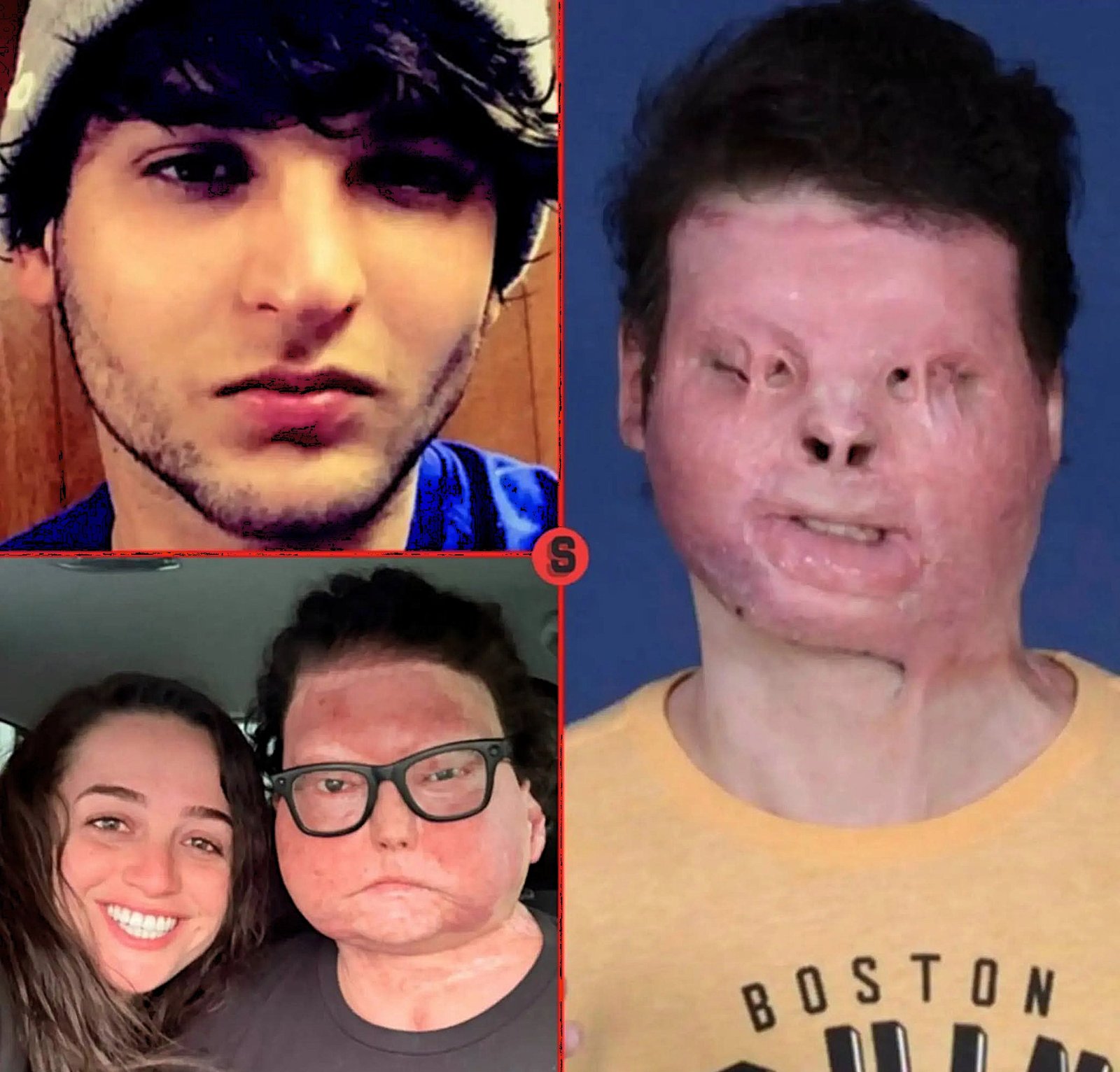
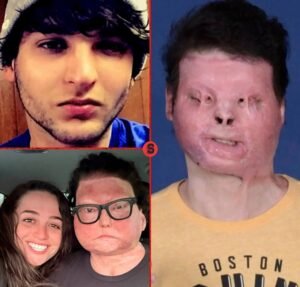
A devastating traffic accident changed his life in an instant. The crash left him with third-degree burns covering more than 80% of his body, forcing doctors to place him in an induced coma for more than two months as they fought to save his life.
He survived—but the road to recovery was only beginning.
The injuries he suffered were catastrophic. Over the years that followed, he underwent numerous reconstructive surgeries as doctors worked to repair the extensive damage caused by the accident. Despite their efforts, the consequences remained severe.
He lost his eyelids, his lips, and several fingers. The damage to his hands and face was so extensive that many ordinary activities became incredibly difficult. Tasks that most people perform without thinking—getting dressed, eating a meal, or taking care of basic personal needs—became major challenges.
For years, he depended heavily on other people for everyday tasks.
His life became a constant battle to regain even a small amount of independence.
But instead of giving up, he continued searching for a way to improve his quality of life.
He spent years undergoing medical treatments, reconstructive procedures, rehabilitation, and therapy. Every small improvement mattered. His ultimate goal was not simply to survive the accident, but to regain the ability to live as independently as possible.
Then, in August 2020, his life took a remarkable turn.
He became the first person in the world to receive a combined face and hand transplant.
The groundbreaking procedure was performed at NYU Langone Health in New York. It was an extraordinarily complicated operation that lasted approximately 23 hours and required the expertise of a massive multidisciplinary medical team.
More than 140 professionals were involved, including surgeons, anesthesiologists, nurses, rehabilitation specialists, and other medical experts.
The operation represented a major milestone in transplant medicine.
For him, however, it meant something much more personal.
It represented the possibility of getting a part of his independence back.
The transplant was only the beginning of another long journey. His body needed time to adjust to the transplanted tissues, and he had to undergo extensive rehabilitation to learn how to use his new hands.
Recovery required patience, determination, and countless hours of therapy.
He had to work on small movements and gradually rebuild his ability to perform everyday tasks. Progress did not happen overnight. But little by little, things that had once seemed impossible began to become possible again.
One of the biggest victories was being able to dress himself.
Something as simple as putting on his own clothes became a powerful symbol of independence. He was also able to eat on his own again, without needing someone else to perform the task for him.
These may sound like ordinary activities, but after years of dependence, they represented an extraordinary achievement.
His recovery also allowed him to rediscover simple pleasures.
He could once again participate in everyday activities and enjoy time with his beloved dog. Moments that might seem insignificant to others became deeply meaningful to him because they represented something he had spent years fighting to regain: freedom.
His story, however, goes far beyond medicine and physical recovery.
After everything he had endured, another unexpected chapter of his life began—one involving love.
Through social media, he met Jessica. Their online connection gradually developed into a relationship, giving him another reason to look toward the future with hope.
Their relationship eventually became something much deeper.
In 2024, the couple got married during a ceremony in Hawaii.
For someone whose life had once been dominated by surgeries, rehabilitation, physical limitations, and dependence on others, reaching that moment represented an extraordinary transformation.
His journey had taken him from fighting simply to survive to building a new life filled with independence, companionship, and love.
His story is therefore much more than the story of a pioneering transplant.
It is a story about resilience.
A terrible accident had changed almost every aspect of his life. His body suffered unimaginable injuries, and for years he faced challenges that most people could never fully understand. Yet he continued moving forward.
The combined face and hand transplant gave him an opportunity that once seemed almost impossible. Through modern medicine and years of rehabilitation, he was able to recover important aspects of his mobility and independence.
But the transplant alone did not create his second chance.
His determination played an equally important role.
Every therapy session, every difficult movement, and every small achievement became another step toward rebuilding his life.
Today, his story stands as a powerful example of what can happen when medical innovation meets extraordinary human perseverance.
His journey also reminds us that recovery does not always mean returning to the life someone had before an accident. Sometimes, recovery means learning how to build an entirely new life—one step at a time.
The road was long and filled with obstacles, but he continued forward.
From surviving burns over more than 80% of his body to undergoing one of the most remarkable transplant procedures in medical history, his life demonstrates the incredible possibilities of modern medicine and the strength of the human spirit.
And perhaps the most inspiring part of his story is that his transformation did not end when the surgery was over.
He regained the ability to perform everyday tasks. He rediscovered independence. He enjoyed time with his dog. He found love through social media. And eventually, he married Jessica in Hawaii in 2024.
What began as a fight for survival ultimately became a journey toward living again.
His story is a reminder that even after life changes in the most devastating way imaginable, hope can remain—and sometimes, with determination, medical innovation, and support, a completely new chapter can begin.