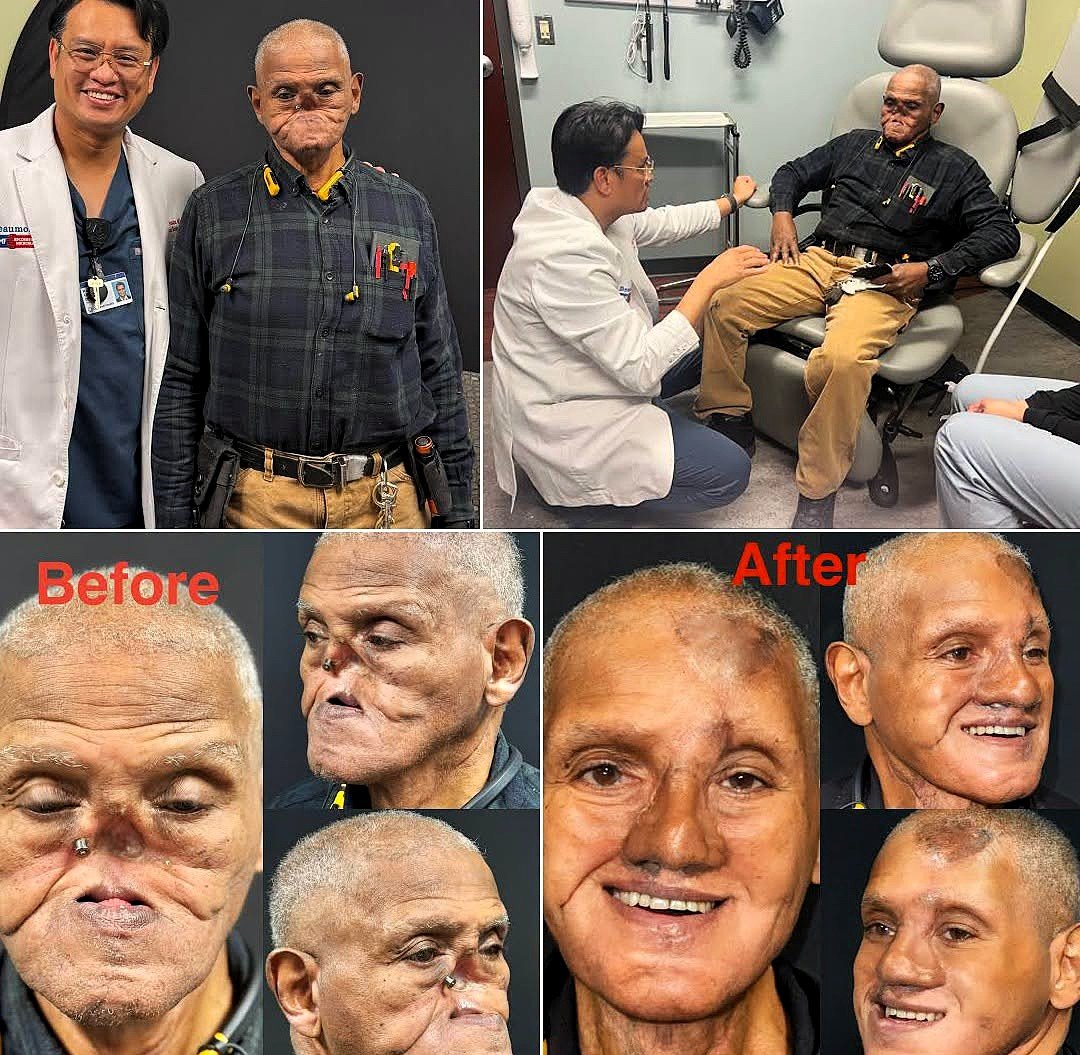
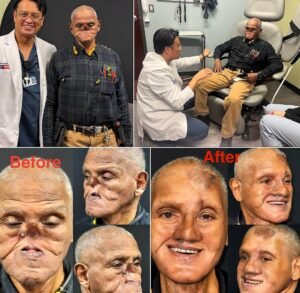
When cancer and its treatment changed one patient’s face forever, rebuilding what had been lost required far more than simply restoring the shape of a nose.
It required surgeons to think about the human face as a complex structure made of skin, tissue, bone, blood vessels and delicate internal surfaces — each playing a different role.
A remarkable reconstruction associated with Dr. Kongkrit Chaiyasate and his surgical team shows just how intricate that process can be.
The patient had lost significant portions of his nose, upper jaw and palate following cancer and treatment. What remained was not simply a cosmetic problem. The loss affected structures that were important for appearance, breathing and the overall function of the face.
To rebuild those structures, surgeons used tissue from different parts of the patient’s own body.
Tissue from the forearm was used to help create the inner lining of the reconstructed nose. Skin from the forehead was used to provide the external covering, while bone taken from the leg helped reconstruct part of the upper jaw.
At first, the idea may sound almost unbelievable.
How could tissue from an arm help create a nose?
How could bone from a leg become part of a face?
But reconstructive surgery often works by carefully selecting tissues that can perform specific jobs in another part of the body.
A nose is much more than the visible structure people see in a mirror.
It has an internal lining, a framework that provides support and an external covering that gives it its recognizable shape. When cancer or treatment destroys several of these components, surgeons may need to rebuild each layer separately.
That is why complex facial reconstruction can require multiple procedures rather than a single operation.
The forearm can provide a thin, flexible piece of tissue that is useful for creating an internal lining. Forehead skin, meanwhile, can provide tissue suitable for reconstructing the outer portion of the nose.
Bone may be needed to recreate missing structural support in areas such as the upper jaw.
Together, these different pieces can become part of a new facial structure.
Dr. Chaiyasate has published research involving techniques used in complex nasal reconstruction, including the use of forearm tissue and forehead flaps. Such procedures demonstrate how reconstructive surgeons can use tissue from one area of the body to repair another area that has been severely damaged.
One of the most extraordinary parts of this type of surgery happens at a microscopic level.
When tissue is transferred from one part of the body to another, it needs a reliable blood supply to survive. Microsurgery allows surgeons to work with extremely small blood vessels, carefully connecting them so that blood can reach the transplanted tissue.
These connections are tiny, but their importance is enormous.
Without an adequate blood supply, transferred tissue may not survive.
With successful microsurgical connections, however, tissue can become living material incorporated into the reconstructed area.
The process can involve considerable planning and several stages.
The initial surgery may establish the basic structure, while later operations can refine the shape, improve symmetry and make the reconstructed area look and function more naturally.
For patients who have experienced cancer and major facial surgery, the journey can therefore extend far beyond the operating room.
There is the physical recovery.
There are follow-up procedures.
There are adjustments.
And there is also the emotional challenge of becoming comfortable with a face that may look very different from the one a person knew before illness.
That is what makes the story of this particular patient especially touching.
According to the account shared about his reconstruction, he was an artist.
After going through the difficult process of treatment and facial reconstruction, he later expressed his gratitude in a way that reflected his own talent.
He painted a portrait of Dr. Chaiyasate.
It was more than simply a painting.
For an artist, creating a portrait can be an intensely personal way of seeing and remembering another person. In this case, the patient used his own artistic ability to capture the face of one of the surgeons who had helped rebuild his.
The irony is striking.
A medical team had worked to reconstruct the patient’s face, carefully piecing together tissue and bone to restore what disease and treatment had taken away.
The patient responded by creating art centered on the face of the person who had helped him.
Behind the technical details of the operation was a person trying to reclaim part of his life.
Stories like this can sometimes make reconstructive surgery sound almost like a miracle, but the reality is much more complex. These operations require detailed planning, specialized surgical skills, careful monitoring and, in many cases, multiple procedures.
They also remind us that reconstructive surgery is not always about making someone look exactly as they did before.
Sometimes it is about restoring as much function as possible.
Sometimes it is about creating a stable structure.
Sometimes it is about helping someone feel comfortable facing the world again.
And sometimes, it is about giving a person the opportunity to look in the mirror and recognize themselves in a new way.
The use of tissue from the forearm, forehead and leg may sound extraordinary, but each component has a practical purpose. Surgeons are essentially using the strengths of different tissues to recreate the missing anatomy.
The final result is not simply assembled like a puzzle.
It is living tissue that must heal, connect and become part of the reconstructed face.
For patients who have lost facial structures because of cancer, this kind of reconstruction can represent an important step in moving forward.
The scars of illness may never completely disappear, but reconstruction can help restore something that disease has taken away — structure, function, confidence and, in some cases, a sense of identity.
And perhaps the most beautiful part of this story is what happened after the surgery.
The patient did not simply leave the hospital with a reconstructed nose and jaw.
He carried his experience into his art.
His portrait of Dr. Chaiyasate became a personal expression of gratitude — an artist using his own hands to honor the surgeon who had used his hands and expertise to help rebuild his face.
It is a powerful reminder that behind every complicated medical procedure is a human story.
There is a patient who endured it.
There is a team that worked to help.
And there is often a long journey of healing that continues long after the operating room lights are turned off.
Sometimes, rebuilding a face requires taking tissue from places no one would expect.
But the ultimate goal is not simply to reconstruct a nose.
It is to help rebuild a life after cancer changed it forever.