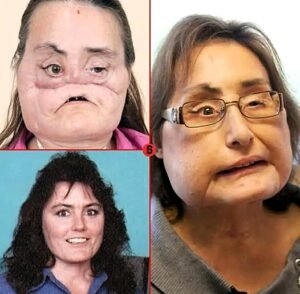
In 2004, Connie Culp’s life changed forever in a single, devastating moment.
What began as an act of violence left her with catastrophic injuries to her face and transformed nearly every aspect of her daily life. But years later, Connie would become a symbol of courage and resilience—and make medical history as the first person in the United States to undergo an almost complete face transplant.
Before the tragedy, Connie was living an ordinary life and had no idea that her future would eventually become part of one of medicine’s most remarkable stories.
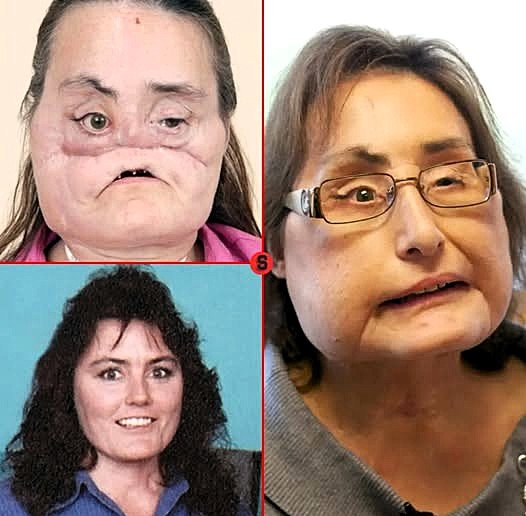
Her life took a horrifying turn when her husband attacked her with a firearm. The shot caused devastating damage to her face, destroying much of her facial structure and leaving her with injuries that would affect her ability to breathe, eat, speak, and live normally.
The physical consequences were enormous.
Connie lost much of her nose, cheeks, and other facial structures. She also suffered severe damage to her upper jaw and surrounding tissues. The injuries were so extensive that conventional reconstructive surgery could only do so much.
Over the following years, Connie underwent numerous operations in an effort to rebuild and restore parts of her face.
Doctors used pieces of bone, skin, and other tissue from different parts of her body to reconstruct what they could. But despite the repeated procedures, many of the essential functions of her face remained severely compromised.
Simple things that most people take for granted became extraordinarily difficult.
Breathing was a challenge. Eating required assistance. Speaking was difficult. Even showing emotions through facial expressions became almost impossible.
And then came an opportunity that seemed almost unimaginable at the time.
In 2008, surgeons at Cleveland Clinic performed an extraordinary operation that would make Connie Culp a landmark patient in the history of reconstructive medicine.
She became the first person in the United States to receive an almost complete facial transplant.
The operation was incredibly complex and lasted more than 20 hours. Surgeons transplanted multiple facial structures from a deceased donor, carefully connecting bones, muscles, blood vessels, nerves, and other tissues.
The goal was not simply to change Connie’s appearance.
It was to give her back functions that had been lost after the shooting.
A facial transplant is fundamentally different from cosmetic surgery. It is an extremely complicated medical procedure designed to restore damaged anatomy and, when possible, improve essential functions.
For Connie, the procedure offered a new possibility.
After years of living with devastating injuries, she finally had a chance to regain some of the abilities she had lost.
The transplant helped improve her ability to speak and eat. It also partially restored her sense of smell. Perhaps just as importantly, the new facial muscles allowed her to express emotions more naturally.
For Connie, these improvements represented far more than medical statistics.
They meant being able to interact with people in ways that had once seemed impossible.
Her face was no longer only a reminder of the violence she had experienced. It became part of her recovery.
The operation also represented a major breakthrough for doctors and researchers.
At the time, facial transplantation was still an emerging field filled with enormous medical challenges. Surgeons had to consider not only the technical difficulties of connecting tissues and blood vessels but also the long-term consequences of transplantation.
Because a transplanted face comes from another person, the recipient’s immune system can recognize the tissue as foreign and attempt to reject it. As a result, patients who undergo facial transplantation generally require lifelong immunosuppressive medication to help prevent rejection.
That means the procedure is not a simple cure.
It is a complex, lifelong medical journey.
Nevertheless, Connie’s case demonstrated something that had once seemed almost impossible: a severely damaged human face could be reconstructed using tissue from another person, and the recipient could regain important functions.
Her story helped push the field of facial transplantation forward.
But behind the medical achievement was a woman who had endured years of physical and emotional hardship.
Connie did not allow the circumstances of her injury to completely define her life.
Instead, she became an advocate for people who had suffered severe facial injuries and for victims of domestic violence. Her public story helped bring attention to the devastating consequences that violence can have—not only physically, but psychologically and socially.
For many people with severe facial injuries, the challenge goes beyond pain or physical disability.
The face plays an enormous role in human communication. We use it to smile, show sadness, express surprise, make eye contact, and communicate emotions without saying a word.
When someone loses those abilities, the emotional impact can be profound.
Connie’s recovery showed how reconstructive medicine can potentially restore more than physical appearance. It can help restore communication, confidence, independence, and a sense of normality.
Her transplant also changed the way the public viewed facial transplantation.
Instead of being something found only in science fiction, it became a real medical possibility.
Connie Culp’s operation was therefore not simply the story of one patient receiving a new face.
It was the beginning of a new chapter in reconstructive surgery.
Her case demonstrated that medicine could go beyond repairing small injuries. In extraordinary circumstances, surgeons could reconstruct an entire facial region and help a person recover functions that had been destroyed.
Yet perhaps the most powerful part of Connie’s story is not the operation itself.
It is what happened afterward.
She continued moving forward despite everything she had experienced.
Her face became a symbol of survival—not because the scars and injuries disappeared, but because she refused to let them erase her identity.
Connie’s journey reminds us that medical breakthroughs are often about much more than technology. Behind every groundbreaking procedure is a human being willing to endure uncertainty, pain, and countless challenges in the hope of gaining a better life.
Her story also carries a powerful message for anyone who has experienced trauma: rebuilding a life may take time, and recovery may not mean returning to the person you were before.
Sometimes, recovery means discovering a new version of yourself.
Connie Culp made history because she became the first person in the United States to receive an almost complete facial transplant.
But she is remembered for something even greater.
She showed the world that even after unimaginable trauma, a person can find the strength to keep going.
Her case opened doors for future facial transplant patients and gave hope to people with devastating facial injuries around the world.
What doctors achieved in the operating room was extraordinary.
What Connie achieved by continuing to live, heal, and inspire others was extraordinary in an entirely different way.
Her story remains a remarkable example of how medical innovation and human resilience can come together to change a life forever.