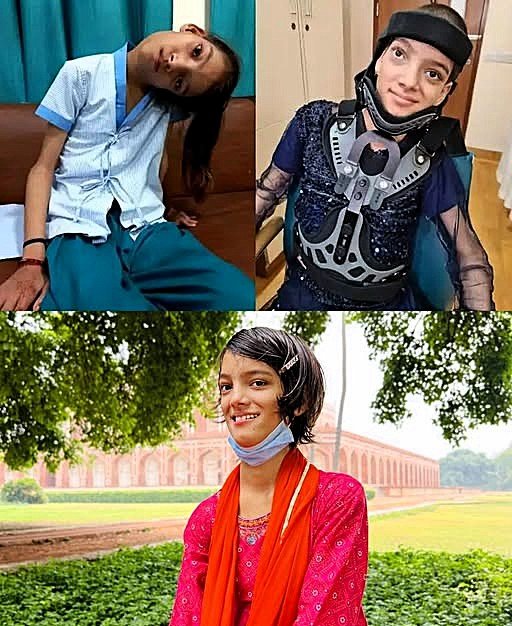
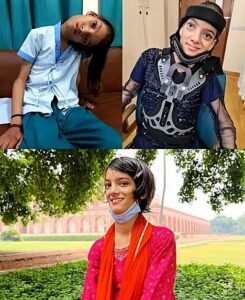
For more than a decade, something as simple as looking straight ahead was almost impossible for Afsheen Gul.
As a young girl growing up in Pakistan, Afsheen suffered a devastating fall that caused a severe spinal injury. What began as an accident gradually transformed into a condition that would affect nearly every part of her childhood.
Over the years, her neck became increasingly deformed until her head was fixed at an angle of almost 90 degrees.
She could no longer hold her head upright.
Walking became difficult.
Eating became painful.
Going to school became nearly impossible.
And ordinary activities that most people perform without giving them a second thought became exhausting challenges.
For Afsheen, childhood was slowly replaced by a daily struggle to simply get through the day.
A Life Turned Upside Down
Imagine waking up every morning unable to look directly at the world around you.
Imagine trying to walk while carrying the weight of a severely deformed neck.
Imagine sitting down for a meal and finding that even eating has become uncomfortable.
For Afsheen, this was not a temporary problem.
It lasted for years.
According to reports about her case, she lived with the severe deformity for around 12 years. As time passed, the physical condition also took an enormous emotional and social toll.
School, friendships, ordinary childhood activities and the freedom to move around normally were all affected.
Her condition was so unusual and severe that finding a solution was incredibly difficult.
Yet Afsheen continued living with the hope that someday something might change.
That opportunity eventually came from an unexpected direction.
Hope From Across the Border
In 2022, Afsheen traveled to New Delhi, India, seeking medical help.
There, spinal surgeon Dr. Rajagopalan Krishnan agreed to take on her extraordinarily complicated case.
It was not a routine operation.
Correcting such a severe spinal deformity involved working dangerously close to critical nerves, the spinal cord and major blood vessels.
The risks were enormous.
A mistake during surgery could potentially have resulted in permanent paralysis—or even death.
But without intervention, Afsheen’s condition offered little hope of returning to a normal life.
Her medical team therefore faced a difficult decision: attempt an exceptionally complicated procedure with significant risks, or leave her living with a deformity that had already taken away much of her childhood.
They chose to give her a chance.
The Operation That Changed Everything
The surgery was an extraordinary medical challenge.
The goal was not simply to straighten Afsheen’s neck.
Doctors had to carefully correct the underlying spinal deformity while protecting the delicate structures surrounding it.
Every movement mattered.
Every millimeter mattered.
The operation required careful planning, advanced surgical techniques and an experienced medical team willing to take on an extremely difficult case.
Then came the moment everyone had been hoping for.
The operation succeeded.
After more than a decade of living with her head dramatically tilted, Afsheen was finally able to hold it upright.
For many people, that might seem like a small thing.
For Afsheen, it represented the return of an entire life.
The Simple Things Became Extraordinary
After the successful surgery, activities that had once been difficult or impossible began becoming possible again.
She could walk more normally.
She could eat with greater comfort.
She could interact with people without constantly struggling with the position of her head.
And perhaps most importantly, she could begin thinking about education and a future beyond her medical condition.
The transformation was about much more than physical appearance.
For years, Afsheen’s body had dictated what she could and could not do.
The surgery gave her an opportunity to reclaim some of the independence that her injury had taken away.
A childhood interrupted by illness could finally begin moving forward.
A Story That Crossed More Than One Border
Afsheen’s story received international attention for another reason as well.
She was a Pakistani girl who traveled to India for treatment.
India and Pakistan have a complicated political relationship, and the two countries have often found themselves divided by conflict, history and politics.
But inside the operating room, those divisions disappeared.
There was no political argument.
No national rivalry.
No border.
There was simply a young person who needed help and a medical team willing to provide it.
Afsheen’s doctors were focused on one goal: giving her the best possible chance at a healthier, more independent life.
And that is what makes her story so powerful.
Medicine has a unique ability to bring people together.
A surgeon does not ask which side of a border a patient was born on before deciding whether to help.
A hospital does not care about political disagreements.
When someone is suffering, the most important thing is often simply another human being’s willingness to help.
More Than a Medical Miracle
Afsheen’s recovery is often described as a remarkable medical achievement, and it certainly was.
But her story is also about resilience.
For roughly 12 years, she lived with a condition that changed almost everything about her daily existence.
She experienced physical limitations that few children could imagine.
Yet she continued forward.
Her journey also highlights the importance of access to specialized medical care.
Rare spinal deformities can require highly experienced surgeons, advanced facilities and complex treatment plans. For families facing such conditions, finding the right specialist can sometimes feel impossible.
Afsheen’s case demonstrates what can happen when medical expertise, determination and opportunity come together.
Her story also reminds us that behind every difficult medical case is a human being.
Not just an X-ray.
Not just a diagnosis.
Not just a surgical challenge.
A person with dreams, fears, hopes and a future.
A New Beginning
The successful surgery did not erase the difficult years Afsheen had experienced.
It could not give her back the childhood she had lost.
But it gave her something incredibly valuable:
A new beginning.
The ability to look forward instead of spending every day struggling with the past.
The ability to walk with greater freedom.
The possibility of returning to education.
And the chance to imagine a future in which her medical condition did not define her entire identity.
Sometimes, the biggest miracles are not dramatic moments.
Sometimes they are simple.
Standing upright.
Eating comfortably.
Walking outside.
Going back to school.
Looking at the world straight ahead.
For Afsheen Gul, those ordinary experiences became extraordinary because she had spent so many years without them.
A Reminder That Humanity Comes First
Afsheen’s journey began with a terrible accident and more than a decade of suffering.
But it eventually became a story of medical courage, human resilience and cooperation across borders.
A Pakistani girl found hope in India.
An Indian surgeon accepted an extraordinarily difficult challenge.
And a successful operation gave a young woman the opportunity to experience life in a completely different way.
Her story reminds us that political borders may separate countries, but they do not have to separate people.
When someone is suffering, compassion can cross borders.
When someone needs help, humanity can be stronger than politics.
And when medicine succeeds, its greatest achievement is not always the complexity of the operation.
Sometimes, it is giving someone the chance to experience the simple things that everyone deserves.
Afsheen spent 12 years seeing the world from a dramatically different angle.
After surgery, she finally had the chance to look forward.
And perhaps that is the most beautiful part of her story.
Because sometimes, healing is not just about fixing the body.
Sometimes, it is about giving someone their future back.