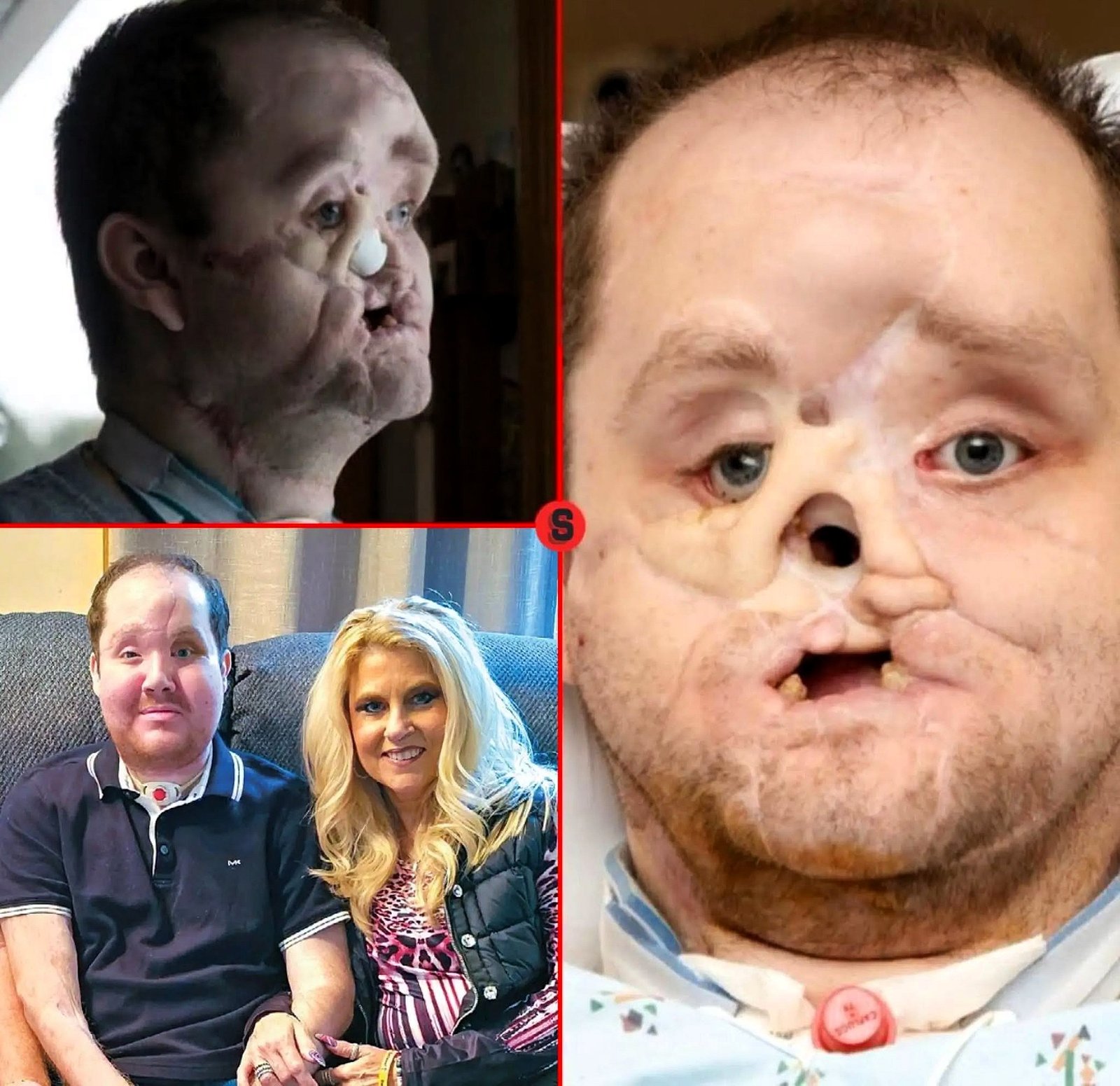
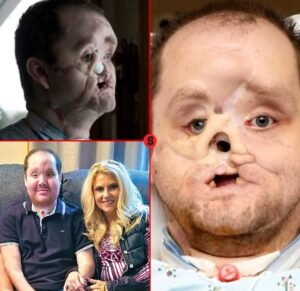
At just 19 years old, Derek Pfaff’s life changed forever after a devastating firearm-related incident left much of his face severely damaged. The injury destroyed major portions of his nose, jaw, and teeth, creating physical challenges that would follow him for more than a decade.
What came next was a journey few people could imagine.
Over the following 10 years, Pfaff underwent 58 reconstructive surgeries in an effort to repair the damage and restore some of the basic functions he had lost. Despite the enormous number of procedures, many of the problems remained.
He struggled to breathe normally and could not properly blink his eyes. His ability to speak was severely affected, and he was unable to eat solid food for years. Instead, he depended on a feeding tube for nutrition.
He also lost his ability to perceive smells, something many people take for granted in everyday life.
For Pfaff, these difficulties were not simply medical problems. They affected nearly every part of his daily existence and forced him to adapt to a life that looked completely different from the one he had imagined as a teenager.
A Decade of Reconstructive Surgery
Traditional reconstructive surgery can repair significant facial injuries, but Pfaff’s case presented extraordinary challenges.
Doctors repeatedly attempted to rebuild portions of his face using conventional techniques. Surgery after surgery, however, could not completely restore the complex structures necessary for normal breathing, eating, speaking, blinking, and facial movement.
After 58 procedures, the physical limitations remained.
For years, something as ordinary as eating a meal with other people was impossible. Speaking clearly could be difficult. Even facial expressions were severely restricted.
Yet Pfaff continued moving forward.
His story eventually brought him to the Mayo Clinic, where specialists began considering an option that could potentially transform his life: a face transplant.
A facial transplant is one of the most complex procedures in modern medicine. Unlike conventional reconstruction, the operation can replace large sections of damaged facial tissue with donated tissue from another person.
But the procedure comes with enormous challenges.
It requires highly specialized surgeons and medical professionals working together, extensive preparation, careful matching between donor and recipient, and lifelong medical treatment afterward to reduce the risk of rejection.
For Pfaff, however, the potential benefits were life-changing.
A 50-Hour Operation
In February 2024, Pfaff underwent an extraordinary facial transplant at Mayo Clinic.
More than 80 specialists participated in the operation, which lasted for more than 50 hours.
The team replaced approximately 85% of Pfaff’s face using tissue from a donor.
The scale of the surgery was remarkable. It involved reconstructing major facial structures and carefully connecting blood vessels, nerves, muscles, and other tissues so the transplanted face could function as naturally as possible.
For the medical team, the operation represented years of preparation, coordination, and advanced surgical expertise.
For Pfaff, it represented something even more important: a chance to regain abilities he had lost when he was only 19.
After the operation, the changes were extraordinary.
He was able to breathe through his nose again. He could blink his eyes. He gradually regained the ability to eat independently and enjoy solid foods.
And perhaps one of the most meaningful changes was something incredibly simple:
He could smile.
After years of surgeries and physical limitations, being able to move his face and express emotions in a more natural way gave Pfaff a new sense of freedom.
More Than a Medical Transformation
Pfaff’s recovery was not simply about rebuilding his appearance.
A face plays an essential role in communication, eating, breathing, facial expression, and human connection. When those functions are severely damaged, the consequences can extend far beyond physical discomfort.
For years, Pfaff had to live with limitations that most people never have to consider.
The transplant offered him the opportunity to reclaim some of those everyday experiences.
Eating without a feeding tube. Breathing more naturally. Blinking. Speaking. Smiling.
Each of these abilities represented a major milestone.
But his journey did not end when the surgery was completed.
Like other transplant recipients, Pfaff faces an ongoing medical journey that requires monitoring and treatment. A successful transplant is not a single event; it is the beginning of a new chapter that requires long-term care and dedication.
Turning His Experience Into a Message of Hope
Perhaps the most powerful part of Pfaff’s story is what he has chosen to do with his experience.
Rather than keeping his journey private, he has increasingly shared his story publicly to encourage people who may be struggling with difficult circumstances.
He has particularly focused on suicide prevention and mental-health awareness, using his own experience to remind others that a devastating moment does not necessarily define the rest of their lives.
His message is rooted in survival.
At 19, Pfaff experienced an event that permanently changed his appearance and physical abilities. He then spent a decade undergoing dozens of surgeries and living with limitations that could easily have overwhelmed him.
But his story continued.
The facial transplant gave him abilities that once seemed impossible, but perhaps its greatest impact has been the perspective it gave him on life.
Today, Pfaff uses his platform to show others that even when life takes an unexpected and painful turn, there can still be another chapter waiting ahead.
A Story of Medicine, Survival and Second Chances
Derek Pfaff’s journey is extraordinary not simply because of the complexity of his facial transplant, but because of what happened before and after it.
The surgery itself was a remarkable achievement involving more than 80 specialists and over 50 hours of highly coordinated work.
But behind those numbers is a person who spent years adapting to a body that no longer functioned as it once had.
Fifty-eight reconstructive surgeries could not fully restore his lost abilities.
The transplant changed that trajectory.
Today, Pfaff’s story stands at the intersection of advanced medicine, human resilience, organ and tissue donation, and the power of hope.
His experience also highlights the importance of reconstructive medicine and the extraordinary possibilities that can emerge when surgeons, researchers, donors, families, and patients come together.
For someone who once struggled to eat, speak, blink, breathe, and express himself normally, the ability to smile again carries a meaning far beyond appearance.
It represents recovery.
It represents possibility.
And it represents a second chance.
Derek Pfaff’s life is a reminder that the worst moment of someone’s life does not have to be the final chapter. Sometimes, with time, support, medical innovation, and extraordinary perseverance, a new chapter can begin.
Today, he is using that second chance not only to rebuild his own life but also to encourage others to keep going when their circumstances seem impossible.
His face may have been reconstructed through one of the most complex medical procedures imaginable, but the message he carries is remarkably simple:
There can still be hope after the darkest moments.