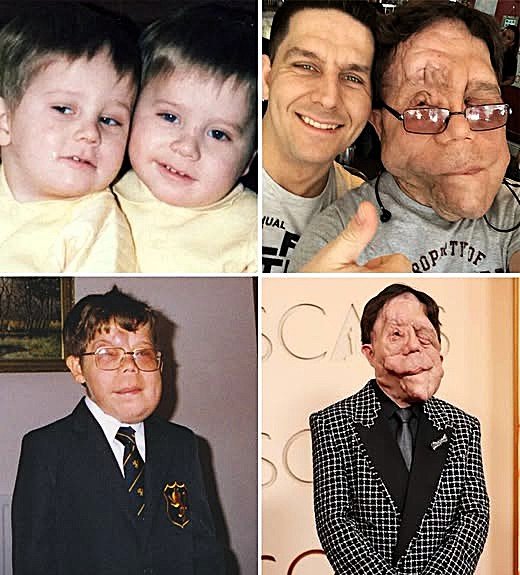
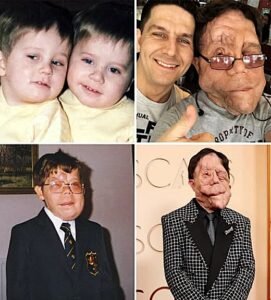
For most of his life, Adam Pearson has known what it feels like to have strangers notice his face before they notice him.
He has lived with neurofibromatosis type 1, a genetic condition that can cause tumors to develop along nerves. For Adam, the condition has dramatically changed the appearance of his face and has led to years of medical treatment.
He has undergone nearly 40 operations.
He has also experienced something that cannot be treated in an operating room: cruelty from other people.
So when a comedian recently made a joke about his appearance, Adam had every reason to be angry.
But instead of simply responding with outrage, he did something that has become characteristic of the way he approaches difficult conversations.
He used humor first.
Then he asked people to think.
The incident happened in March 2026, shortly after Adam attended the Oscars. Comedian Danny Polishchuk shared a photograph of Adam from the red carpet and made a joke about his appearance.
The post quickly became part of a much larger discussion about comedy, disability and where the boundaries of a joke should exist.
Adam could have ignored it.
He could have responded with anger.
Instead, he answered in a way that made people look beyond the joke itself.
With his characteristic sense of humor, Adam joked that he had apparently discovered a supposed treatment that could somehow transform a person into an Academy member, an award-winning actor and an Oscars guest.
It was funny.
But it was also deliberate.
Because after the humor came the message Adam really wanted people to consider.
“You can tell a lot about a person’s character by looking at who they’re willing to punch down towards, even in the name of comedy.”
That sentence shifted the conversation.
Suddenly, the question was no longer simply whether a comedian had made a funny joke.
It became a question about who becomes the target of humor—and what happens when the person being mocked decides to answer.
Some people responded by telling Adam that he should simply learn to take a joke.
But Adam’s response was straightforward.
He had taken the joke.
Now he was exercising the same freedom to respond to it.
There was no demand that comedy disappear.
There was no suggestion that comedians should never make controversial jokes.
Instead, Adam was pointing out something basic: if someone has the freedom to make a joke, the person who is targeted has the freedom to decide how they feel about it and whether they want to respond.
When another person suggested that everyone should simply move on, Adam offered an even more direct response.
“Ideally I’d like to not have my disability mocked, but I guess that’s too much to ask, eh?”
Behind those words is a lifetime of experience.
Adam was diagnosed with neurofibromatosis type 1 when he was just five years old.
Growing up, his appearance made him a target for bullying. Like many people with visible differences, he learned early that strangers could make assumptions about him before they ever knew anything about his personality, ambitions or abilities.
But Adam did not allow other people’s reactions to determine the size of his life.
In fact, he eventually entered an industry where appearance is often placed under an enormous microscope.
Entertainment.
He became an actor, presenter and disability advocate.
He appeared alongside Scarlett Johansson in the science-fiction film Under the Skin. Years later, he starred in A Different Man, a film that explores identity, appearance and the complicated way society responds to visible difference.
His career has also included television presenting and advocacy work focused on disability representation.
That career matters because Adam is not speaking about these issues from a distance.
He has spent years living inside the conversation.
He knows what it is like to have his appearance become the first thing people notice.
He also knows what it is like to prove that there is an entire human being behind that appearance.
And perhaps that is why his response to the recent joke resonated with so many people.
Adam has never suggested that comedy should be stripped of its edge.
His argument is more nuanced.
A comedian can make a joke.
An audience can laugh.
And the person who becomes the subject of that joke can still say, “That hurt.”
Those things can exist at the same time.
The debate surrounding Adam’s experience also raises a broader question about disability representation.
For decades, people with visible disabilities have often been portrayed through stereotypes, pity or as objects of curiosity. Increasing representation in film, television and public life has helped challenge some of those patterns, but visibility can also bring another problem.
The more visible someone becomes, the more visible the criticism can become too.
Adam has chosen to remain visible anyway.
He has appeared on screens.
He has walked red carpets.
He has discussed his condition publicly.
He has allowed audiences to see him as an actor, presenter, advocate and individual rather than simply as someone with a medical diagnosis.
That choice takes the conversation beyond one comedian or one social-media post.
It becomes a question about what society expects from people with disabilities.
Are they expected to laugh at every joke made about them?
Are they expected to remain silent when something hurts?
Or should they be allowed the same complexity afforded to everyone else—to laugh sometimes, object sometimes, and answer back when they choose?
Adam’s response suggests the third option.
He can take a joke.
He can make a joke about himself.
He can laugh.
And he can still say when something crosses a line for him.
Those positions do not contradict each other.
In fact, they may be part of what makes his message so powerful.
Because the conversation around disability does not need to be built entirely around sympathy.
It can be built around dignity.
Adam Pearson does not appear to be asking people to treat him as fragile.
He is asking people to treat him as human.
That means allowing him the same right everyone else has: the right to decide what he finds funny, the right to disagree, and the right to answer when someone crosses a boundary.
The debate over comedy will undoubtedly continue.
People will disagree about where the line should be.
Some will argue that comedy needs freedom to challenge social boundaries. Others will argue that certain jokes reinforce harmful attitudes, particularly when they target characteristics people cannot simply choose to change.
There may never be one universal line that everyone agrees on.
But Adam’s story adds an important voice to that conversation.
Because behind every joke about someone’s appearance is a person who has lived with that appearance every day.
And sometimes, the person at the center of the joke has something important to say.
Adam Pearson chose not to disappear.
He chose to answer.
And in doing so, he reminded people that being the target of a joke does not mean surrendering your voice.
Comedy can have a punchline.
But the person on the receiving end can still have the final word.
Read Next
- Lisa and her son Nic both have Down syndrome, and their story shows the power of family support
- At 13, Ellie Found a Small Lump and Was Too Embarrassed to Speak About It. Months Later, She Was Diagnosed With Stage 4 Cancer
- For 12 Years, She Saw the World Sideways—Then a Remarkable Surgery Changed Her Life