On a cold April day in 1967, a young woman stepped onto the starting line of the Boston Marathon with a simple goal: to run 26.2 miles and prove that she belonged there just as much as any man.
Her name was Kathrine Switzer. She was only 20 years old, and the number pinned to her sweatshirt was 261.
She had trained for months, prepared herself for the exhausting challenge, and arrived ready to run. But she was about to discover that finishing the marathon would require more than physical endurance. She would have to stand up against a belief that women did not belong in one of the world’s most famous running events.
And she refused to give up.
The Day One Race Number Made History
On April 19, 1967, women were not officially permitted to compete in the Boston Marathon. Many people believed that running such a long distance was unsuitable for women, while others argued that women simply lacked the physical ability to complete it.
But Kathrine wasn’t interested in accepting those limitations.
She had been running seriously and wanted to experience the Boston Marathon for herself. With encouragement from her coach, Arnie Briggs, she trained hard and prepared to cover the same distance as the male competitors.
When she registered for the race, she signed her name as K. V. Switzer, the name she commonly used. Her entry was accepted, and she received her race number: 261.
She had no intention of creating a worldwide controversy. She simply wanted to run.
Yet just a short distance into the race, everything changed.
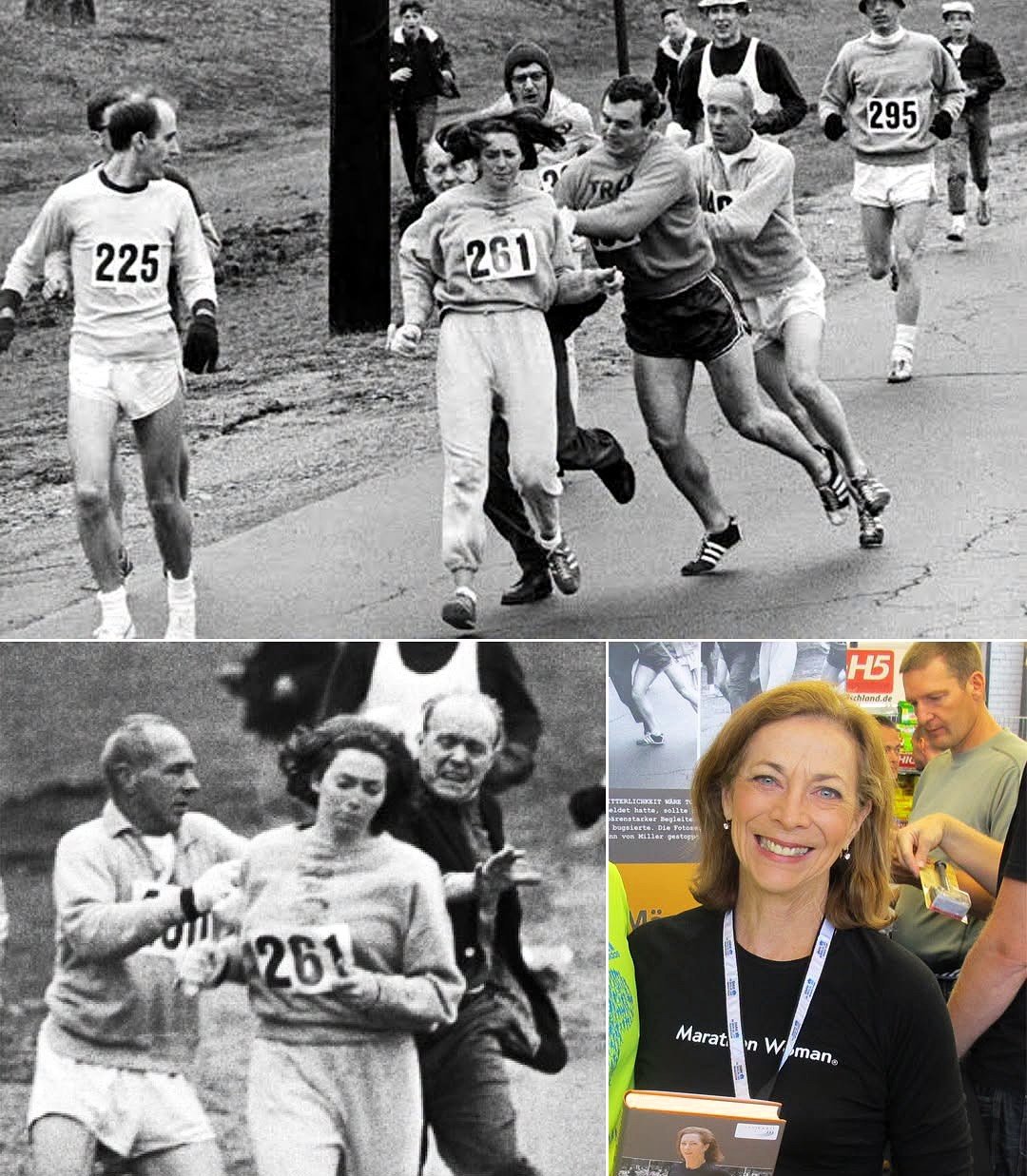
An official named Jock Semple noticed Kathrine running among the men. Angered by her presence, he rushed toward her and tried to grab her clothing and tear away her race number.
The confrontation was shocking. Kathrine suddenly found herself facing someone who was determined to force her out of the competition.
Her boyfriend, Tom Miller, who was running alongside her, intervened and pushed Semple away. That brief moment gave Kathrine the opportunity she needed.
She kept moving.
Photographers captured the confrontation, producing images that would become some of the most recognizable photographs in marathon history. The pictures showed more than an argument on a racecourse. They captured a young woman fighting for the right to participate in a sport that had shut its doors to her.
She Finished the Race
Kathrine could have stopped. She could have decided that the confrontation was too frightening, too humiliating, or simply not worth the trouble.
Instead, she focused on the road ahead.
She continued running through the miles, dealing with the physical demands of the marathon while knowing that her presence had become a subject of controversy.
After approximately four hours and twenty minutes, she crossed the finish line.
That finish mattered enormously. Kathrine had demonstrated through her own experience that a woman could complete the Boston Marathon, despite the objections of those who believed otherwise.
But the significance of her achievement went far beyond her personal accomplishment.
Her story reached people around the world. The photographs of the official attempting to remove her number helped expose the barriers women faced in competitive running. What had begun as one athlete’s determination became part of a much larger movement for equal opportunities in sports.
Kathrine had not merely completed 26.2 miles. She had helped challenge a system that told women they should not even be there.
From One Runner to a Movement
Kathrine Switzer was not the first woman to run the Boston Marathon course.
In 1966, Bobbi Gibb had completed the race unofficially without an assigned race number, after her application was rejected because she was a woman.
Gibb’s achievement had already challenged the rules. Switzer’s officially registered entry and the dramatic confrontation in 1967 brought even greater public attention to the issue.
Together, their efforts helped change the conversation about women’s distance running.
In 1972, the Boston Marathon introduced an official women’s division. Women could finally compete in the event under the same formal race structure that had previously excluded them.
For Kathrine, this was an important step, but it was not the end of her work.
She continued running competitively and won the women’s race at the New York City Marathon in 1974. She also devoted herself to expanding opportunities for women in distance running, helping establish events and initiatives that encouraged more women to participate.
Her mission was no longer just about her own place in a race. It was about making sure that other women would not have to face the same barriers.
She wanted future generations to approach the starting line without having to justify their presence.
Fifty Years Later, She Returned to Boston
In 2017, Kathrine returned to the Boston Marathon at the age of 70.
Fifty years had passed since the confrontation that made her famous. The world of distance running had changed dramatically, and women were now competing openly in marathons across the globe.
Still, she wanted to run Boston again.
Once more, she wore bib number 261.
This time, the number represented not exclusion but perseverance, progress, and the extraordinary distance society had traveled since 1967.
Kathrine completed the 2017 marathon in approximately four hours and forty-four minutes. At 70, she crossed the finish line of the same race she had first run as a determined 20-year-old.
Her return was a powerful reminder that courage does not belong to a single moment in someone’s life. Sometimes, it means continuing to show up decades after the world has changed.
The following day, the Boston Athletic Association officially retired bib number 261 in her honor.
The number that an official had once tried to tear away was now permanently associated with one of the defining stories in the marathon’s history.
What Bib 261 Really Means
Today, the story of Kathrine Switzer is remembered as a milestone in women’s sports. But its message reaches far beyond running.
It reminds us that rules and traditions are not always fair simply because they have existed for a long time. Sometimes, progress begins when one person refuses to accept that a closed door must remain closed.
Kathrine did not change everything in a single afternoon. Change also required the courage of other women, the support of allies, and years of continued effort. But her determination helped make the barriers visible, and her actions inspired people to question them.
Imagine the young girls who now line up for marathons, train with running clubs, and dream of athletic achievements without being told that their gender makes those dreams impossible.
They may never have to experience the confrontation Kathrine faced. That is part of what makes her story so meaningful.
Progress is not only about the people who fight in the moment. It is also about the people who benefit because someone fought before them.
Bib 261 is more than a number on a running shirt. It is a reminder that determination can challenge prejudice, that courage can inspire change, and that one person’s refusal to quit can help open the road for thousands of others.
Kathrine Switzer started the Boston Marathon wanting to run 26.2 miles.
She finished having helped change the future of women’s distance running.
What does the number 261 represent to you: courage, equality, perseverance, or the power of refusing to give up?