Imagine crawling deep beneath the surface of the Earth, entering a dark labyrinth where sunlight has not reached for thousands of years. The walls are covered with strange mineral formations, the air is cold and still, and every step takes you farther away from the modern world.
Then, in the darkness, you discover something extraordinary.
A human skeleton.
But this is not the remains of a person who disappeared centuries ago. It belongs to a Neanderthal who lived more than 130,000 years ago—and whose bones have remained trapped inside the cave ever since.
This remarkable fossil, known as the Altamura Man, is one of the most unusual prehistoric discoveries ever made in Europe.
A Discovery Hidden Beneath Southern Italy
The story began in 1993, when a group of spelunkers exploring the Lamalunga cave system near Altamura in southern Italy entered a previously unexplored section of the underground network.
What they found was astonishing.
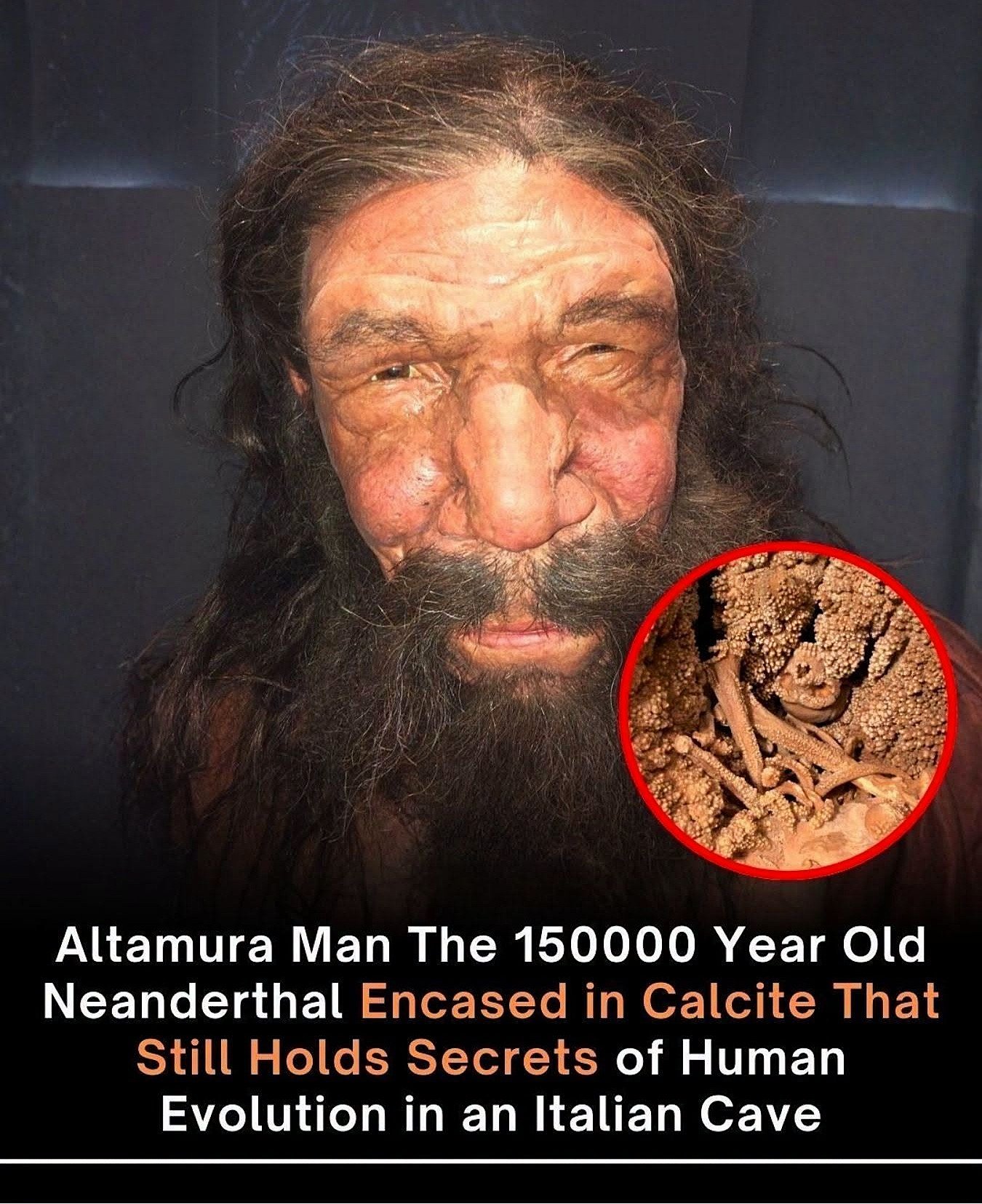
Deep inside the cave was a human skeleton surrounded and partially covered by thick layers of calcite and other mineral deposits. The bones appeared to have become part of the cave itself.
The discovery immediately attracted scientific attention.
Unlike many prehistoric human fossils, which are found as scattered bones or incomplete fragments, the Altamura skeleton was remarkably complete. Much of the skeleton remained in its original position, preserved exactly where it had been for an immense period of time.
But there was a problem.
The skeleton was essentially locked inside the rock.
Mineral-rich water had slowly dripped through the cave over thousands upon thousands of years. As the water evaporated or moved across the bones, it deposited minerals that gradually formed calcite coatings and stalagmitic structures around the skeleton.
Over time, the fossil became sealed inside a natural mineral shell.
The very process that protected the bones also made removing them extremely dangerous.
A Natural Time Capsule
Researchers eventually determined that the calcite surrounding the skeleton formed during the Pleistocene, with dating studies placing the deposits broadly between about 130,000 and 172,000 years ago.
That means the individual lived during a very different chapter of human history.
Europe was inhabited by Neanderthals, large Ice Age animals roamed the landscape, and modern humans had not yet established themselves across the continent in the way they eventually would.
The Altamura skeleton therefore represents an extraordinary snapshot of Neanderthal life from a distant prehistoric world.
And remarkably, the individual remained almost exactly where he had died.
Why Scientists Didn’t Simply Remove the Skeleton
When archaeologists discover an important fossil, it might seem obvious that the next step would be to carefully excavate it and place it inside a museum.
But Altamura Man presented an unusual challenge.
The skeleton was embedded so deeply within the cave’s mineral formations that removing it could cause irreversible damage.
The calcite was not simply sitting around the bones. In many places, it had grown directly over and around them.
Breaking the surrounding material could destroy portions of the skeleton that had survived for more than a hundred thousand years.
For this reason, researchers largely chose to study the fossil in situ, meaning in its original location.
Instead of physically removing everything, scientists turned to modern technology.
Studying a Skeleton Without Taking It Apart
Advanced imaging and digital techniques have transformed the study of Altamura Man.
Researchers have used techniques including laser scanning, photogrammetry and virtual reconstruction to create detailed digital models of the skeleton and the surrounding cave environment.
These methods allow scientists to examine the fossil from different angles without repeatedly touching or disturbing the fragile remains.
Even more remarkable is what these technologies can reveal beneath the surface.
Researchers have been able to digitally investigate structures that would otherwise be extremely difficult to study, including parts of the skull and the nasal region.
In other words, scientists can now explore aspects of this ancient individual’s anatomy virtually—even though the actual skeleton remains trapped inside the cave.
This is one of the strangest aspects of the discovery: a prehistoric human can be studied with extraordinary detail without ever being fully removed from the rock.
The Mystery of How He Died
Another question remains fascinating: How did the Neanderthal end up so deep inside the cave?
No one knows exactly what happened.
One possibility is that he accidentally fell into a natural opening, crevasse or sinkhole connected to the underground system.
He may have become trapped in the cave and eventually died there.
Another possibility is that geological changes gradually altered the cave environment around him.
Whatever the circumstances, once the individual died, the underground environment began its incredibly slow work of preservation.
Water carrying dissolved minerals passed through cracks in the cave ceiling and walls. Layer by layer, calcite accumulated around the bones.
The process was unimaginably slow.
Year after year.
Century after century.
Millennium after millennium.
Eventually, the skeleton became part of the cave itself.
The Genetic Clues Hidden in the Bones
Altamura Man has also provided scientists with important biological information.
Because the skeleton is so difficult to access, researchers have had to be extremely selective about removing material.
A small fragment from the right scapula was eventually extracted and analyzed.
The resulting research helped identify the individual as a Neanderthal and provided valuable genetic information.
The recovered DNA is particularly important because ancient genetic material rarely survives for such enormous periods of time.
The discovery therefore offers researchers another piece of the complicated evolutionary puzzle surrounding Neanderthals and their relationship to other ancient human populations.
One of Europe’s Most Unusual Human Fossils
What makes Altamura Man so valuable is not simply his age.
It is the combination of age, completeness, preservation and location.
Many ancient human fossils have been damaged, scattered or altered by geological processes. Others survive only as individual teeth, skull fragments or isolated bones.
Altamura Man is different.
His skeleton remained largely in place inside a protected cave environment, providing researchers with an unusually complete view of Neanderthal anatomy.
The discovery can potentially help scientists understand aspects of Neanderthal body structure, physical development and biological variation that are difficult to reconstruct from fragmented fossils.
A Window Into Our Deep Past
The story of Altamura Man also demonstrates why caves are so important to archaeology and paleoanthropology.
Caves can function like natural archives.
They protect bones from weather, sunlight and many of the destructive processes that affect remains exposed on the surface.
Sometimes, under precisely the right conditions, they can preserve evidence for extraordinary lengths of time.
The Lamalunga cave did something even more remarkable.
It didn’t merely preserve a few bones.
It effectively created a natural time capsule around an entire Neanderthal skeleton.
Today, modern researchers can use digital technologies to investigate this ancient individual while leaving much of the fossil exactly where it has rested for more than 130,000 years.
Strange but Fascinating Fact
Here’s one of the most incredible things about Altamura Man:
Scientists can study internal anatomical structures of this ancient Neanderthal without fully removing the skeleton from the cave.
Through advanced imaging, scanning, photogrammetry and digital reconstruction, researchers can virtually examine delicate structures—including parts of the nasal cavity—that would be extremely difficult or impossible to access safely through traditional excavation.
More than 130,000 years after this Neanderthal disappeared from the world, technology has given scientists a way to look inside his ancient anatomy while leaving him almost exactly where nature preserved him.
Altamura Man is more than an ancient skeleton.
He is a frozen moment from a lost chapter of human evolution—a silent witness to a world long before our own.
And deep beneath southern Italy, that chapter is still waiting to be fully read.