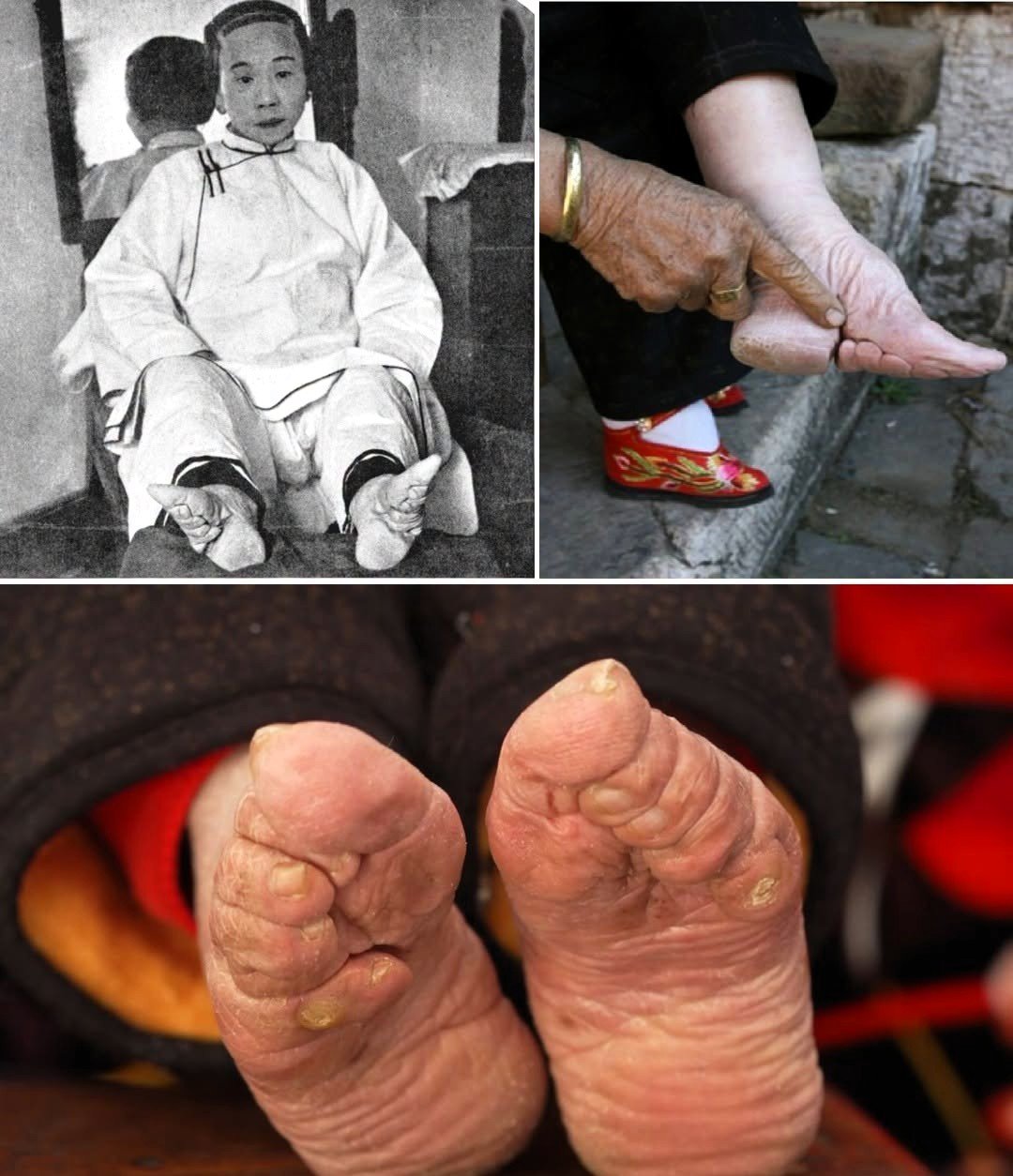
The smaller they were, the more beautiful they could be considered.
A foot only a few inches long was once celebrated as a symbol of elegance, femininity, refinement, and even social status. Such feet became known as “lotus feet.”
But there was nothing natural about their appearance.
They were created through a painful tradition known as foot binding—a practice that transformed the bodies of generations of Chinese women in the name of beauty.
The process often began when a girl was still a child, sometimes around five or six years old.
At an age when children were normally running, playing, and growing, these girls were beginning a process that would permanently change their feet.
Their toes were folded underneath the foot, while the arch was gradually forced downward. Long strips of cloth were wrapped tightly around the feet, restricting their natural growth and holding them in an unnatural position.
The bindings had to be repeatedly tightened.
The goal was not simply to make the foot smaller.
It was to reshape it.
Over time, bones could break and heal in distorted positions. Walking could become painful and difficult. The entire structure of the foot could be permanently altered.
Yet the smaller the foot became, the more desirable it could be considered.
The most prestigious ideal was sometimes called the “golden lotus,” referring to a foot measuring roughly three inches—about 7.6 centimeters.
That is smaller than many modern newborns’ feet.
And yet, for generations, this extraordinary size was treated as an ideal of feminine beauty.
Tiny embroidered shoes were specially crafted for bound feet.
Some surviving shoes are so unbelievably small that they can look almost like children’s footwear—or even dolls’ shoes—until you understand the painful human story behind them.
The tradition appears to have emerged among elite women during the Song period, around the 10th century, and gradually spread more widely among Han Chinese communities.
As it became established, foot binding was connected to much more than appearance.
For some families, it became tied to a daughter’s marriage prospects and social standing. A girl with appropriately bound feet could be viewed as more refined and desirable.
That created a powerful social pressure.
Parents were not simply making a decision about fashion.
They were making a decision they believed could affect their daughter’s future.
And the girls themselves had little choice.
Imagine being five years old and being told that your feet must not grow normally.
Imagine the pain of having your toes forced beneath your foot and your feet wrapped tightly day after day.
Imagine learning to walk while your body was being deliberately reshaped.
Then imagine growing into adulthood carrying the consequences of that decision for the rest of your life.
For many women, the physical effects lasted forever.
Walking could remain difficult. Balance could be affected. The altered structure of the feet could contribute to chronic pain and other health problems.
Yet within the society that created the ideal, these same feet could be praised as beautiful.
That contradiction is what makes the history of foot binding so difficult to forget.
Something that caused enormous suffering could simultaneously be treated as a mark of elegance.
But cultural attitudes eventually began to change.
By the late 19th and early 20th centuries, Chinese reformers increasingly criticized foot binding. They argued that the practice harmed women, restricted their lives, and stood in the way of a changing China.
Opposition grew.
Campaigns against the tradition spread, and after the fall of the Qing dynasty, the new Republic of China officially prohibited foot binding in 1912.
But laws could not instantly erase centuries of tradition.
In some rural communities, girls continued to have their feet bound secretly for years afterward.
The practice slowly disappeared rather than vanishing in a single moment.
Today, the surviving lotus shoes, photographs, and personal accounts offer a glimpse into a world that can feel almost impossible to understand from a modern perspective.
The tiny shoes are particularly haunting.
They are beautifully decorated.
They can be delicate and carefully embroidered.
And they can be small enough to fit into the palm of a hand.
At first, they may look like miniature works of art.
Then comes the realization of what they were designed for.
They were made to fit feet that had been deliberately reshaped through years of painful binding.
That is the part of this history that should never be forgotten.
Foot binding was not simply an unusual fashion trend.
It was an example of what can happen when a society creates such a powerful definition of beauty that people are expected to physically change themselves to meet it.
The standard was reinforced by family expectations, marriage, social acceptance, and cultural tradition.
For many women, refusing the practice could mean standing outside the beauty standard that surrounded them.
And that is what makes this story relevant even today.
Beauty standards may change, but the pressure to conform has not disappeared.
Every generation creates its own ideas about what bodies should look like, how people should dress, how they should age, and what features are considered desirable.
Some standards are harmless.
Others can lead people to feel that their natural bodies are somehow inadequate.
The history of the lotus foot reminds us that beauty is not always as innocent as it appears.
Sometimes, what one generation calls elegance is later recognized as suffering.
Sometimes, society becomes so accustomed to a particular ideal that people stop questioning the cost required to achieve it.
The women who lived through foot binding did not choose the world into which they were born.
They inherited its expectations.
Today, their tiny shoes remain behind as more than historical objects.
They are reminders of the extraordinary power of culture—and of the importance of questioning any beauty standard that demands too much from the human body.
Because perhaps the most important question is not simply:
“What did people once consider beautiful?”
It is:
“What are we willing to sacrifice today to be considered beautiful—and what might future generations think of that?”
What beauty standard from our own era do you think future generations will find hardest to understand?