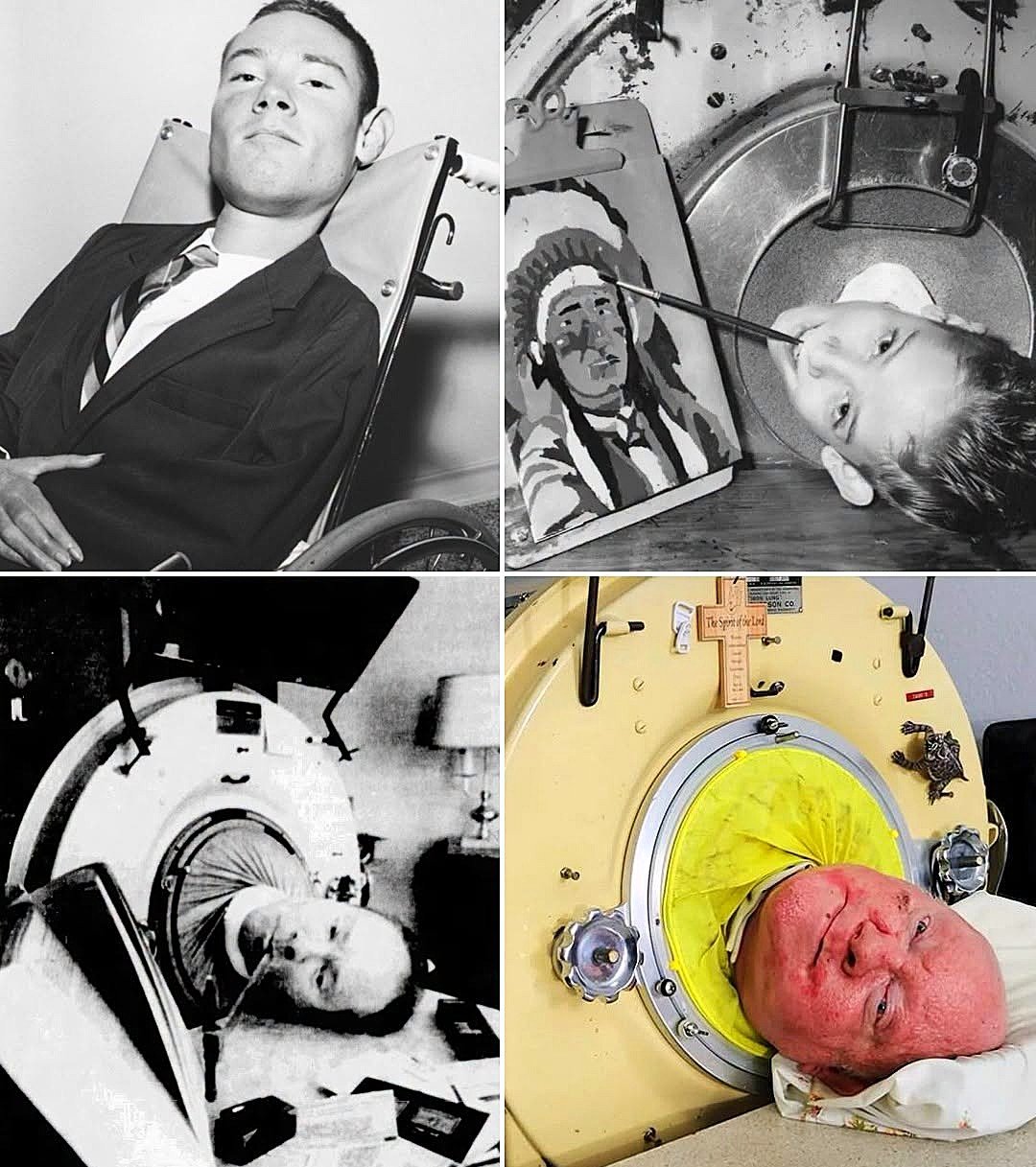
Polio had attacked his body so severely that he could no longer breathe on his own. Doctors placed him inside the enormous metal machine, where changes in air pressure helped his lungs move.
For most children, childhood meant school, friends, games, and dreaming about the future.
For Paul, it suddenly meant learning how to survive.
He contracted polio in Texas in 1952, during one of the worst polio outbreaks in American history. Within days, he became paralyzed and lost the ability to breathe normally.
The iron lung became his lifeline.
But Paul refused to let it become the boundary of his life.
At first, he could barely imagine spending even a few moments outside the machine. Then a therapist gave him a challenge that would change everything.
If he could learn to breathe outside the iron lung for three minutes, she promised him a puppy.
For a 6-year-old boy trapped inside a steel cylinder, that puppy became more than a reward.
It became a reason to fight.
Paul spent nearly a year learning a technique he later called “frog breathing.” Instead of relying on his diaphragm normally, he learned to use muscles in his mouth and throat to push air into his lungs.
Three minutes.
That was the goal.
Eventually, he achieved it.
And he got his puppy.
But those three minutes became something much bigger.
They became hours.
Paul slowly learned that he could spend increasing amounts of time outside the iron lung. The machine would remain essential to his survival, but it no longer controlled every moment of his life.
He went to school.
He graduated from high school.
He attended the University of Texas at Austin and earned his bachelor’s degree in 1978.
Then he set himself an even bigger challenge.
Law school.
In 1984, Paul earned his law degree from the University of Texas School of Law. Two years later, he was admitted to the Texas Bar.
The little boy doctors had once fought simply to keep alive had become a lawyer.
And he did it while living with paralysis from the neck down.
Paul learned to write by holding a pen in his mouth. He eventually practiced law for nearly three decades, proving again and again that a body severely limited by disease did not have to mean a life without purpose.
He also became an author.
Using the same determination that had carried him through childhood, Paul worked on his autobiography and eventually published Three Minutes for a Dog in 2020.
Technology transformed almost every part of the world around him during his lifetime.
But Paul continued relying on an iron lung—a machine that had become almost obsolete in modern medicine.
He maintained it, repaired it, and searched for replacement parts long after hospitals had largely stopped using the technology.
Then he began sharing his story online.
A new generation learned about the realities of polio not from a textbook, but from a man who had actually lived through them.
Paul’s story was never simply about an iron lung.
It was about what can happen when circumstances take away almost everything except the ability to keep trying.
Polio took his ability to walk.
It took his ability to move most of his body.
It took away the simple act of breathing without assistance.
But it could not take away his determination to learn.
It could not take away his education.
It could not take away his ambition.
And it could not write the ending of his story for him.
Paul Alexander died on March 11, 2024, at the age of 78.
He had spent more than seven decades living with the consequences of a disease that nearly killed him as a child.
But his life became far larger than the illness that changed it.
He became a college graduate.
A lawyer.
An author.
And an inspiration to millions of people who learned his story.
Imagine that little 6-year-old boy in 1952, lying inside a massive iron machine while doctors struggled to keep him alive.
Nobody could have known exactly what the future held for him.
Nobody could have looked at that child and seen the attorney he would become.
But Paul did not need to know the entire future.
He only needed to fight for the next breath.
Then the next.
Then the next.
And eventually, those breaths carried him through more than seven extraordinary decades.
Sometimes a life is not measured by how much the world gives you.
Sometimes it is measured by what you build with whatever remains.
Paul Alexander was given an iron lung.
He built a life beyond it.