Imagine standing on a battlefield in the 16th century, surrounded by the sounds of clashing weapons, frightened soldiers, and the chaos of war. In an age when medical knowledge was limited and even relatively small wounds could become fatal, survival often depended on luck as much as skill.
Now imagine suffering an injury so devastating that it seems impossible to survive.
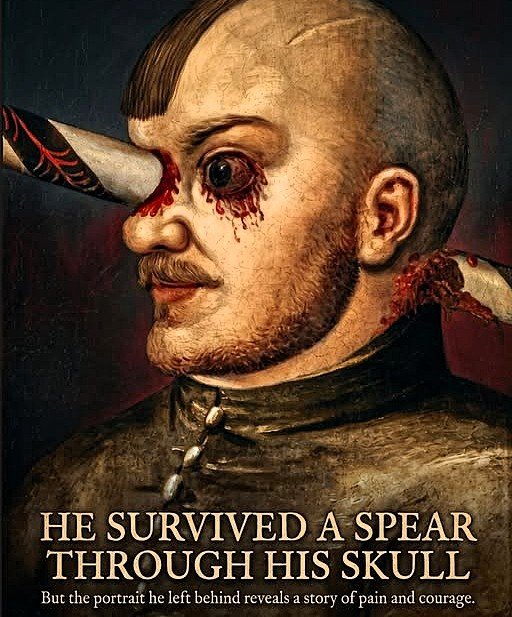
This is the extraordinary story associated with Gregor Baci, a Hungarian man whose haunting portrait has preserved the memory of one of history’s most disturbing injuries. A long spear reportedly pierced his eye and passed through his skull, leaving the weapon protruding from both sides of his head. Against all expectations, Baci survived the initial trauma, creating a story that has continued to fascinate people centuries later.
His image is difficult to forget. Yet behind the shocking appearance lies a deeper story about the brutality of historical warfare, the limitations of early medicine, and the uncertain boundary between life and death.
a battlefield injury that seemed impossible to survive
Gregor Baci is traditionally associated with 16th-century Hungary, during a period when conflicts between Christian European forces and the expanding Ottoman Empire shaped much of the region’s history.
Warfare during this era was often fought at close quarters. Soldiers faced swords, lances, spears, arrows, and other weapons capable of inflicting catastrophic injuries. Protective armor could offer some defense, but it could not guarantee safety, particularly during the confusion of battle.
According to the account associated with Baci’s portrait, he suffered a terrible wound when a spear entered through one eye and emerged from the opposite side of his skull.
The injury would have been devastating. The head contains the brain, major blood vessels, nerves, and delicate structures essential for vision, movement, and consciousness. A penetrating injury in this region can cause severe bleeding, brain damage, infection, and death.
Even with modern emergency medicine, such an injury would require immediate specialist assessment and careful treatment.
In the 16th century, however, physicians lacked the diagnostic equipment, surgical techniques, antibiotics, and intensive care available today. They could not examine internal injuries with CT scans or MRI machines, and they had far fewer ways to control complications.
For someone to remain alive after such trauma would have appeared extraordinary to those who witnessed it.
Yet survival after a penetrating head injury, while highly unusual, is not anatomically impossible. The outcome depends on the precise path of the object, the structures damaged, the amount of bleeding, and whether critical areas of the brain are spared.
Without detailed medical records, the exact nature of Baci’s injury cannot be established from the portrait alone.
Nevertheless, the image has become a remarkable visual record of a story that continues to capture the imagination.
why the weapon was reportedly left in place
One of the most striking details in the traditional account concerns the decision made by the physicians who treated Baci.
Removing an object that has penetrated the head can be extremely dangerous. The object may be damaging tissue, but it can also be compressing injured blood vessels and limiting bleeding. Pulling it out without understanding the wound could worsen the damage or trigger catastrophic hemorrhage.
Today, doctors manage such injuries through carefully planned emergency treatment, imaging, surgery when appropriate, and close monitoring. The safest approach depends on the individual injury.
For physicians working centuries ago, the situation would have been considerably more difficult.
According to the story, Baci’s doctors feared that pulling out the spear might cause fatal bleeding or additional damage. They therefore cut away the portions of the weapon that protruded from his head, leaving the remaining shaft in place.
It is a detail that makes the account particularly unsettling.
The decision reflects a dilemma that has existed throughout medical history: sometimes, an attempt to remove the cause of an injury can create an even greater danger.
However, the historical details surrounding Baci’s treatment should be approached cautiously. The surviving portrait is not a medical record, and the full circumstances of his treatment cannot be confirmed simply by looking at it.
What the account does illustrate is the extraordinary challenge of treating serious injuries before modern surgical care existed.
For physicians of the period, every decision could carry enormous consequences. They had to work with limited knowledge, rudimentary instruments, and little ability to see what was happening inside a patient’s body.
In such circumstances, keeping a patient alive could be a desperate struggle against uncertainty.
a year of suffering and an uncertain ending
The traditional story becomes even more difficult when it describes what happened after Baci survived the initial injury.
According to the account, he endured severe pain for approximately a year before eventually being found dead in his bed.
If accurate, his survival would have involved far more than simply escaping death on the battlefield. It would have meant living with the consequences of an injury that had once appeared unsurvivable.
A penetrating injury to the head can lead to numerous complications, including chronic pain, neurological problems, infection, and damage to the eye or surrounding tissues. In the absence of modern diagnostic tools and effective antimicrobial treatment, complications could be especially dangerous.
But the precise cause of Baci’s reported death is not established by the story.
It would be tempting to assume that the wound eventually killed him, but that conclusion cannot be drawn with certainty without reliable medical documentation.
The uncertainty is an important part of the historical record. Centuries separate modern audiences from the events associated with Baci, and the details that survive may have passed through different accounts and interpretations.
We may never know exactly what he experienced during his final months, how much of his vision remained, or whether he suffered other complications.
Still, the story invites us to think about the person behind the portrait.
He was not merely an extraordinary injury captured in paint. He was a human being who, according to the account, lived through a traumatic event and continued living afterward, despite the uncertainty surrounding his recovery.
That distinction matters.
the portrait that kept his story alive
Perhaps the most enduring part of Gregor Baci’s story is the portrait associated with his injury.
Historical portraits can preserve details that written accounts sometimes leave behind. Clothing, armor, hairstyles, facial expressions, and physical injuries can provide glimpses into how people understood themselves and how their experiences were remembered.
Baci’s image is especially striking because the injury occupies such a central place in the viewer’s attention.
The spear crossing his head transforms the portrait into something more than a conventional likeness. It becomes a visual statement about violence, survival, and the human body’s vulnerability.
For modern viewers, the image can provoke immediate disbelief. How could anyone survive an injury that appears so catastrophic?
That reaction is understandable, but the portrait also deserves to be considered in its historical context.
Images of unusual injuries, extraordinary medical cases, and dramatic events could attract attention in earlier centuries, just as remarkable medical stories continue to circulate today. Such images could preserve memories of unusual experiences, although they do not always provide enough evidence to verify every detail of the accompanying narrative.
The portrait therefore occupies an intriguing space between historical testimony and the limits of what can be known.
It preserves the image associated with Baci’s extraordinary experience, while leaving many questions about the man and his life unanswered.
And perhaps that is why it remains so memorable.
Long after the battles of his era ended, his image continues to invite people to pause, look closer, and wonder about the life behind it.
what gregor baci’s story teaches us about survival
Stories like Baci’s can easily become sensationalized because the injury itself is so shocking. But the deeper significance lies in what the account reveals about the relationship between human survival and medical knowledge.
For much of history, people suffering serious injuries had few effective treatment options. Physicians relied on observation, experience, and the medical theories of their time. Some treatments helped, while others could cause additional harm.
Modern medicine has transformed the treatment of traumatic injuries through advances in emergency response, imaging, neurosurgery, infection control, and critical care.
Even so, penetrating brain injuries remain serious and unpredictable. Surviving one does not necessarily mean escaping permanent consequences, and no two injuries follow precisely the same course.
Baci’s story reminds us that survival is rarely a simple matter of toughness alone. Anatomy, the exact location of an injury, access to treatment, and many other factors can influence the outcome.
It also reminds us to approach historical stories with both curiosity and caution.
A remarkable image can preserve an extraordinary memory, but it cannot answer every question about what happened. Distinguishing between documented facts and traditional accounts allows us to appreciate history without treating every detail as certain.
Most importantly, the story encourages us to see beyond the spectacle.
Behind the spear and the haunting portrait was a person whose experience, whatever its precise details, became part of a much larger human story about violence, suffering, and the struggle to survive.
a haunting reminder from centuries ago
Today, Gregor Baci’s name remains associated with one of the most unsettling portraits to emerge from the history of early modern Europe.
The image confronts us with an injury that seems almost impossible to comprehend. The traditional account describes a man who survived a spear passing through his skull, endured a long period of suffering, and eventually died under circumstances that remain uncertain.
We cannot reconstruct every moment of his experience. We cannot know precisely what he felt, what his doctors understood, or what ultimately caused his death.
But we can recognize the extraordinary nature of the story and the historical world in which it is remembered.
Baci’s portrait is a reminder that history is not made up solely of kings, victories, and political decisions. It also contains the experiences of ordinary individuals whose lives became extraordinary through circumstances they never chose.
His story has endured because it forces us to confront uncomfortable questions about the fragility of the human body and the limits of medical knowledge.
How much can a person survive? How did earlier generations respond when confronted with injuries they barely understood? And how much of a human life can a single image truly reveal?
Centuries later, these questions remain.
What goes through your mind when you see Gregor Baci’s remarkable portrait? Is it the astonishing possibility of survival, the suffering he may have endured, or the limitations faced by physicians in his time?
Share your thoughts and pass this story along to someone who loves forgotten history.
Sometimes, a single image can open a window into a world that has long since disappeared—and remind us how much there still is to learn about the people who lived before us.