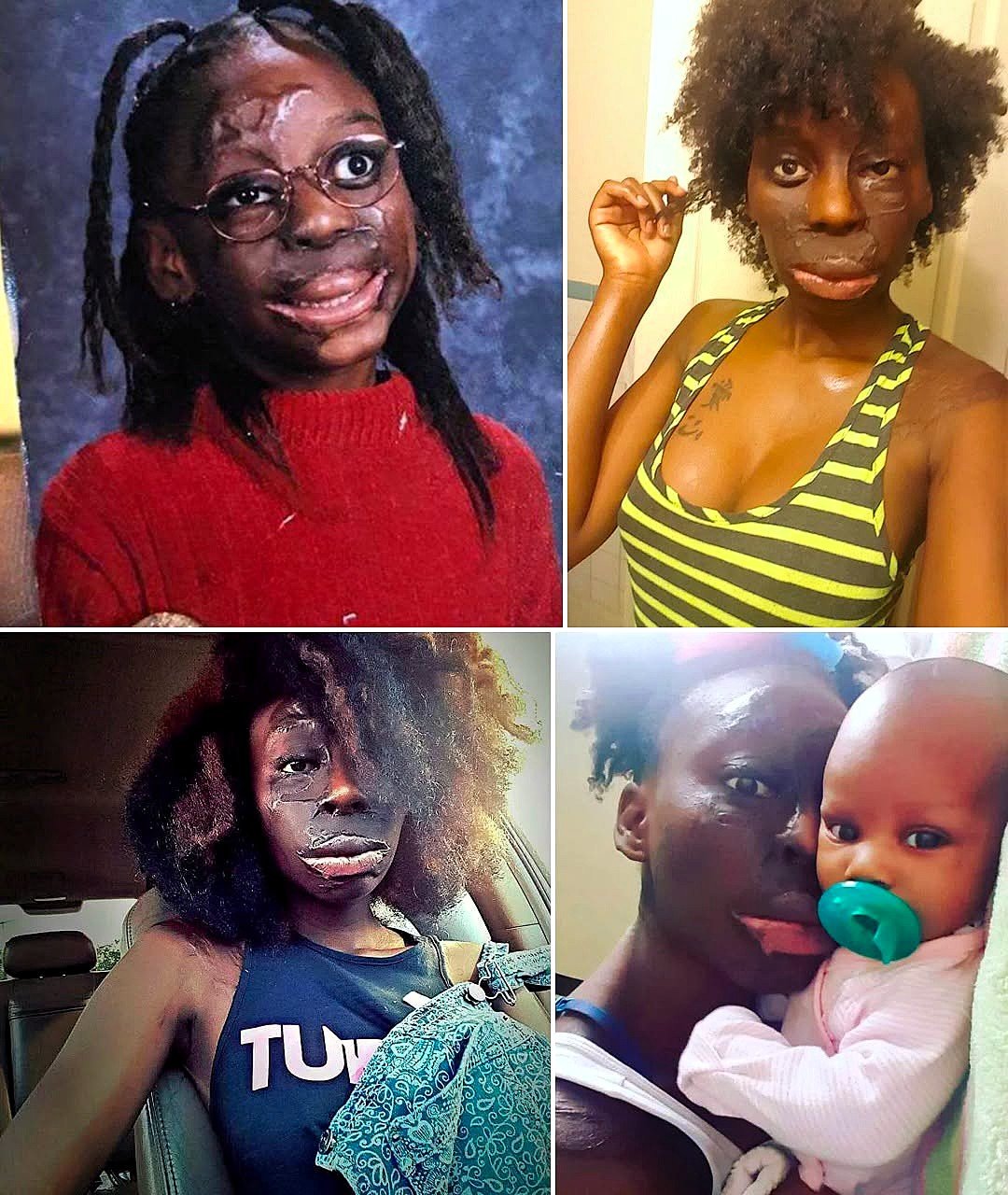
She had suffered severe burns to her face after hot butter fell onto her during a childhood accident.
She was so badly injured that she spent two weeks in a coma.
Her family did not know what the future would look like.
They only knew they might lose the little girl they loved.
But Alyssa survived. ❤️
And surviving was only the beginning.
Because the scars left behind would become something she would carry with her for the rest of her life.
Alyssa lost the vision in one eye and spent much of her childhood going back and forth to hospitals. Her early years were filled with treatments, procedures, skin grafts and reconstructive surgeries.
By the time she reached her teenage years, she had reportedly undergone more than 100 medical procedures.
But some of the hardest moments happened far away from hospital rooms.
They happened at school.
Other children noticed her scars immediately.
Some stared.
Some whispered.
Some were frightened by her appearance.
And some were cruel enough to call her a “monster.” 💔
Imagine being a child and already feeling different from everyone around you.
Imagine walking into a classroom knowing that before anyone learns your name, they may notice your scars.
For years, Alyssa tried to navigate that reality.
She wanted to fit in.
She wanted people to see her as a normal girl instead of seeing only what had happened to her face.
But eventually, something changed.
Around the age of 13, Alyssa began to understand that she could spend the rest of her life trying to disappear—or she could decide that she didn’t need to disappear at all.
Her scars weren’t going away.
So why should she spend her entire life wishing they weren’t there?
That realization became a turning point.
As she grew older, Alyssa became increasingly comfortable with the idea that she did not need endless reconstructive operations simply to satisfy society’s expectations of what a person should look like.
Her scars were part of her story.
They were evidence of something she had survived.
And instead of seeing them only as imperfections, she began seeing them as part of the person she had become.
❤️
Alyssa eventually began sharing her experience publicly, using her story to encourage people who felt different because of their appearance.
Her message became beautifully simple:
“I Wear My Flaws Like Diamonds.”
She also described herself as a “walking Picasso”—a one-of-a-kind work of art that could never be duplicated.
That idea represented something much bigger than confidence.
It was freedom.
Freedom from the belief that beauty has only one acceptable shape.
Freedom from the idea that scars must always be hidden.
Freedom from the expectation that people with visible differences should make themselves smaller so everyone else can feel comfortable.
The little girl who once had children running away from her eventually became a woman willing to face the world exactly as she was.
She didn’t erase her past.
She didn’t pretend the bullying hadn’t hurt.
She didn’t claim the journey had been easy.
Instead, she learned to carry all of it with her.
The accident.
The surgeries.
The hospital rooms.
The pain.
The stares.
The cruel words.
And the strength she discovered along the way.
Alyssa’s story is not simply about surviving a terrible childhood accident.
It is about what happens afterward.
Because sometimes surviving the physical injury is only the first battle.
The next battle is learning to live in a world that constantly tells you that looking different means you are somehow worth less.
Alyssa chose not to accept that message.
She chose to be visible.
She chose to speak.
She chose to stop apologizing for a face that told the story of everything she had survived.
And perhaps that is the most powerful part of her journey.
The scars did not disappear.
But their meaning changed.
What once made her feel like an outsider became something she could carry with pride.
What others called a flaw became something she compared to a diamond.
And the child who once wondered whether she could ever belong grew into someone who understood that belonging does not always mean looking like everyone else.
Sometimes it means finally becoming comfortable being yourself.
Her story leaves us with a question worth sitting with:
If there were something about you that could never be hidden, would you spend your life wishing it away—or would you eventually learn to see it as part of what makes you uniquely you? ❤️