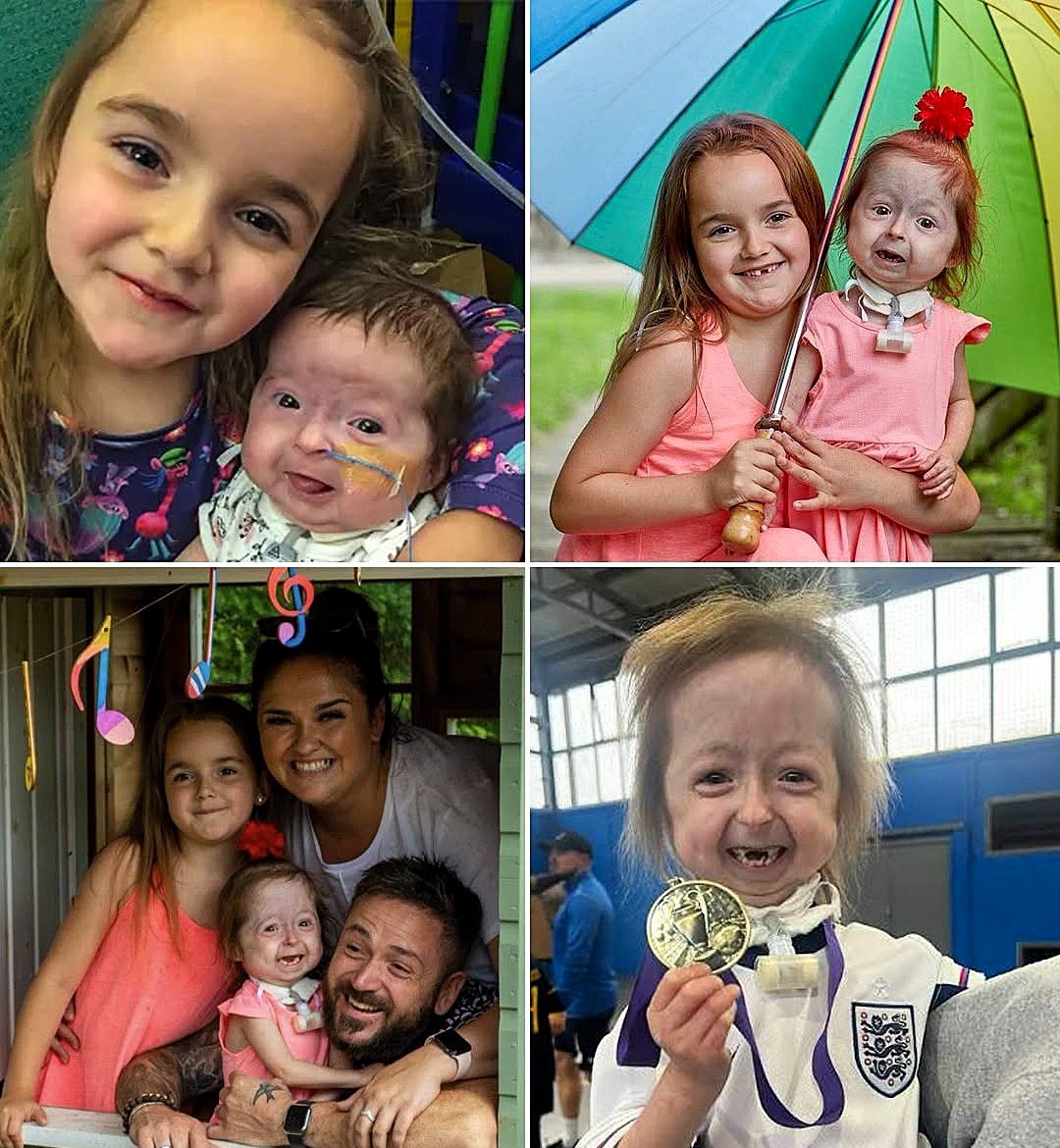
When Isla Kilpatrick-Screaton came into the world, her parents had no idea that they were about to begin a journey into a medical condition so rare that even her doctors had never encountered her exact genetic change before.
Isla was born prematurely in England in February 2017.
From the very beginning, she needed intensive medical care. Her oxygen levels were dangerously difficult to maintain, and during her first days of life, doctors placed her in an induced coma.
For her parents, those first moments of motherhood and fatherhood were filled with uncertainty rather than the peaceful beginning they had imagined.
And going home did not mean the frightening part was over.
Isla experienced episodes in which her airway became blocked. At times, she would turn blue and require urgent medical attention. Her parents watched helplessly as doctors tried to understand why their baby was struggling so badly to breathe.
There were tests.
More tests.
Specialist appointments.
Questions that didn’t have immediate answers.
Eventually, doctors discovered that Isla had mandibuloacral dysplasia, an exceptionally rare genetic disorder associated with changes involving bone development, skin and the distribution of body fat.
But even that diagnosis did not provide the certainty her parents desperately wanted.
Because Isla’s genetic findings were unusual.
Doctors identified a particular genetic variant that had not previously been seen in the same way. She also did not fit neatly into either of the two recognized forms of mandibuloacral dysplasia.
In other words, there wasn’t another child whose medical journey could simply be placed beside Isla’s and used as a guide.
There was no clear timeline.
No reliable list of what would happen next.
No easy answer when her parents asked the question every parent asks when their child is seriously ill:
What does the future look like?
The honest answer was that nobody really knew.
Mandibuloacral dysplasia can produce physical characteristics sometimes associated with premature aging. Because of this, Isla’s condition has occasionally been described in the media as “Benjamin Button disease,” referring to the unusual appearance of some features.
But Isla isn’t a fictional character aging backward.
She’s a real little girl living with a rare genetic disorder—and behind the diagnosis is a child with a personality, dreams, frustrations, friendships and an enormous determination to experience life on her own terms.
Her condition has affected many parts of her childhood.
Breathing has been a continuing challenge. Her growth and development have required close monitoring. She has needed feeding support, specialist medical care and assistance with communication.
There have been countless appointments and interactions with different medical teams.
But Isla’s story has never been only about hospitals.
At home, her parents have watched her personality emerge.
She has been described as clever, expressive and determined. When speaking has been difficult, she found another way to make herself understood. She learned to communicate using signs.
She reached developmental milestones on her own timeline.
She learned to crawl later than many other children.
And eventually, something happened that her family had once worried might be particularly difficult.
Isla started school.
🎒
Imagine what that moment must have meant to parents who had spent years hearing words like “rare,” “unknown,” “specialist,” and “uncertain.”
Their daughter wasn’t simply entering a classroom.
She was stepping into a part of childhood that, at one point, they couldn’t be sure she would experience in the way other children did.
She began meeting classmates.
Making friends.
Learning.
Growing more confident.
And showing the people around her that a diagnosis does not necessarily tell the whole story of a child.
By 2025, Isla was eight years old and attending school. Her life still involved medical challenges, but it also contained ordinary childhood moments—the kinds of moments that can easily be overlooked when a child has spent so much of her life surrounded by doctors.
For her family, those ordinary moments became extraordinary.
Because when doctors cannot tell you exactly what tomorrow will bring, every milestone can carry a different kind of meaning.
Today, Isla is nine.
Her exact genetic variant remains extraordinarily unusual, meaning there still isn’t another child whose medical journey provides a perfect blueprint for hers.
Her parents cannot simply open a book and find a predictable timeline.
They cannot know exactly which challenge will come next.
They cannot erase the uncertainty.
What they can do is meet each day as it arrives.
And perhaps that has become one of the greatest lessons of Isla’s story.
Sometimes parents want certainty more than anything.
They want to know their child will be healthy.
They want to know what will happen next year, next month, even tomorrow.
But when the medical world doesn’t have those answers, families like Isla’s are forced to discover another kind of courage.
The courage to keep going without knowing the entire road.
To celebrate progress without knowing what the next obstacle will be.
To make plans while understanding that plans may have to change.
And most importantly, to make sure that a child is allowed to be a child—even when her medical history is complicated.
Isla is not just her genetic variant.
She is not just a diagnosis.
She is not just the little girl doctors once struggled to understand.
She is a daughter.
A student.
A friend.
A child who has learned ways to communicate, ways to adapt and ways to keep moving forward.
Her story doesn’t promise that every challenge will disappear.
It offers something quieter and perhaps more meaningful.
It shows what can happen when a family refuses to let uncertainty define the entirety of a child’s life.
There may still be questions about Isla’s future.
There may still be medical problems waiting around the corner.
And there may never be a perfect roadmap for someone with her exact genetic change.
But Isla has already taught the people around her something important:
You don’t always need to know where the entire road leads before taking the next step.
Sometimes, you just take today’s step.
Then tomorrow’s.
And eventually, you look back and realize how far you’ve come.