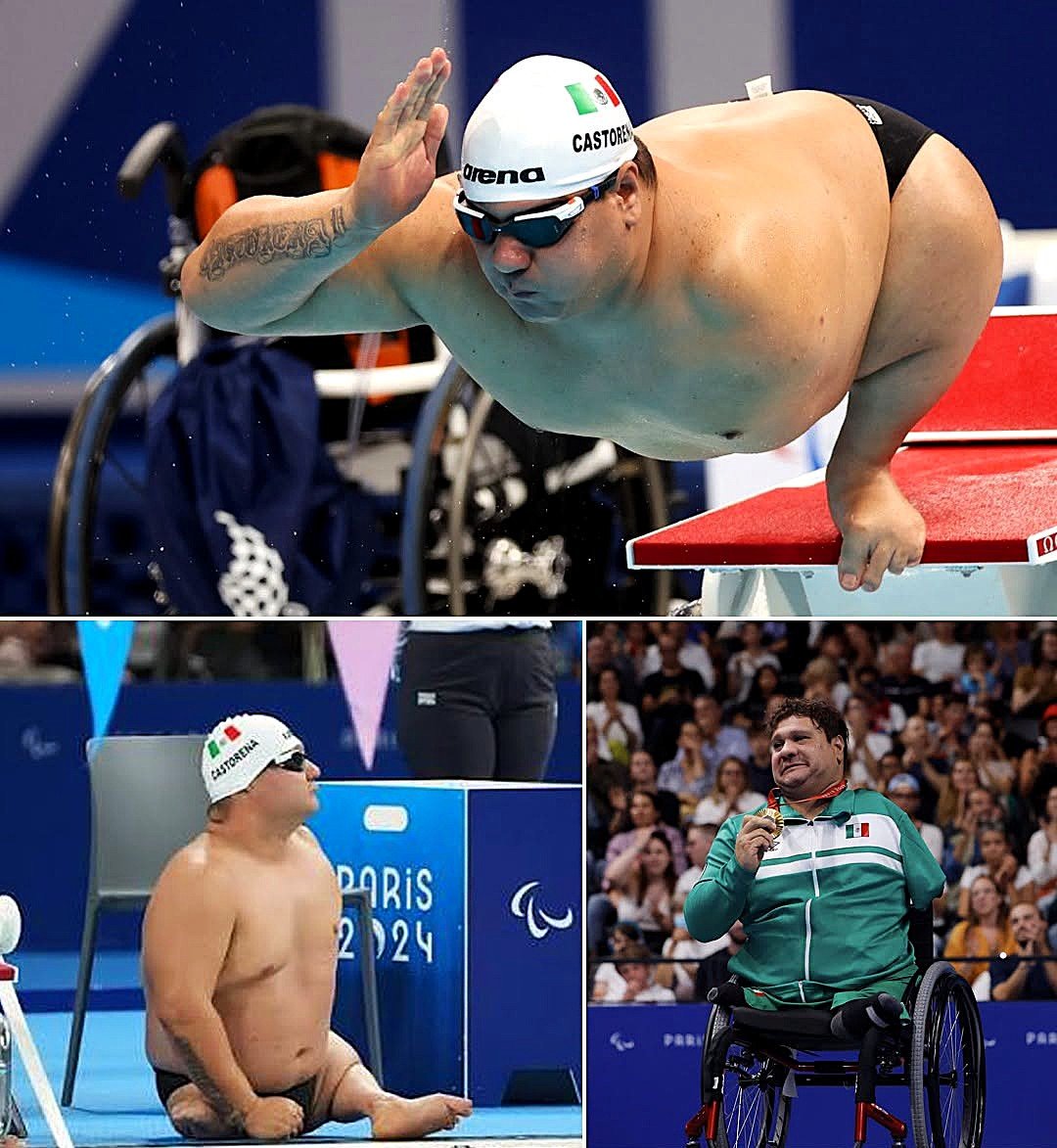
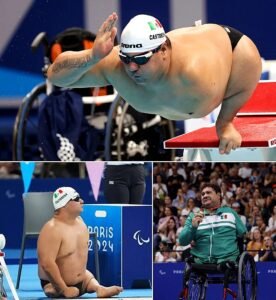
He was born in Guadalajara, Mexico, in 1978 with a congenital condition that affected the development of his legs and left arm. His mother died during childbirth, and his father left soon afterward. With no parents to raise him, Arnulfo was brought up by his grandmother.
From the beginning, his childhood was shaped by circumstances he never chose.
When he was just 6 years old, Arnulfo was sent to a boarding school in Mexico City. Finding a school willing to accept a child with a disability was difficult, and the boarding school became an important part of his early life.
Then, unexpectedly, a door opened.
A nun known as “Sor Chiva” introduced him to swimming.
For Arnulfo, the water was different from the world around him.
On land, his disability affected almost every movement. Getting from one place to another could be difficult, and independence was something he had to fight for. But inside the swimming pool, those limitations seemed to fade.
He could move.
He could compete.
He could feel free.
And he discovered that he was exceptionally good at it.
Swimming began as an activity, but gradually it became something much bigger.
After his grandmother died, Arnulfo returned to Guadalajara. Without her support, his life became considerably harder. He had very little money and few opportunities. As a teenager, he sold chewing gum and cleaned windshields at traffic lights to earn enough money to survive.
There were even times when he moved through the streets sitting on a small skateboard because he did not have a wheelchair.
Yet somehow, through all of it, he continued swimming.
He kept returning to the pool.
He kept training.
He kept believing that there might be another life waiting for him beyond the difficult circumstances surrounding him.
Eventually, his talent could no longer be overlooked.
Arnulfo began training seriously, and the boy who once struggled simply to get through the streets of Guadalajara was soon competing on one of the biggest stages in international sport.
At the 2000 Paralympic Games in Sydney, Australia, he won his first Paralympic gold medal in the 50-meter breaststroke in the SB2 classification.
The teenager who had once sold gum at traffic lights was now a Paralympic champion.
Four years later, in Athens, he did it again.
Another gold medal.
Another reminder that his past did not have to determine his future.
But Arnulfo’s story did not end there.
Years passed. Generations of athletes came and went. Yet he continued competing at the highest level.
At the Tokyo 2020 Paralympic Games, held in 2021 because of the COVID-19 pandemic, Arnulfo returned to the top of the podium in the same 50-meter breaststroke event.
Two decades after his first Paralympic title, he was still a champion.
And then came Paris.
In 2024, at 46 years old, Arnulfo once again won Paralympic gold in the 50-meter breaststroke.
Four Paralympic gold medals.
Seven Paralympic medals in total.
For an athlete whose childhood had been marked by loss, poverty and barriers, the achievement was extraordinary.
But perhaps the most remarkable part was that he still wasn’t finished.
In 2025, at the age of 47, Arnulfo won another world title in the 50-meter breaststroke, extending a career that had already lasted for more than two decades at the international level.
His journey is about much more than medals.
It is about a child who lost his mother at birth.
A boy raised by his grandmother.
A young person who struggled to find an accessible education.
A teenager who sold gum and cleaned windshields simply to survive.
And an athlete who found something in a swimming pool that the outside world had rarely given him: a place where his ability could come before his limitations.
Someone had to notice him.
Someone had to give him an opportunity.
For Arnulfo, that opportunity came from a nun who put him in the water and introduced him to swimming.
Nobody could have known where that first lesson would lead.
A swimming pool became a place of freedom.
That freedom became a passion.
The passion became a career.
And the career eventually produced four Paralympic gold medals and a legacy spanning more than two decades.
Arnulfo Castorena’s life is a powerful reminder that talent can exist in places where circumstances make it difficult to see.
Sometimes a child doesn’t need someone to tell them what they cannot do.
Sometimes they simply need someone willing to discover what they can.
And sometimes, one opportunity can change an entire life.
From cleaning windshields at traffic lights to standing atop the Paralympic podium, Arnulfo’s journey shows just how far determination can carry a person when someone finally gives their ability a chance to shine.
His story began with hardship.
It became a story of freedom.
And eventually, it became a story written in gold.