For years, the ability to stand and walk independently has seemed almost impossible for many people living with paraplegia or severe mobility limitations. But advances in robotics are beginning to change that reality.
A remarkable robotic exoskeleton developed by French technology company Wandercraft is giving some people a new way to stand upright and walk without relying on traditional walking aids such as crutches or canes.
Unlike conventional exoskeletons that often require users to maintain balance with external support, Wandercraft’s technology is designed with a self-balancing system that allows the robotic device to maintain stability while its user walks. The system responds to subtle movements of the wearer’s body, particularly movements of the torso, helping coordinate a walking pattern that is intended to feel more natural.
One of the most inspiring examples of this technology is French Paralympic tennis player Kevin Piette.
Piette lost the use of his legs following a motorcycle accident. For years, his mobility was fundamentally changed by the injury. Yet his determination to remain active never disappeared.
Then robotics offered him an extraordinary opportunity.
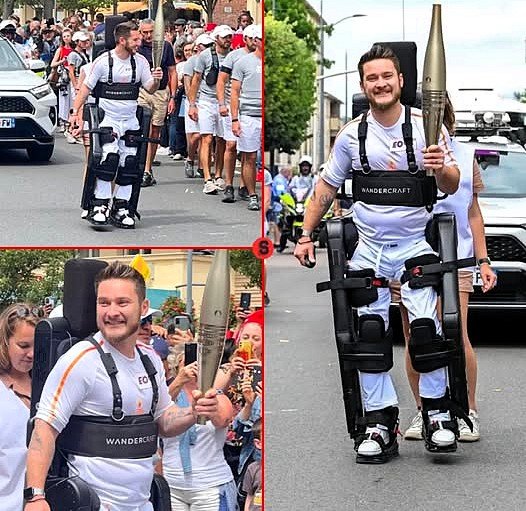
Wearing the robotic exoskeleton, Piette was able to stand upright and walk using his own body movements to guide the machine. His hands remained free because he did not need to depend on crutches, canes, or another person for support.
That capability became particularly meaningful during the Paris 2024 Olympic Games.
Piette had the opportunity to participate in the Olympic torch relay while walking in the exoskeleton. The sight of a Paralympic athlete carrying the Olympic flame while taking steps on his own feet became a powerful symbol of how technology can help challenge traditional ideas about disability and mobility.
How Does the Robotic Exoskeleton Work?
At first glance, a robotic exoskeleton may look like a sophisticated set of mechanical legs. But the technology behind it is considerably more complex.
Wandercraft’s system is designed to help users maintain their balance while taking steps. Instead of simply moving the wearer’s legs mechanically, the robotic system interprets the user’s movements and works with them.
Small movements of the torso can provide important information about the user’s intention and position. The system then uses this information to coordinate the movement of the robotic legs.
This creates a different experience from simply being moved by a machine.
The goal is to make the user an active participant in the walking process.
The exoskeleton continuously adjusts its movements to maintain balance, allowing the wearer to remain upright while the robotic legs perform the complicated movements required for walking.
This self-balancing capability is particularly important because human walking is much more than moving one leg after another. Every step requires constant adjustments involving balance, weight distribution, posture, and coordination.
A robotic system capable of handling those adjustments can potentially reduce the amount of physical support a user needs.
Walking Without Crutches or Canes
One of the most striking aspects of Wandercraft’s technology is that users can walk without holding onto traditional walking aids.
For many powered exoskeleton systems, external support is necessary because maintaining balance can be challenging. Crutches or canes may provide stability, but they also occupy the user’s hands.
Wandercraft’s self-balancing approach is designed to overcome this limitation.
With the robotic system supporting balance, the user can keep both hands free while standing and walking.
That seemingly simple difference can have a major psychological and practical impact.
Being able to stand upright with both hands available can make a person feel less dependent on their surroundings. It can also allow them to interact with other people at eye level, carry objects, gesture naturally, or simply experience the sensation of walking without having to concentrate on supporting themselves with a mobility aid.
Kevin Piette’s Historic Moment
Kevin Piette’s story demonstrates the emotional power of this technology.
As a Paralympic tennis player, Piette was already familiar with pushing physical boundaries. After losing mobility in his legs following a motorcycle accident, however, walking independently became something he could no longer take for granted.
The robotic exoskeleton provided an opportunity to experience upright walking again.
His participation in the Paris 2024 Olympic torch relay transformed that personal achievement into a moment watched and celebrated by people around the world.
Carrying the Olympic flame is already considered one of the great honors associated with the Games. But Piette’s participation carried an additional message.
He was not simply being transported along the route.
He was walking.
The image of an athlete with paralysis standing upright and carrying the Olympic torch demonstrated what can happen when human determination meets advanced engineering.
It also offered a powerful reminder that accessibility technology is not simply about machines. It is about restoring opportunities and experiences that many people might otherwise lose.
A New Direction for Mobility Technology
Robotic exoskeletons are part of a rapidly developing field of assistive technology.
Researchers and engineers around the world are working on systems designed to help people with spinal cord injuries, neurological conditions, muscle weakness, and other mobility challenges.
The long-term possibilities are significant.
Future generations of robotic exoskeletons may become lighter, more responsive, more comfortable, and easier to operate. Improvements in artificial intelligence, sensors, motors, batteries, and control systems could also make these devices increasingly sophisticated.
Instead of requiring users to consciously control every movement, future systems could potentially understand movement intentions more naturally and respond almost instantaneously.
However, these technologies are still developing, and they are not a universal replacement for wheelchairs or other mobility devices. Their suitability depends on the individual, their physical condition, rehabilitation goals, and the specific design of the exoskeleton.
For some users, the ability to stand and walk with robotic assistance may provide benefits that go beyond movement itself.
More Than Just Taking Steps
Walking is often viewed as an ordinary part of everyday life. But for someone who has lost the ability to walk, taking even a few independent steps can represent something much bigger.
It can mean seeing the world from a standing position again.
It can mean looking directly into another person’s eyes.
It can mean feeling the ground beneath your feet.
And sometimes, it can mean participating in a historic event that would once have seemed impossible.
Kevin Piette’s Olympic torch relay moment captured that idea beautifully.
His journey shows that technological progress does not necessarily replace human strength or determination. Instead, the right technology can amplify what a person is capable of achieving.
The robotic exoskeleton may be made of motors, sensors, software, and mechanical components, but the person inside it remains at the center of the experience.
Piette’s story is therefore about much more than a machine that can walk.
It is about possibility.
It is about independence.
And it is about the idea that losing the ability to walk does not necessarily mean losing the opportunity to experience movement again.
As robotics continues to advance, stories like Kevin Piette’s may become increasingly common. What once looked like science fiction is gradually becoming a real-world assistive technology.
And perhaps the most powerful part of the story is not that a robot walked for him.
It is that the technology helped him stand, move forward, and carry one of the world’s most recognizable symbols of hope — the Olympic flame.