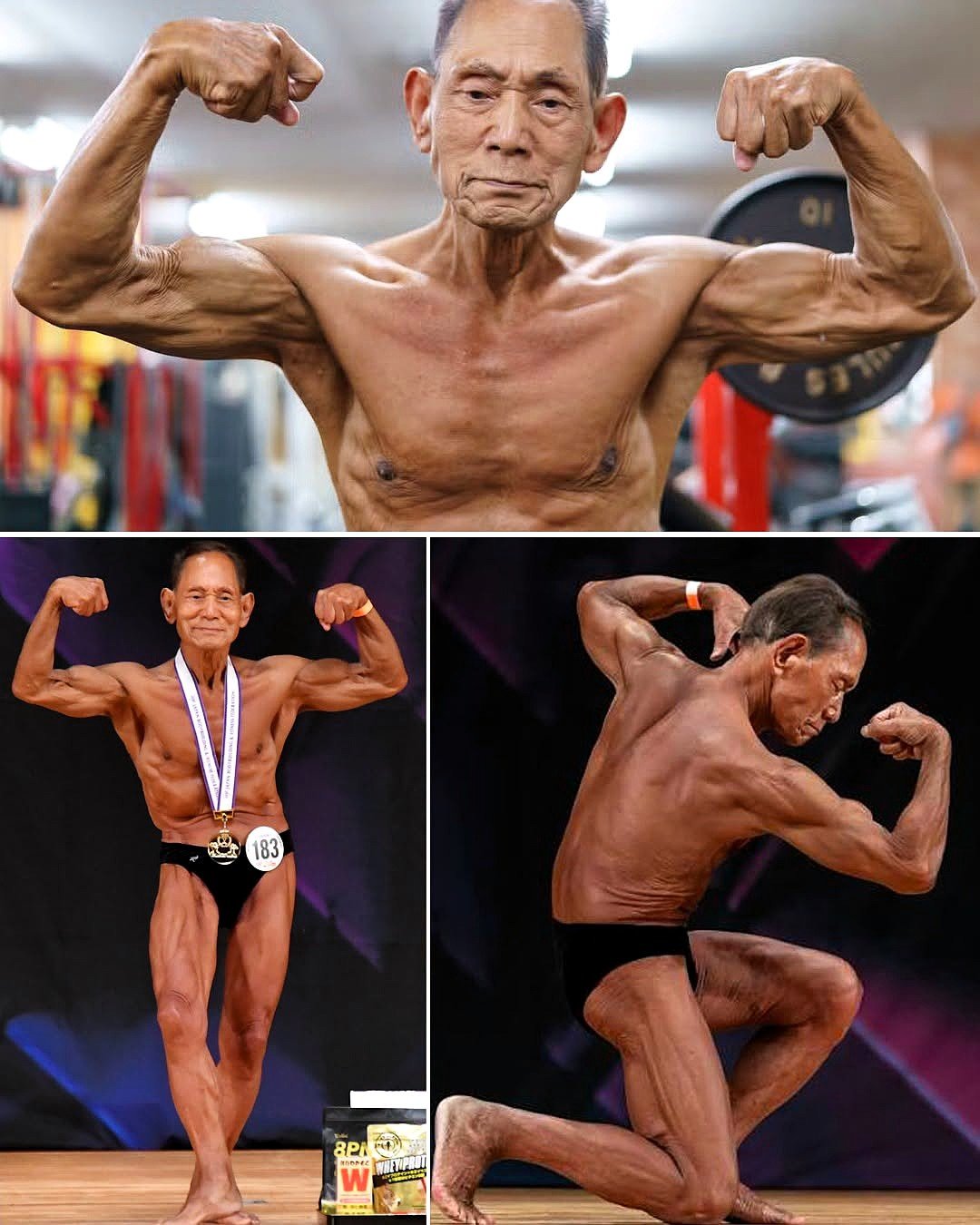
Imagine celebrating your 90th birthday on a Saturday and stepping onto a bodybuilding stage the very next day to win another national championship. For most people, that might sound almost impossible. But for Toshisuke Kanazawa, age has never been a reason to give up on the sport he loves. 🏆
On August 30, 2026, Kanazawa competed at the Japan Masters Championships in Hiroshima, Japan, and took first place in the category for bodybuilders aged 85 and older. The victory marked his 17th Masters championship win and brought his remarkable total to 19 national bodybuilding titles.
What makes this achievement even more extraordinary is that his journey began more than six decades ago. While many athletes eventually step away from competition and leave their sporting ambitions behind, Kanazawa has continued to return to the stage, proving that dedication can remain powerful even in the later decades of life.
And at 90 years old, he still has another goal he wants to achieve.
a dream that began at 20
Kanazawa’s relationship with bodybuilding started when he was just 20 years old. At that age, the future was full of possibilities, and the discipline of building strength became part of his life.
Bodybuilding is not simply about lifting heavy weights or developing impressive muscles. It requires consistency, patience, attention to technique, and a willingness to repeat the same movements day after day. Progress often happens gradually, and maintaining it requires years of commitment.
For Kanazawa, those early years laid the foundation for a career that would last far longer than most people might have imagined.
In 1960 and 1963, he earned the prestigious Mr. Japan title. Those victories established his place in Japanese bodybuilding and became important milestones in his athletic journey.
More than 60 years later, those early achievements remain part of a story that continues to grow.
The young athlete who once stood onstage in pursuit of national recognition has become a symbol of long-term dedication, returning to competition at an age when many people would never consider entering a bodybuilding contest.
Yet his greatest achievement may not be any single trophy. It may be the fact that he never completely lost his connection to the sport.
stepping away didn’t mean the journey was over
Like many athletes, Kanazawa experienced a period away from competition. His bodybuilding career did not follow a perfectly straight line from his first championship to his latest victory.
There was a time when he stepped away from the competitive stage. For some athletes, such a break marks the end of a chapter that can never be reopened. Priorities change, routines disappear, and the years gradually make a return seem less realistic.
But Kanazawa eventually made a decision that would shape the next four decades of his life.
He returned to competitive bodybuilding at 50.
At an age when many athletes have already spent years in retirement, he began another chapter in the sport. His comeback was not a brief attempt to revisit the past. It developed into a remarkable continuation of his athletic career.
The return also offers an important reminder: sometimes, a break from a dream does not mean the dream has disappeared.
People can change direction, take time away, and discover that something they once loved still has a place in their lives. Starting again may require adjustments, patience, and a different understanding of what success looks like.
Kanazawa’s story shows what can happen when someone decides that a previous chapter does not have to be the final one.
the discipline behind a 90-year-old champion
A championship photograph captures a single moment. It cannot show the hours of preparation, the decisions about training, or the importance of recovery.
In a September radio interview, Kanazawa discussed the principles behind his training routine. Rather than simply attempting to lift as much weight as possible, he focuses on choosing weights he can manage, working different muscle groups on different days, and allowing time for his body to recover.
His schedule includes six training days each week, with Sundays reserved as a rest day.
That approach reflects an important principle of physical training: progress is not only about effort. It also depends on consistency, suitable intensity, proper technique, and recovery.
As people age, their physical abilities and recovery needs can change. A training routine that works for one person may not be suitable for another, and safe exercise should take individual health, mobility, and fitness into account.
Kanazawa’s approach is a reminder that staying active over the long term does not necessarily mean pushing the body to its limits every day. Knowing how to work within one’s abilities can be just as important as having the motivation to train.
His routine also demonstrates how a long-term goal can shape everyday decisions.
Each training session becomes part of a larger plan. Different muscle groups receive attention on different days. Rest has its own place in the schedule. Preparation continues even when there is no competition immediately ahead.
That is the less visible side of achievement: the repeated choices that gradually become a way of life.
19 national titles and a remarkable milestone
Kanazawa’s latest victory brought his national title count to 19, including 17 Masters championship wins.
These numbers represent far more than a collection of medals. They reflect a career that has stretched across generations, with the sport remaining a central part of his life long after his first national victories.
The distance between his early Mr. Japan championships and his latest Masters win is extraordinary. The world around him has changed, bodybuilding has continued to evolve, and decades have passed since he first began pursuing the sport.
Yet he continues to prepare, compete, and measure himself against a goal that matters to him.
His victory at the Japan Masters Championships is especially striking because it arrived immediately after his 90th birthday.
Instead of treating the milestone as a reason to step away, he entered another competition and added another achievement to his record.
For many people, a 90th birthday is an occasion to look back on a lifetime of memories. For Kanazawa, it also became an opportunity to keep moving forward.
His story challenges the assumption that ambition belongs primarily to the young. While age can bring genuine physical limitations and different priorities, it does not automatically erase a person’s desire to learn, participate, or pursue meaningful goals.
his next goal is already waiting
Perhaps the most inspiring detail is that Kanazawa does not appear to view his latest championship as the end of his journey.
He has another target: to remain a competitive bodybuilder until the age of 93.
That goal gives his training a clear purpose. There is another birthday ahead, another season to prepare for, and another opportunity to discover what he can accomplish.
Whether he reaches that exact milestone or eventually decides to take a different path, the ambition itself says something powerful about his outlook.
He is not simply trying to preserve memories of the athlete he once was. He is continuing to participate in the sport as it exists in his life today.
That distinction matters. Looking back can bring pride and satisfaction, but having something to work toward can also give structure and meaning to the present.
For Kanazawa, the coming years are not merely time to be counted. They are time in which he hopes to keep training, improving, and competing.
His story also reminds us that goals do not have to be identical at every stage of life. A person may once dream of winning a first championship and later find meaning in maintaining strength, mastering technique, or simply continuing to participate.
The important thing is that the goal remains personally meaningful.
what his story teaches us about aging
Kanazawa’s achievement is remarkable, but his journey should not be treated as a standard everyone must meet.
People age differently. Health, genetics, circumstances, injuries, and access to resources all influence what someone can safely do. Not everyone will be able to train six days a week, compete at 90, or pursue a physically demanding sport throughout their later years.
And that is perfectly okay.
The deeper lesson is not that everyone must remain an athlete forever. It is that meaningful goals can continue to exist at every age, even if they look different from one person to another.
For some, that goal might be learning a musical instrument. For others, it could be gardening, painting, travelling, helping their community, spending time with family, or taking up an activity they have always wanted to try.
Aging does not need to mean abandoning every ambition. Sometimes, it means discovering new ways to pursue what matters most.
Kanazawa’s career is a powerful example of how commitment, adaptation, and a sense of purpose can sustain a passion over many decades.
He began bodybuilding at 20, returned to competition at 50, and continued winning national titles into his 90s. His latest victory is not simply a story about physical strength. It is a story about a person who continues to find a reason to prepare for tomorrow.
And that may be the most meaningful part of all.
At 90, Toshisuke Kanazawa still has a goal on the calendar, a training routine to follow, and another challenge ahead of him.
So here is a question worth thinking about: What would you love to still be doing when you turn 90?
Would you want to keep playing your favorite sport, travelling around the world, creating something new, or spending every possible moment with the people you love?
Whatever your answer may be, Kanazawa’s story offers a beautiful reminder that a birthday does not have to mark the end of a dream.
Sometimes, it can be the beginning of another remarkable chapter. 💪❤️
Read Next
- Maria Sharapova: The Tennis Champion Who Built a Legacy Beyond the Court
- The Robotic Exoskeleton Helping People Walk Again — And the Athlete Who Carried the Olympic Torch
- Before Arnulfo Castorena became a four-time Paralympic champion, there were years when simply getting through the day was an achievement