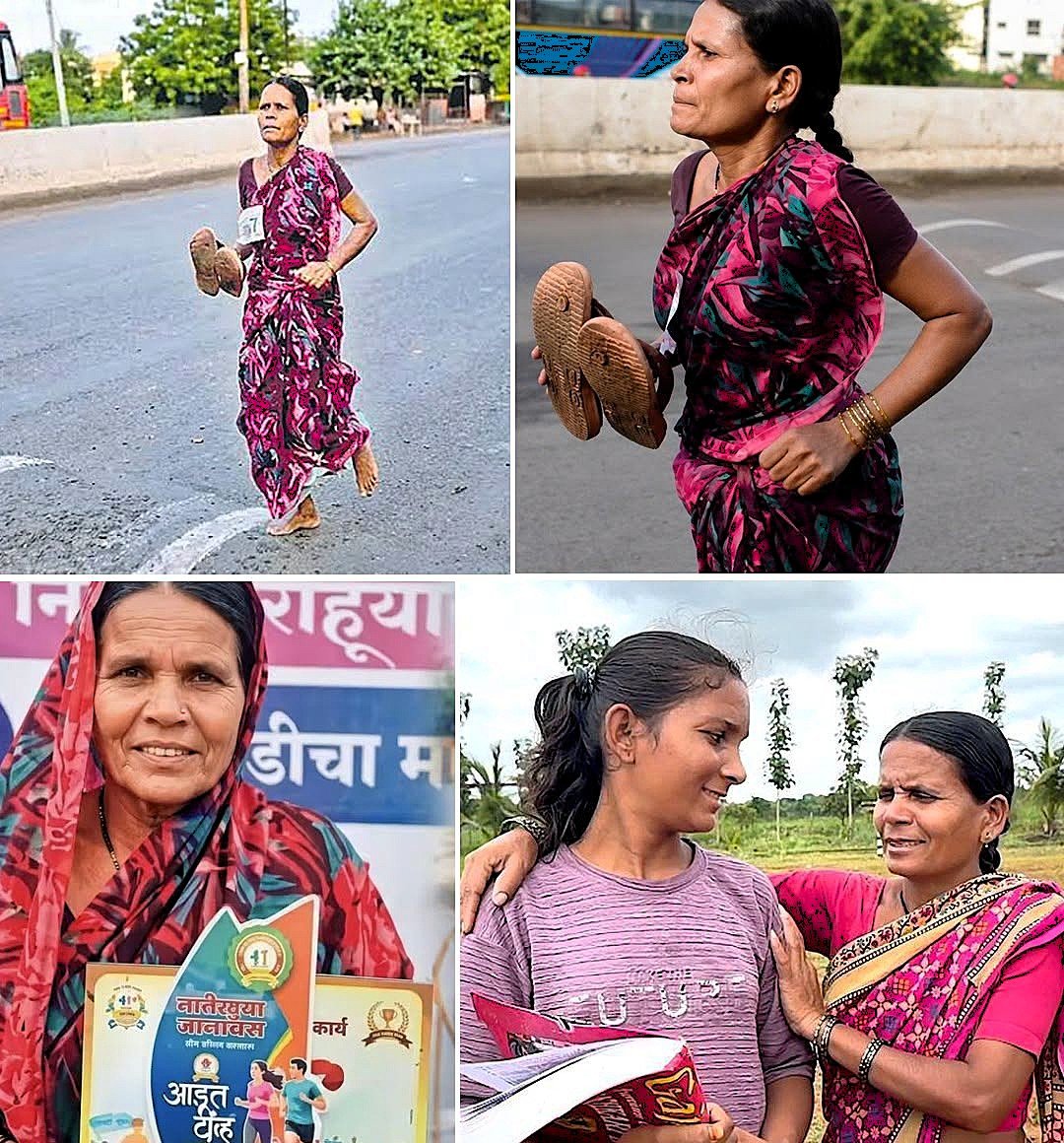
Ramabai Ranveer had never imagined herself standing at a starting line.
She had never trained for a race. She didn’t own running shoes. She didn’t have athletic clothes, a coach, or years of practice behind her.
But at 47, she entered a 3-kilometre race for one simple reason:
Her daughter needed books.
And Ramabai was determined to find a way to get them.
For years, life had demanded more from her than she ever expected.
After her husband died in 2012, Ramabai became the sole parent to her two daughters. She had already known hardship from an early age. She had been forced to leave school when she was only 13, ending an education she wished she could have continued.
Instead, she worked.
She harvested soybeans and chickpeas. She processed and sold turmeric. She took whatever work was available because there was never much room for choice when her family depended on her.
Eventually, she found work as a cook at an academy in Maharashtra.
Her own education had stopped when she was a child.
But she didn’t want the same thing to happen to her daughters.
She wanted them to study.
She wanted them to have opportunities she had never been given.
In August 2026, her younger daughter, Aarti, was preparing for competitive government examinations. She needed study materials and books that would help her prepare.
The cost was around 3,200 Indian rupees.
For many people, that might seem like an ordinary expense.
For Ramabai, it was money she simply didn’t have.
Aarti was so upset that she stopped speaking to her mother for eight days.
Then Ramabai heard about a local 3-kilometre race.
There was a cash prize of 3,000 rupees for the winner.
Almost exactly enough to buy the books.
So she decided to run.
She didn’t suddenly become an athlete.
She simply became a mother who had found one more possibility.
On race day, Ramabai arrived wearing a colorful sari—the kind of clothing she normally wore—and a pair of simple slippers.
There were no expensive running shoes.
No sports uniform.
No special preparation.
Just determination.
When the race began, the slippers quickly became a problem. They slipped and made running difficult.
Ramabai could have stopped.
Instead, she removed them.
She gathered her sari in one hand and continued.
Barefoot.
Over damp asphalt.
Over stones.
With every step, she kept moving forward.
And then something remarkable happened.
One by one, she began passing the other runners.
The woman who had never competed in a race before was suddenly at the front.
She kept going until she crossed the finish line first.
Ramabai had won.
The prize was only 3,000 rupees—roughly $31.
But sometimes money cannot be measured by its size.
For Ramabai, those 3,000 rupees represented something much bigger than a race prize.
They meant books.
They meant study materials.
They meant her daughter could continue preparing for the future she dreamed of.
And the day held another beautiful moment.
Ramabai’s older daughter, Pooja, also competed in her own category and finished second, earning another cash prize.
It was almost as if the daughters were running beside the mother who had spent years carrying their hopes on her shoulders.
Ramabai says she doesn’t want her daughters to struggle through life the way she did.
One dreams of joining the police.
The other is preparing for civil service examinations.
Their mother never had the opportunity to finish her own education.
She left school at 13.
But she refused to let that ending become her daughters’ ending.
So at 47, Ramabai did something she had never done before.
She ran.
Not for fame.
Not for a medal.
Not because she wanted to become a runner.
She ran because her daughter needed books.
And when her slippers wouldn’t stay on, she simply took them off.
She ran barefoot toward the finish line—and toward a future she hoped would be different for her children.
That is the part of this story that makes the 3,000-rupee prize feel so much larger than it really was.
To someone else, $31 might disappear in a single shopping trip.
To Ramabai, it became an investment in her daughter’s dream.
It became proof that sometimes a parent will find strength in places they never knew existed.
She couldn’t give her daughters the education she herself had received, because she never had that chance.
But she could give them something else.
She could fight for their opportunity.
And on that day, she did it one barefoot step at a time.
How much can $31 be worth?
Sometimes, it can be worth exactly enough to keep someone’s dream moving forward. ❤️🇮🇳