
When we hear the words “animal rescue,” we often imagine volunteers pulling frightened dogs from dangerous streets, shelter workers providing medical treatment, or families opening their homes to animals that have nowhere else to go.
But in Rio de Janeiro, one extraordinary shelter decided to look at animal rescue from a different perspective.
Instead of helping only the dogs and cats living on the streets, the organization also chose to help the people who were protecting them.
That simple idea has created a remarkable cycle of compassion—one in which homeless animals and people experiencing homelessness are given something they desperately need: a chance.
HOPE Shelter, also known as Abrigo Hope, was founded in 2017 by journalist Glenn Greenwald and his late husband, David Miranda.
The organization was built around an observation that is easy to overlook.
People living on the streets often have very little.
They may struggle to find food, shelter, medical care or even a safe place to sleep.
Yet many of them still share whatever they have with abandoned animals.
A person who doesn’t know where their next meal will come from may still save part of a meal for a hungry dog.
Someone sleeping outside may allow a frightened cat to curl up beside them for warmth.
And someone who owns almost nothing may still stand between an abandoned animal and the dangers of the street.
HOPE chose not to ignore those relationships.
Instead, it asked a powerful question:
What if helping these people could also help the animals they already care about?
The answer became one of the shelter’s most meaningful programs.
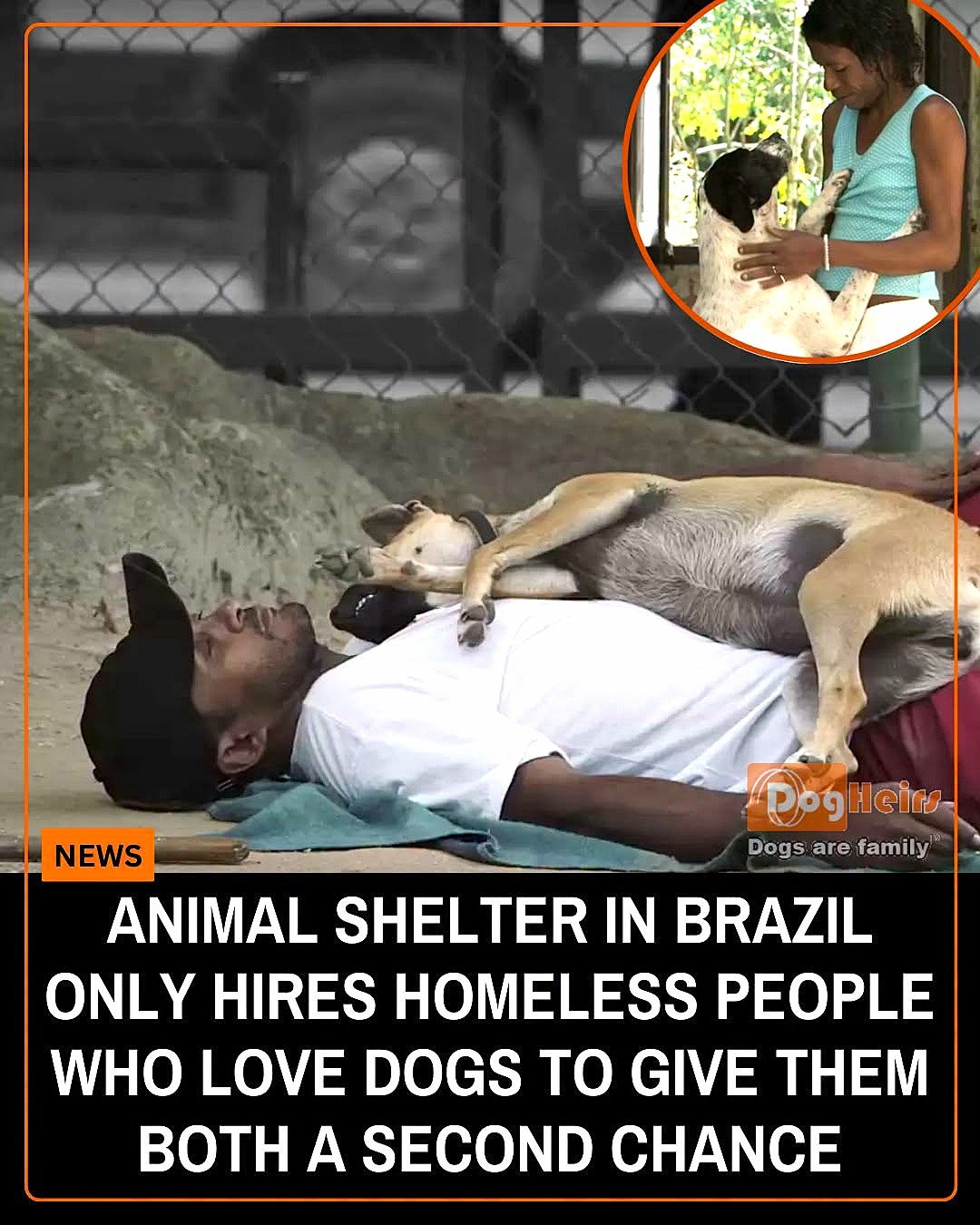
HOPE began employing people experiencing homelessness who had demonstrated exceptional compassion toward animals.
Rather than treating their circumstances as a reason to exclude them, the shelter saw their experience and kindness as valuable qualities.
These individuals were given real jobs caring for animals.
They helped rescue abandoned dogs, feed them, clean their living areas and provide the attention and protection the animals needed while waiting for permanent homes.
For the dogs, it meant safety.
For their caregivers, it meant something equally important—an opportunity.
A paycheck can provide much more than money when someone has been living without stability.
It can be the first step toward opening a bank account.
It can mean being able to obtain official identification.
It can provide the ability to rent a room or apartment.
And, perhaps most importantly, it can restore a sense of independence and dignity.
But HOPE understood that employment alone would not solve every problem.
That’s why the organization surrounded its workers with additional support.
Social workers and psychologists work with employees to help them navigate the complicated process of rebuilding their lives.
They assist people with obtaining government identification and opening bank accounts. They help workers understand how to manage their earnings and plan for a more stable future.
Eventually, the goal is not simply to provide someone with a job at a shelter.
It is to help them reach a point where they can secure housing and build an independent life.
One of the early examples of the program was a young man named Lucas.
At just 20 years old, Lucas had been living on the streets.
His circumstances could easily have caused people to overlook him.
Instead, HOPE gave him an opportunity to work.
By caring for the rescued dogs and earning an income, Lucas was eventually able to use his wages to find a place to live.
His story illustrates what makes the shelter’s approach so different.
The dogs weren’t simply being rescued from the streets.
A person who had also experienced life on those streets was being given a path away from them.
Two lives were changing at the same time.
For the rescued animals, HOPE provides the basic things every dog deserves.
They receive food, veterinary treatment, protection and a safe environment.
Most importantly, they are given the opportunity to leave the shelter and become part of loving families.
The organization has already helped thousands of dogs find homes and cares for close to 200 animals at any given time.
But its work extends beyond the shelter walls.
HOPE also provides food and medication assistance to lower-income pet owners throughout Rio de Janeiro.
That part of the mission is especially important because keeping an animal out of a shelter can sometimes be the most effective form of rescue.
For families struggling financially, the cost of food or medicine can become overwhelming.
Without assistance, they may be forced to surrender an animal they deeply love.
By helping with those basic needs, HOPE gives families a way to keep their pets.
And that means fewer animals ending up abandoned on the streets.
It also means families don’t have to experience the heartbreak of losing a beloved companion simply because they temporarily cannot afford the cost of care.
The organization is funded entirely through public donations, making the support of ordinary people an important part of its ability to continue this work.
As the number of animals needing help has grown, so has the shelter’s ambition.
In 2024, HOPE secured a new parcel of land where it could build a larger facility.
The new location is designed to significantly expand the organization’s capacity, allowing it to care for roughly twice as many dogs.
The new shelter is scheduled to open in the summer of 2026.
But the most powerful part of HOPE’s story isn’t the size of its new facility.
It is the philosophy behind it.
The shelter recognizes something that is sometimes forgotten in conversations about homelessness and animal rescue: compassion doesn’t belong only to people who have comfortable homes.
Someone can be struggling to survive and still love an animal deeply.
Someone can have almost nothing and still give everything they can to a frightened dog.
And sometimes, the person sitting beside a homeless animal on a city street may be the very person who understands that animal’s fear better than anyone else.
HOPE didn’t simply see people experiencing homelessness as individuals who needed help.
It also saw them as people who already possessed something valuable—the ability to care.
By creating employment around that compassion, the shelter transformed a difficult circumstance into an opportunity for both humans and animals.
A dog gets a warm bed.
A person gets a paycheck.
A frightened animal receives medical treatment.
A worker receives identification and a bank account.
A rescued dog eventually finds a family.
A former street resident eventually finds a home of their own.
And somewhere along the way, the boundary between “animal rescue” and “human support” begins to disappear.
Because sometimes, saving an animal means looking at the person standing beside it.
Sometimes the person who needs a second chance is already holding the paw of someone else who needs one, too.
That may be the most beautiful lesson HOPE Shelter offers.
We don’t always have to choose between helping people and helping animals.
Sometimes, by helping one, we can help the other.
And sometimes the most meaningful rescue story is not about one life being saved.
It’s about two lives finding their way home together.