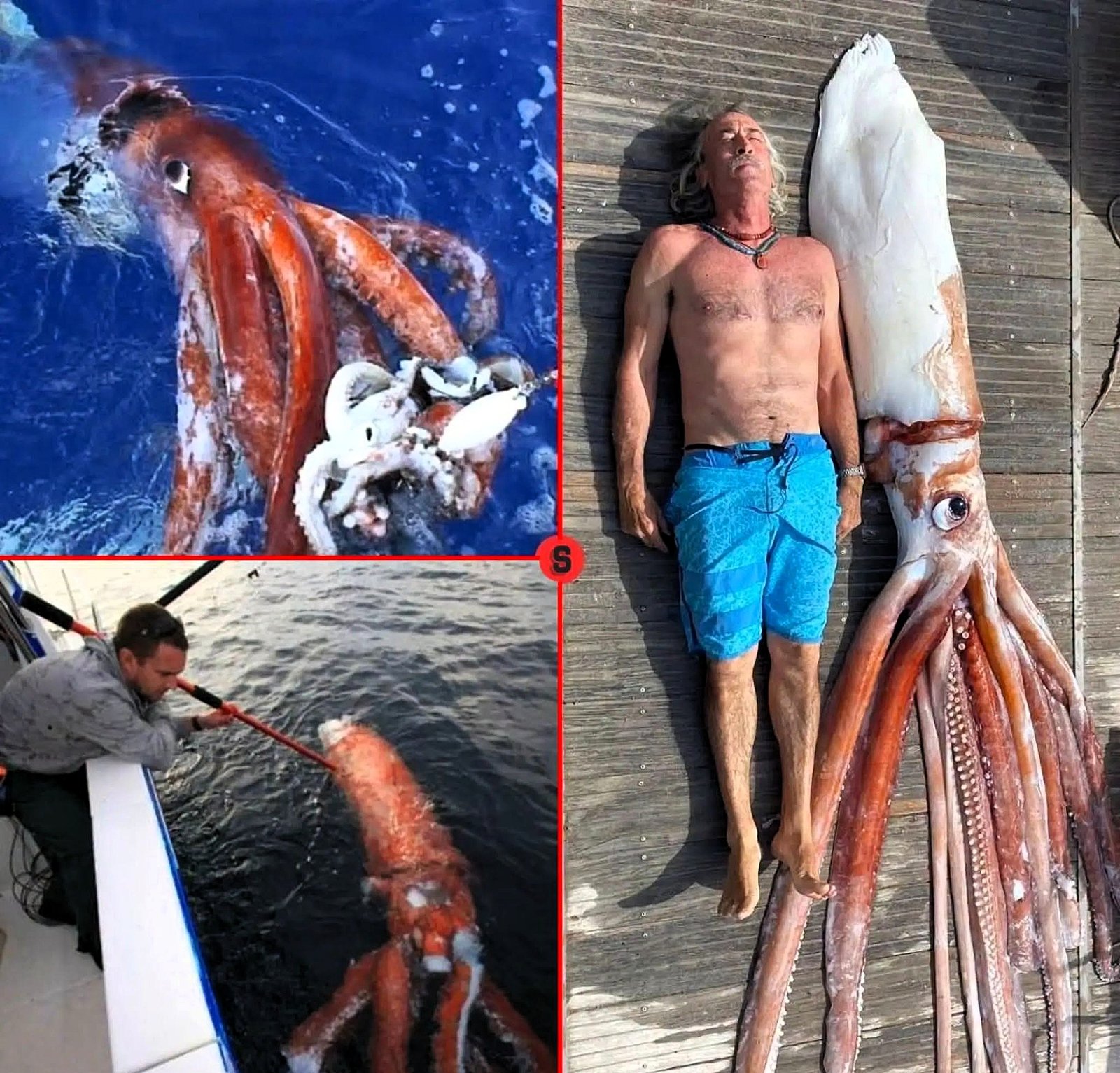

For centuries, sailors told terrifying stories about enormous sea creatures lurking beneath the waves. Ships were said to encounter gigantic tentacles rising from the darkness, pulling prey into the depths. To many people, these stories sounded more like legends than reality.
Then science began to reveal the truth.
The giant squid is very real—and its life in the deep ocean may be even more fascinating than the old stories suggested.
These elusive animals live hundreds of meters below the surface, where pressure is enormous and almost no sunlight reaches. Some have been found at depths approaching 1,000 meters or more. Because of this extreme environment, humans rarely encounter a giant squid alive.
Even today, scientists know surprisingly little about how these creatures live.
A mature giant squid can reach several meters in length, with some estimates approaching 10 meters or more when the long feeding tentacles are included. That makes it one of the largest invertebrates known to science.
But its size isn’t the only extraordinary thing about it.
Perhaps the most remarkable feature of the giant squid is its eyes.
Its eyes can be enormous—among the largest eyes found in the animal kingdom. In the darkness of the deep sea, such huge eyes are believed to help the squid detect even faint flashes or movements in the surrounding water.
Down there, every tiny signal of light could mean something important.
It might be prey.
It might be a predator.
Or it might be another creature moving through the darkness.
The giant squid is also equipped with two exceptionally long feeding tentacles. These tentacles can extend far beyond the rest of its body and are lined with powerful structures that help it seize prey.
Once something comes within reach, the squid can rapidly pull it toward its mouth.
Its diet is believed to include fish and other squid, including members of its own species. Life in the deep ocean is unforgiving, and every encounter can become a struggle for survival.
And then there is the creature that has made the giant squid famous in another way: the sperm whale.
For a long time, scientists and naturalists wondered what happened when these two enormous deep-sea animals met. Evidence from sperm whales has provided some remarkable clues. Many sperm whales carry circular scars on their bodies that are consistent with encounters involving the suction-cup-lined tentacles of giant squid.
These marks have helped scientists understand that encounters between the two animals can be intense.
The giant squid was once almost impossible to study because scientists could rarely observe one alive. Most knowledge came from dead or damaged specimens that washed ashore or were recovered from the stomachs of predators.
That changed as technology improved.
Deep-sea cameras, remotely operated vehicles and specialized submersibles allowed researchers to venture into environments that were previously almost impossible to explore.
In 2006, Japanese researchers reported filming a live giant squid in the wild, marking a major moment in marine science. Later expeditions captured additional footage of these elusive animals in their natural habitat.
For the first time, people could see the legendary creature moving through the darkness of the deep ocean rather than simply examining a dead specimen.
The footage helped transform the giant squid from a creature of mythology into a living subject of scientific study.
Yet many mysteries remain.
Scientists still have much to learn about its reproduction, behavior, population size and daily life. We don’t know exactly how often these animals encounter one another, how they navigate the deepest parts of the ocean, or how their populations change over time.
And perhaps that’s what makes the giant squid so fascinating.
It isn’t a monster from an ancient sailor’s nightmare.
It is a highly adapted deep-sea animal that evolved to survive in one of the most extreme environments on Earth.
For centuries, humans looked toward the ocean and imagined monsters hiding beneath its surface.
Today, science has shown us that some of those legends were based on something real.
The giant squid really does live in the darkness.
It really does possess enormous eyes, powerful tentacles and an extraordinary body built for deep-sea survival.
And despite everything modern technology has revealed, this mysterious animal still keeps much of its life hidden from us.
Somewhere in the blackness of the deep ocean, beyond the reach of ordinary divers and sunlight, a giant squid may still be moving silently through the water.
And that thought alone is enough to remind us how little we truly know about the world beneath the waves. 🌊🦑❤️