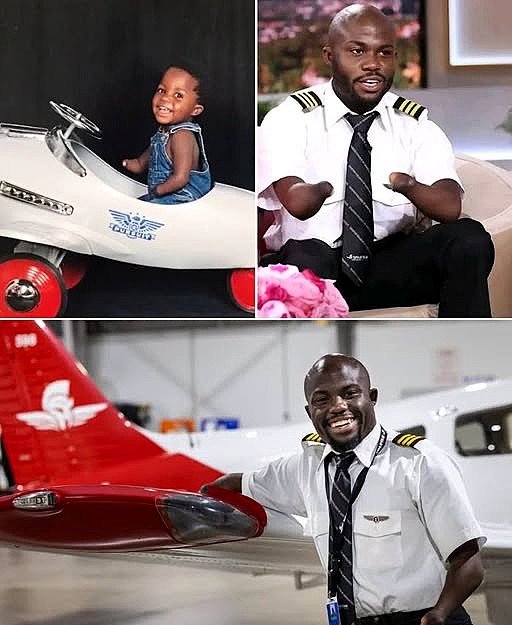
It began much earlier—with a childhood spent refusing to believe that being different meant being unable to participate.
Zack was born in Nigeria without fully formed hands or feet. Later, he was adopted by an American family and grew up on a farm in Wisconsin surrounded by 18 brothers and sisters.
It was a big family, and keeping up with everyone was not always easy.
But Zack’s childhood wasn’t defined by what he was missing.
It was defined by what he was determined to do.
His mother once recalled something remarkable about him: Zack was around eight years old before he truly understood that he was missing his hands and feet.
Why?
Because he had been too busy trying to keep up with everyone else.
While other children were figuring out how to climb trees, Zack wanted to climb them too.
When his siblings rode horses, he found ways to ride.
When they played sports, he looked for his own method of joining in.
He learned something that would eventually shape the rest of his life:
You don’t always have to do something the same way everyone else does it.
Sometimes, you simply have to find your own way.
That lesson became especially important years later when Zack was a high school senior.
While many students were thinking about college, careers and what they wanted their future to look like, Zack had already made his decision.
He wanted to fly.
Not just once.
Not as a passenger.
He wanted to become a professional pilot.
✈️
For some people around him, the dream seemed almost impossible.
Questions came quickly.
How would he operate the controls?
Would aviation authorities approve him?
Could someone without fully formed hands and feet safely control an aircraft?
Even Zack’s school counselor suggested that he consider a different career path.
But Zack had spent his entire life hearing questions about what he could and couldn’t do.
He wasn’t interested in accepting someone else’s conclusion before he had tested himself.
In 2017, he applied to five flight schools.
Four applications didn’t lead where he hoped they would.
One did.
Spartan College of Aeronautics and Technology in Tulsa, Oklahoma, gave Zack an opportunity.
For many people, getting accepted into flight school would have been the biggest hurdle.
For Zack, it was only the beginning.
Before he could pursue professional aviation, there was another authority he had to convince.
The Federal Aviation Administration.
Zack needed medical approval to continue toward his goal of becoming a professional pilot.
And according to Zack, the FAA denied him five times.
Five separate moments when the answer was essentially no.
For someone who had spent years learning to adapt, those rejections could easily have become the end of the dream.
But Zack didn’t want anyone to simply assume he was capable.
He wanted the opportunity to prove it.
Eventually, he was given that opportunity.
Instead of being judged solely by how his body looked, Zack was able to demonstrate what mattered most in aviation:
Could he safely operate an airplane?
The answer was yes.
He passed.
That opened the door to the next stage of his journey.
Zack began learning how to operate aircraft controls using specialized adaptations and specially fitted prosthetics.
He had to develop techniques that worked for his body.
There was no shortcut.
There was no pretending that the training would be identical to everyone else’s.
He simply learned to fly in his own way.
And then came the moment that turned years of determination into something official.
In 2019, Zack earned his commercial pilot certification.
🛩️
He became widely recognized as the world’s first licensed commercial pilot with a quadruple limb difference.
But earning the license wasn’t the end of his story.
It was the beginning of another chapter.
Zack returned to Spartan College as a flight instructor.
Think about that for a moment.
The young man who had once been questioned about whether he could realistically become a pilot was now teaching other aspiring pilots how to fly.
The same place that had given him a chance became the place where he began helping others find their own path into aviation.
His role was no longer simply about proving himself.
He was now helping other people learn.
And that may be one of the most meaningful parts of his story.
Because Zack’s journey isn’t really about pretending that disability doesn’t create obstacles.
It does.
His path required adaptations, additional approvals, persistence and an enormous amount of determination.
What makes his story extraordinary is what he did when those obstacles appeared.
He didn’t deny them.
He worked through them.
When people questioned his dream, he continued pursuing it.
When four flight schools didn’t work out, he kept searching.
When the FAA rejected him, he continued seeking an opportunity to demonstrate his abilities.
And when that opportunity finally came, he was ready.
In 2025, Aviation Week honored Zack with one of its Laureate Awards for his contribution to aviation.
By then, the story had come full circle.
A boy born without fully formed hands or feet had grown up on a Wisconsin farm, surrounded by siblings and constantly finding creative ways to participate in the world around him.
That boy had eventually looked toward the sky and decided that he wanted to fly.
People questioned the dream.
Institutions said no.
But he kept going.
Today, Zack isn’t simply someone who learned to fly an airplane.
He’s an example of what can happen when a person refuses to let someone else’s doubt become their identity.
His story also reminds us that “different” and “incapable” are not the same thing.
Sometimes a person doesn’t need someone to tell them that their dream is realistic.
They need someone willing to give them a fair opportunity to prove what they can do.
Zack’s journey began with people asking, “Can he really fly?”
Years later, the question has a very different answer.
Yes.
He can fly.
And now, he teaches others how to do it.
Perhaps the most powerful lesson isn’t that Zack overcame every obstacle.
It’s that he refused to let those obstacles make the decision for him.
Five FAA denials could have become the final chapter.
Instead, they became part of the journey toward a commercial pilot license.
Four flight schools said no.
One said yes.
And that one opportunity was enough for Zack to begin proving what was possible.
His story leaves us with a question worth asking ourselves:
How many dreams are abandoned because someone says “no” before we ever get the chance to discover what we’re capable of?
Sometimes, the first person who doubts you isn’t seeing your limits.
They’re simply seeing the limits of their own imagination.
Zack Anglin kept looking beyond those limits.
And eventually, he found the sky.
Read Next
- EVERY YEAR, A “CRIMINAL” IS LOCKED IN A CAGE AND LOWERED TOWARD AN ITALIAN RIVER — BUT THE TRUTH IS NOT WHAT THE VIDEOS MAKE IT LOOK LIKE.
- 👑 THE NIGHT PRINCESS DIANA FELL ASLEEP — AND THE WORLD SOON LEARNED WHY 😴
- At just two years old, Alyssa McDonald survived an accident so devastating that doctors warned her family to prepare for the worst