Sometimes, the moments that change our lives don’t arrive with a warning.
They don’t look important when they happen.
They may seem like an ordinary Tuesday, a silly accident, or a moment you’ll forget by the end of the day.
For Jayne Hardman, it was nothing more than a playful bump from her beloved dog.
She never imagined that tiny accident would eventually lead doctors to discover a rare and potentially life-threatening disease.
Back in 2012, Jayne was spending time with her dog, Cece, when the playful animal accidentally struck her in the nose.
At first, Jayne didn’t think much of it.
A sore nose after being bumped by an excited dog hardly seemed like something to worry about.
But the pain didn’t go away.
Neither did the swelling.
Days turned into weeks.
Weeks became months.
And what Jayne thought was simply the lingering effect of an unfortunate accident began to feel increasingly strange.
Eventually, she sought medical attention.
That’s when her life took an unexpected turn.
Doctors discovered that Jayne wasn’t dealing with an ordinary injury at all.
She had granulomatosis with polyangiitis, commonly known as GPA—a rare autoimmune condition that causes inflammation in blood vessels and can damage organs and tissues throughout the body.
The diagnosis explained what had been happening.
The damage to Jayne’s nose wasn’t simply the result of Cece’s playful accident.
The disease was progressively attacking the tissue and cartilage.
And as time passed, the physical changes became impossible to ignore.
Her nose gradually collapsed.
Her face began to look dramatically different from how it had before.
But the emotional damage was just as painful as the physical changes.
Jayne found herself becoming increasingly uncomfortable in public.
People stared.
Some looked away.
Others asked questions that were deeply personal and difficult to answer.
For someone simply trying to live her life, constantly feeling as though strangers were examining her appearance became exhausting.
Eventually, Jayne reached a point where leaving the house felt almost unbearable.
For around 18 months, she barely went out.
The outside world had become a place where she expected to be judged before anyone even knew her name.
Imagine waking up every morning and wondering whether people will stare at you when you walk into a shop.
Imagine wanting to meet friends, go shopping, or simply take a walk—but feeling trapped by the fear of other people’s reactions.
That was Jayne’s reality.
And then, in 2017, the damage had become so severe that doctors made another difficult decision.
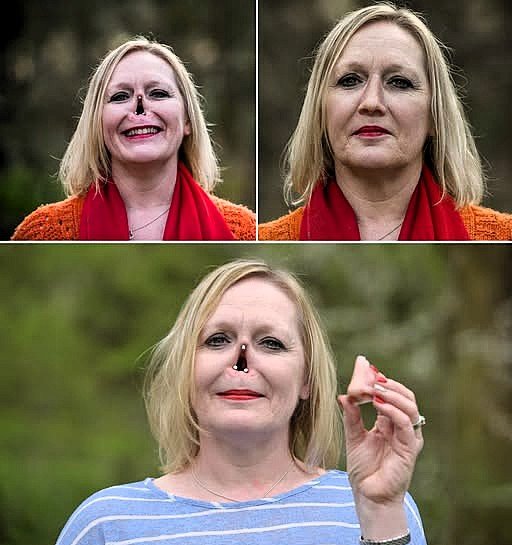
Her collapsed nose had to be surgically removed.
For many people, losing part of their face would feel like the end of something.
For Jayne, however, it became the beginning of a completely different chapter.
Specialists at Queen Elizabeth Hospital Birmingham worked on an extraordinary solution.
They created a hyperrealistic prosthetic nose designed specifically for Jayne.
It wasn’t simply a cosmetic cover.
It was carefully crafted to look remarkably natural and to help restore something Jayne had lost along the way—confidence.
Small implanted attachments allow the prosthetic nose to connect magnetically to her face.
That means Jayne can put it on in the morning and remove it at night.
And perhaps most surprisingly, she didn’t stop with just one.
Today, Jayne has a collection of prosthetic noses designed to match different skin tones and different occasions.
What once might have been something she desperately wanted to hide became something she was willing to talk about openly.
She began showing people how the prosthetics work.
She explained her experience.
She answered questions.
And slowly, something extraordinary happened.
People started listening.
Jayne’s openness eventually brought her attention on social media, where videos about her prosthetic noses reached millions of viewers.
But the attention wasn’t simply about appearances.
Jayne decided to use her growing platform for something much more meaningful.
She began raising awareness about vasculitis, the group of diseases involving inflammation of blood vessels, while also speaking openly about facial differences.
Her message is simple but powerful:
Looking different does not make someone less worthy.
A face that has changed doesn’t mean the person behind it has changed.
And sometimes, the thing people notice first is only a tiny part of someone’s story.
For years, Jayne had searched for someone who looked different and wasn’t afraid to be seen.
Someone who could show her that life could continue.
Someone who could prove that a changed appearance didn’t have to mean a smaller life.
Now, she has become that person for others.
And there’s an incredible twist to her story.
Jayne still thinks about the day Cece accidentally bumped her nose.
It would be easy to look back at that moment and blame the accident for everything that followed.
But Jayne sees it differently.
The dog didn’t cause her autoimmune disease.
The bump didn’t create the condition.
Instead, the accident became the reason Jayne sought medical attention.
And that medical journey eventually revealed a serious illness that might otherwise have remained hidden.
A simple moment of play had unknowingly opened the door to a diagnosis.
Something that initially looked like bad luck may have actually helped save her life.
Today, Jayne isn’t hiding.
She’s sharing her story.
She’s showing her prosthetic noses.
She’s talking about the challenges she’s faced.
And she’s helping people understand that behind every unusual appearance, there may be a story filled with pain, courage, survival, and hope.
Her journey is a reminder that we rarely know what someone has been through just by looking at them.
The person you see on the street may have spent years fighting a disease.
The person whose appearance catches your attention may have battled tremendous fear just to step outside.
And the person wearing a prosthetic may have fought battles you could never imagine.
So perhaps Jayne’s story isn’t really about a nose.
It’s about resilience.
It’s about refusing to disappear simply because the world looks at you differently.
And it’s about finding the courage to become visible again.
That playful bump from Cece changed Jayne’s life in a way nobody could have predicted.
But instead of allowing her illness to define the rest of her story, Jayne turned her experience into a reason to educate, inspire, and give others hope.
Sometimes life-changing moments arrive disguised as accidents.
Sometimes the thing we desperately wish had never happened becomes the first step toward discovering what we needed to know.
And sometimes, what feels like the worst chapter of our lives eventually becomes the story that gives someone else the courage to keep going.
Jayne’s story leaves us with a powerful question:
If an ordinary accident could lead to the discovery of a hidden illness and ultimately change the course of someone’s life, would you still call that moment nothing more than bad luck?