Sometimes, a child sees something that adults have learned to walk past.
A lonely animal.
A frightened face.
A pair of eyes quietly waiting for someone to come back.
For 6-year-old Reese Luckey, that was all it took to break his heart.
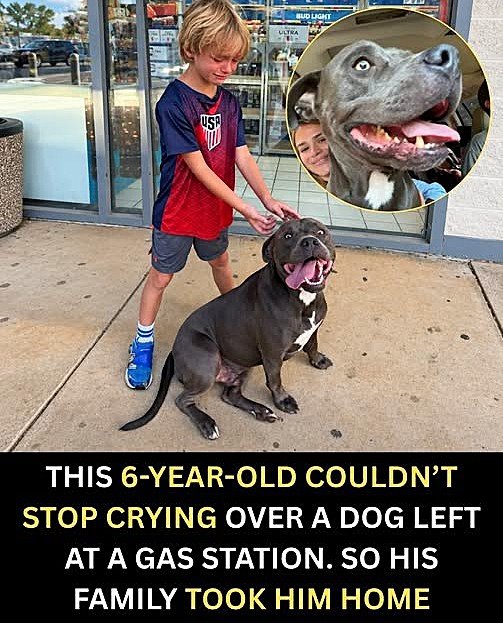
During Labor Day weekend in 2026, Reese was traveling with his parents, Alexandra and Rollins Luckey, as their family made the drive from Florida to their home in Atlanta. Like many road trips, theirs was supposed to be a simple journey home—until an unexpected stop for gas introduced them to a dog they would not soon forget.
The family stopped at a gas station in Columbus, Georgia.
Outside the station was a large pit bull.
At first, there was nothing particularly unusual about seeing a dog near a busy gas station. But as the Luckeys approached, the dog walked directly toward them.
And instead of keeping his distance, he welcomed them.
His tail moved with excitement. His body language was relaxed. He seemed eager to receive attention from anyone willing to give it.
There was something almost heartbreaking about how quickly he trusted them.
He behaved like a dog who was accustomed to being around people.
Like someone had loved him before.
Like someone had once called him their own.
But there was no owner anywhere in sight.
The family looked around, expecting that perhaps his person was nearby. Maybe someone had stepped inside the station. Maybe the dog had wandered away from a nearby home.
But no one came.
So Alexandra and Rollins asked the employees inside the gas station about him.
What they heard made the situation much more difficult to ignore.
The employees told the family that the dog had been around for quite some time. They did not know who owned him, and nobody seemed to be coming back for him.
He wasn’t simply passing through.
He appeared to have been left behind.
And Reese understood that immediately.
The little boy had already become attached to the dog. He had seen the animal’s friendly personality and felt comfortable around him. To Reese, this wasn’t just a stray dog standing outside a gas station.
This was a dog who wanted someone.
A dog who was still willing to trust people even though nobody had come looking for him.
And when Reese realized that the dog might actually have been abandoned, the emotions became too much for him.
He started crying.
Not because the dog had frightened him.
Not because the dog had done anything wrong.
He cried because he couldn’t understand why someone would leave behind an animal who was so loving.
For a 6-year-old child, the situation was painfully simple.
The dog was friendly.
The dog wanted affection.
The dog appeared to need help.
So why wasn’t anyone coming back?
Reese’s tears said what words couldn’t.
He didn’t see a dangerous animal.
He saw a lonely dog.
His parents could comfort him, but they couldn’t simply erase what he had just witnessed. The dog was still standing there, looking at the people around him with the same hopeful expression.
Perhaps he was waiting for his family.
Perhaps every passing car made him wonder if his person had finally returned.
Perhaps he had been waiting for days.
We may never know exactly what was going through the dog’s mind.
But what Reese did know was that the dog deserved better.
That moment became more than a quick encounter during a road trip. It became one of those unexpected experiences that stays with a person long after the journey is over.
For Reese, it was a lesson about compassion.
Children often have a remarkable ability to recognize suffering without trying to explain it away. They don’t always ask whether something is convenient, expensive or difficult. They simply see someone—or something—in need and wonder why nobody is helping.
That is what happened at that gas station.
A little boy met a dog.
The dog offered affection.
And the boy offered tears.
There is something deeply moving about that exchange.
The dog didn’t know Reese’s name. He didn’t know where the family was headed. He didn’t know that the little boy was only 6 years old.
All he knew was that someone had stopped.
Someone had noticed him.
Someone was willing to kneel down, look at him and treat him with kindness.
For an animal who had apparently been waiting alone, that attention may have meant more than anyone could know.
And for Reese, the encounter revealed something equally important: kindness can hurt sometimes because it forces us to notice what others have ignored.
The family eventually had to continue their journey toward Atlanta, leaving behind a dog they had only just met.
But Reese’s reaction showed just how deeply the encounter had affected him.
His tears were a reminder that abandoned animals are not objects that can simply be forgotten when life becomes inconvenient.
They are living beings capable of fear, excitement, attachment and trust.
They wait.
They hope.
They remember kindness.
And sometimes, all they ask for is a person who will stop long enough to see them.
The story of Reese and the pit bull is not simply about a child crying at a gas station.
It is about the extraordinary empathy that can live inside a child.
It is about a dog who continued approaching people with love despite being left alone.
And it is about the uncomfortable truth that sometimes the animals we encounter on ordinary days are carrying stories we may never fully understand.
That Labor Day weekend, Reese was supposed to be traveling home with his parents.
Instead, he encountered a dog who changed the emotional course of their journey.
The family may have spent only a short amount of time with him, but Reese’s reaction made one thing clear: the dog had made an impression.
Some encounters last minutes.
Some last a lifetime.
And sometimes, the smallest heart in the room is the one that feels the most.
Reese couldn’t solve the dog’s entire story that day.
He couldn’t explain why the dog had been left outside the gas station.
He couldn’t make the world suddenly fair.
But he could do one thing.
He could care.
And sometimes, caring is where every rescue story begins.
Because before a dog finds a safe home, someone usually has to notice that he needs one.
Before an abandoned animal receives a second chance, someone has to stop walking and look.
And before people learn to speak for animals who cannot speak for themselves, they have to learn what Reese already seemed to understand at only 6 years old:
A lonely dog is still someone’s precious life.
A frightened animal still deserves kindness.
And no creature should have to spend its days wondering whether anyone is coming back.
That little boy’s tears were not weakness.
They were compassion.
And perhaps that is the part of this story worth remembering most.