In the summer of 2009, U.S. Army National Guard Master Sgt. Mark Allen was sent on a mission in Afghanistan that would change his life—and the lives of his family—forever.
Allen was part of an effort to locate Sgt. Bowe Bergdahl, an American soldier who had disappeared from his post in Afghanistan. During a mission in July 2009, Allen and other American and Afghan forces were gathering information in two Afghan villages when their unit came under attack by insurgents using small arms, machine guns and rocket-propelled grenades.
In the middle of the ambush, Allen was shot in the head.
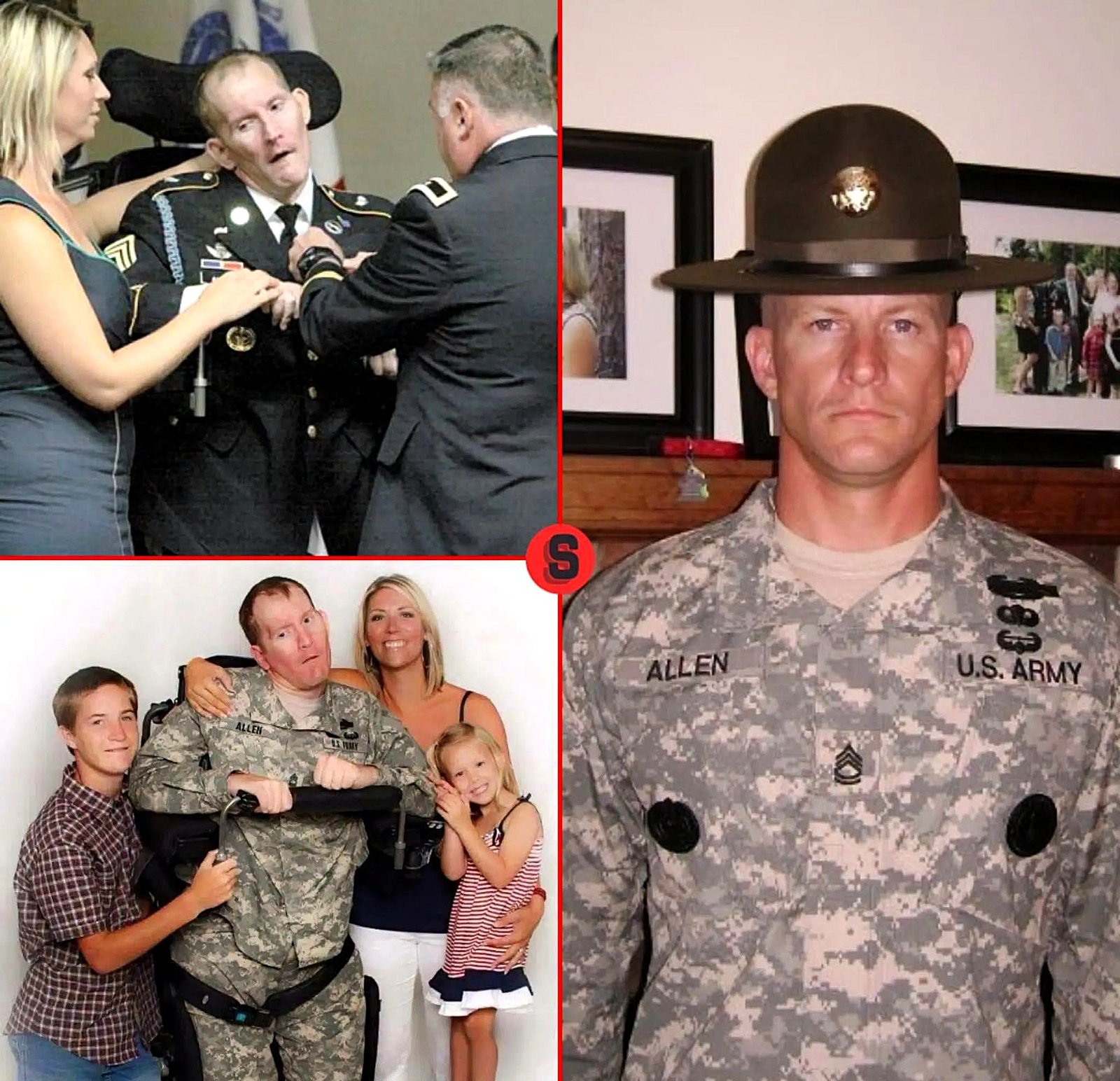
He survived the devastating injury, but the man who returned home was profoundly different from the soldier who had left for Afghanistan. The traumatic brain injury left him unable to speak, unable to walk normally and dependent on others for almost every aspect of daily life. His wife, Shannon Allen, and their family would spend the next decade navigating a life they had never imagined.
For Mark, the war did not truly end when he left Afghanistan.
It followed him home.
A Mission That Changed Everything
Bowe Bergdahl disappeared from his post on June 30, 2009, triggering a major search operation by U.S. forces. Allen was among the soldiers involved in efforts connected to that search.
According to reports, Allen’s unit was attempting to gather information that could help locate Bergdahl when the attack occurred. The mission quickly became a fight for survival.
Allen was struck in the head and suffered a catastrophic traumatic brain injury.
The consequences were permanent.
Military court records later described the severity of his condition. Following his injury, Allen was severely disabled, unable to speak and largely unaware of his surroundings. He underwent numerous surgeries and experienced extensive paralysis and seizures, requiring care around the clock.
For a soldier who had spent years serving his country, the sudden loss of independence was devastating.
But his story was also about the people who stood beside him.
A Wife Who Became His Caregiver
After Mark returned home, Shannon Allen became one of the most important figures in his long recovery and daily care.
Their lives had been transformed overnight.
Before the injury, Mark was an active soldier and an outdoorsman. Afterward, he depended on a wheelchair and could no longer communicate through speech.
During testimony at Bergdahl’s 2017 sentencing hearing, Shannon described just how demanding their daily routine had become.
Getting Mark out of bed, showered and dressed could take approximately 90 minutes. A pulley system attached to the ceiling was used to help move him. His seizures and physical limitations meant that he needed constant supervision and assistance.
Yet Shannon continued to care for him.
Their children also grew up alongside the consequences of his injury. Their young daughter would sometimes climb into Mark’s wheelchair and sit on his lap, creating moments of connection despite the communication barriers that separated him from the life he once knew.
It was a different kind of family life—one shaped by patience, sacrifice and unconditional love.
Ten Years of Fighting a Different Battle
Mark’s physical wounds were visible, but the emotional impact extended far beyond his own body.
His injury affected his wife, his children and the wider community around them.
For more than a decade, Shannon and her family faced the challenges that came with caring for someone who had suffered such a devastating brain injury. Mark required extensive medical attention and assistance with basic daily activities.
The military had sent him into a dangerous environment, but after coming home, his greatest battle became the long struggle to live with the consequences of what had happened.
Reports about his condition emphasized how completely the injury had changed his life. He could no longer walk or speak, and his family had to adapt to a new reality.
Still, Mark remained surrounded by people who refused to abandon him.
His community rallied around the family. Volunteers helped build a playground for his young daughter, while people inspired by Mark’s story also supported other wounded soldiers by providing adaptive clothing and other assistance.
His sacrifice therefore reached far beyond the battlefield.
The Bergdahl Case Brought His Story Back Into the Spotlight
For several years, the public knew relatively little about what had happened to Mark Allen.
That changed when Bowe Bergdahl’s case eventually reached a military courtroom.
Bergdahl had been held by the Taliban for five years after leaving his post. He was eventually released in 2014 as part of a prisoner exchange involving five Taliban detainees held at Guantanamo Bay.
When Bergdahl later faced military proceedings, the consequences of the search operation became part of the discussion.
Shannon Allen testified about what had happened to her husband and how dramatically the injury had changed their family.
Her testimony gave the public a deeply personal view of the cost of the mission.
Mark Allen was not simply a name connected to a military case. He was a husband, a father and a soldier whose life had been permanently altered.
A Soldier Remembered for His Service
Allen had already served in Iraq and had a long history of military service. A family friend recalled that he had chosen to return to a frontline unit because he did not want his fellow soldiers to go without him.
That decision became an important part of how people remembered him.
His military career ultimately spanned 21 years, and he received a Purple Heart following his injuries. He retired from military service in 2013.
For his family and those who knew him, however, medals could never fully express what he had sacrificed.
The true cost was measured in the years that followed—the years spent in a wheelchair, the inability to speak, the medical procedures, the seizures and the constant care required simply to get through an ordinary day.
The Final Chapter
Ten years after the ambush that changed his life, Mark Allen’s long struggle came to an end.
He died on October 12, 2019, at the age of 46, with his family by his side.
Shannon announced his death publicly, describing how her husband had suffered significant health problems since his devastating injury and had experienced additional illnesses during the final months of his life.
His death marked the end of a decade-long journey that had begun with a battlefield injury but had become a story about family, perseverance and sacrifice.
Mark Allen had survived the bullet.
But surviving was only the beginning.
For the next ten years, he and his family faced challenges that most people could never imagine. His wife became his caregiver. His children grew up with a father who could no longer communicate in the way he once had. His community stepped forward to help. And his name became permanently connected to one of the most controversial military stories of the Afghanistan War.
Yet beneath all the controversy surrounding the Bergdahl case, there was a human story.
There was a soldier who went into a dangerous environment as part of a mission.
There was a family who waited for him to come home.
And there was a wife who spent years caring for the man she loved after he returned home profoundly wounded.
Mark Allen’s story is ultimately a reminder that the cost of war cannot always be measured by the number of people killed on a battlefield.
Sometimes, the cost is a life that continues—but never returns to what it was before.
Mark Allen died at 46, but his sacrifice remains part of the history of the soldiers who served in Afghanistan and the families who carried the consequences of war long after the fighting stopped.
His story was not only about how he was wounded. It was about how he lived afterward—and the people who never stopped standing beside him.