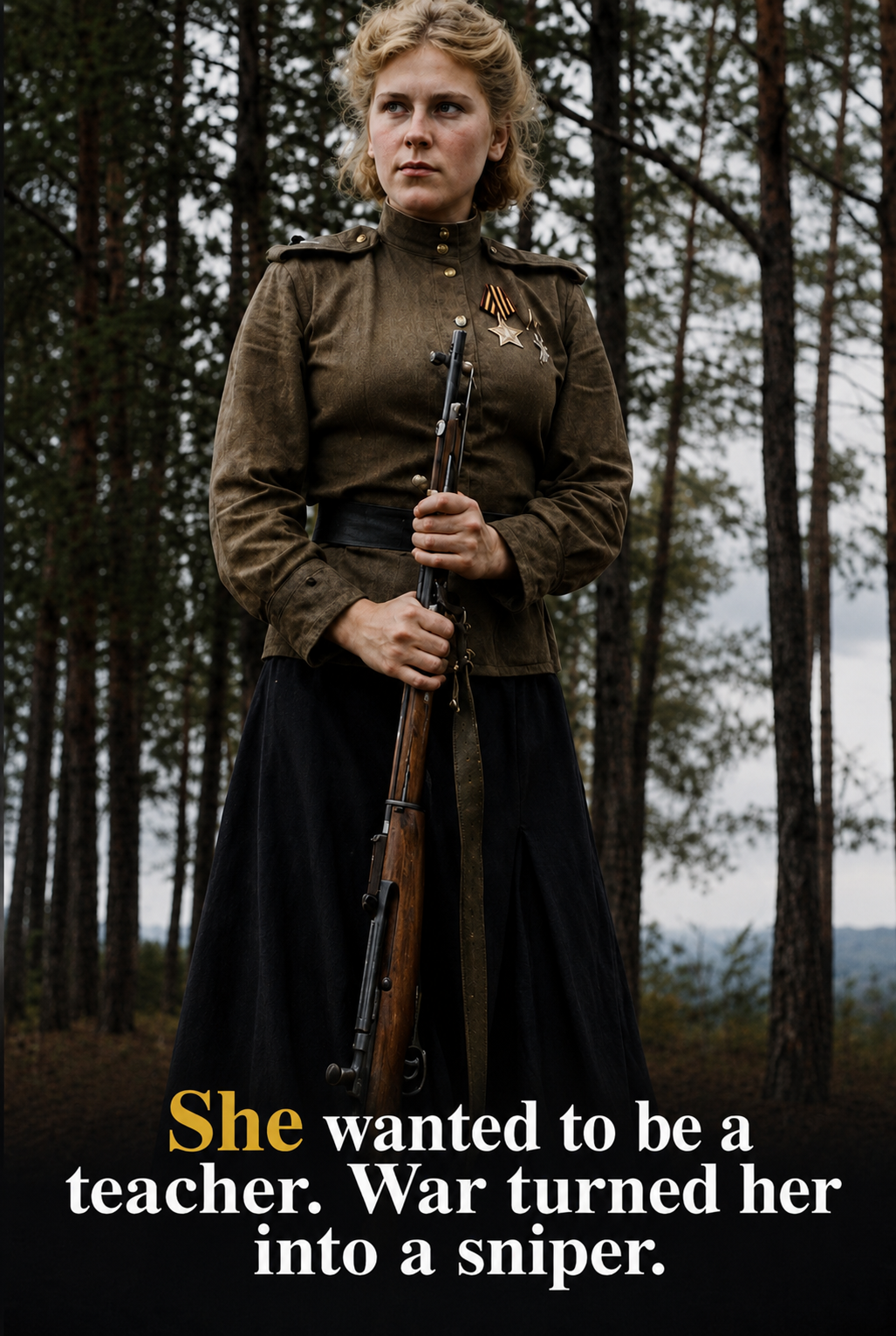
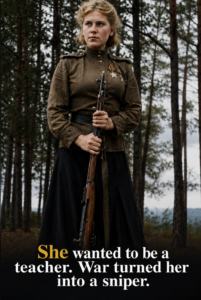
Roza Shanina was born in 1924 in the Arkhangelsk region of the Soviet Union. Before the war, she dreamed of becoming a teacher and had little reason to imagine that her name would one day be associated with the Eastern Front.
Then the war reached her family.
After the deaths of people close to her, Shanina volunteered for military service. She entered the Central Women’s Sniper Training School, where she became one of its strongest students.
When she requested assignment to the front, she was sent into combat with the Soviet forces.
Shanina quickly developed a reputation for extraordinary accuracy and composure. She fought as a sniper during some of the fiercest battles of the war and became one of the best-known Soviet women snipers.
Her wartime record is often given as 59 confirmed kills, although Soviet-era figures and the methods used to record sniper kills can vary between sources.
But Shanina’s diaries reveal another side of her.
Away from the battlefield, she wrote about loneliness, friendship, love and dreams of a life beyond the war. She was still a young woman who wanted an education and a peaceful future.
The contrast is heartbreaking.
Someone who could spend hours patiently watching an enemy through a rifle scope could also write about ordinary hopes that had nothing to do with war.
In January 1945, Shanina was caught in heavy fighting in East Prussia. She was only 20 years old.
She was mortally wounded while attempting to help an injured officer during an artillery barrage.
Her life ended before she ever had the chance to return to the classroom she had once imagined.
Roza Shanina is remembered today not simply because she was an exceptionally skilled sniper, but because her story shows what war can take from a person.
She had wanted to teach.
Instead, history gave her a rifle.
And beneath the uniform was still the young woman who dreamed of spring, education and a life beyond the battlefield.
Read Next
- After 30 Years, the Mystery of Everest’s “Green Boots” Still Haunts the World
- For centuries, a woman’s beauty in parts of China could be judged by something she had no control over at birth: the size and shape of her feet.
- The Woman Who Refused to Quit: How Bib 261 Changed the Boston Marathon Forever