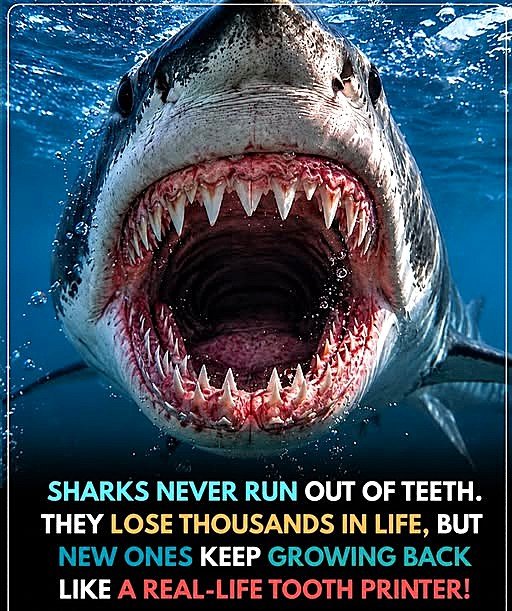
Imagine losing a tooth today—and instead of waiting months or years for a replacement, a brand-new tooth is already forming behind it, ready to take its place. For sharks, this isn’t science fiction. It’s everyday life.
Sharks have one of the most fascinating dental systems in the animal kingdom. Unlike humans, who normally receive only two sets of teeth during their lifetime, sharks are constantly producing and replacing teeth. Depending on the species, a shark can go through thousands—and in some cases, tens of thousands—of teeth during its lifetime.
This remarkable system works almost like a biological conveyor belt. As older teeth become worn, damaged, or fall out, new teeth move forward to replace them. The process allows sharks to maintain rows of sharp, functional teeth throughout their lives.
A Never-Ending Supply of Teeth
When you look inside a shark’s mouth, you may notice several rows of teeth. But what you see is only part of the story. Behind the front row are additional rows of developing teeth, waiting for their turn.
A shark’s teeth are continuously produced in a specialized area inside the mouth. As a tooth reaches maturity, it gradually moves forward. When a front tooth is lost, a replacement can shift into position.
Some shark species may replace individual teeth in only a week or two. Others can take longer. The exact rate depends on the species, age, diet, and environmental conditions.
Over a lifetime, this adds up to an astonishing number of teeth. Some estimates suggest that certain sharks may use or replace tens of thousands of teeth throughout their lives.
Why so many?
Because hunting can be rough.
Sharks often bite hard materials such as fish bones, turtle shells, crustaceans, and other prey. Their teeth can become damaged, loosened, or completely lost during feeding. Instead of depending on a single permanent set, sharks evolved a system that allows them to continually replace their dental weapons.
Teeth Designed for Survival
Shark teeth are more than just tools for biting. They are highly specialized structures adapted to the shark’s diet.
Different species have different tooth shapes.
Great white sharks, for example, have broad, triangular teeth with serrated edges. These teeth are well suited for cutting through flesh. Tiger sharks have teeth with curved, serrated edges that help them handle a wide variety of prey.
Other sharks have much smaller or differently shaped teeth because they feed in different ways.
This variety demonstrates an important principle of evolution: teeth evolve according to what an animal needs to survive.
For a shark, having teeth that remain sharp and functional can make the difference between successfully capturing food and going hungry.
A Biological Conveyor Belt
The replacement system is sometimes compared to a conveyor belt because the teeth continuously move through different stages.
A developing tooth begins behind the active teeth. As it grows and matures, it gradually moves toward the front. Eventually, it can take the place of a tooth that has been lost.
This means a shark’s mouth is constantly changing.
Some teeth are actively being used.
Others are developing.
Some are moving forward.
And others may eventually fall out.
The process happens continuously throughout much of the shark’s life.
Humans have nothing quite like it. We are born with developing baby teeth, lose them during childhood, and receive permanent adult teeth. Once most permanent teeth are lost, however, we generally do not grow another natural replacement.
Sharks operate under a completely different system.
Why Sharks Lose So Many Teeth
It might seem strange that an animal could lose thousands of teeth and still thrive. But for sharks, losing teeth is not necessarily a serious problem.
In fact, it is part of their normal biology.
When a shark bites prey, tremendous forces can be placed on its teeth. A tooth can break or become dislodged. Instead of treating tooth loss as a major failure, the shark’s body is prepared for it.
A replacement is already waiting.
This is particularly useful for predatory sharks that depend on powerful bites to capture and consume prey.
Think of it like carrying a huge supply of spare tools. If one tool breaks, another is immediately available.
Nature has essentially built sharks with their own automatic replacement system.
More Than 400 Million Years of Survival
Sharks belong to an ancient lineage that stretches back more than 400 million years. They existed long before dinosaurs appeared and have survived enormous environmental changes throughout Earth’s history.
Their teeth are only one part of their incredible evolutionary success, but their continuously replacing dental system is certainly one of the most impressive.
Over hundreds of millions of years, sharks have evolved into many different forms, occupying environments ranging from shallow coastal waters to the deep ocean.
Their ability to continuously replace teeth is especially valuable for species that depend heavily on biting and tearing prey.
It is a simple but powerful survival strategy:
Lose a tooth.
Replace it.
Keep hunting.
Sharks Don’t Have Just One “Set” of Teeth
When people think about human teeth, they usually imagine one fixed row. Sharks are completely different.
Many sharks have multiple rows of teeth, and the number of visible and replacement rows varies among species.
The teeth in the front are generally the ones doing the work. Behind them, replacement teeth are developing and waiting.
As the front teeth are lost, the teeth behind them can move forward.
This arrangement allows the shark to maintain an effective biting surface without needing to wait for a completely new set of teeth to develop.
It is one of the reasons shark mouths look so unusual compared with those of humans and many other animals.
A Perfect Example of Adaptation
The shark’s dental system is a powerful example of adaptation.
Sharks live in environments where food can be difficult to catch, competition can be intense, and injuries can happen during feeding. A damaged tooth could become a disadvantage for an animal that relies heavily on biting.
But sharks have an answer built directly into their biology.
Their teeth are replaceable.
That means losing a tooth doesn’t necessarily mean losing the ability to hunt effectively.
The system is efficient, continuous, and perfectly suited to the shark’s lifestyle.
The Next Time You See a Shark…
The next time you see a shark swimming through the ocean, remember that its mouth is not static.
Behind those frightening front teeth, an entire replacement system may be operating.
New teeth are forming.
Older teeth are moving.
Damaged teeth are being replaced.
And the cycle continues.
What looks like a terrifying mouth is actually an extraordinary example of biological engineering shaped by millions of years of evolution.
Sharks don’t need to worry about running to the dentist for a replacement tooth. Their bodies have already developed a remarkable solution.
A shark can lose a tooth today and continue its life with another one ready to take its place.
That is what makes shark teeth so fascinating. They are not simply sharp weapons—they are part of a continuously renewing system that helps these ancient predators remain effective hunters.
And perhaps the most incredible part is that this process has been refined over hundreds of millions of years.
Nature didn’t give sharks one perfect set of teeth.
It gave them a system for making new ones.
🦈🦷 From endless tooth replacement to specialized shapes designed for different diets, shark teeth are one of the ocean’s most remarkable examples of adaptation.