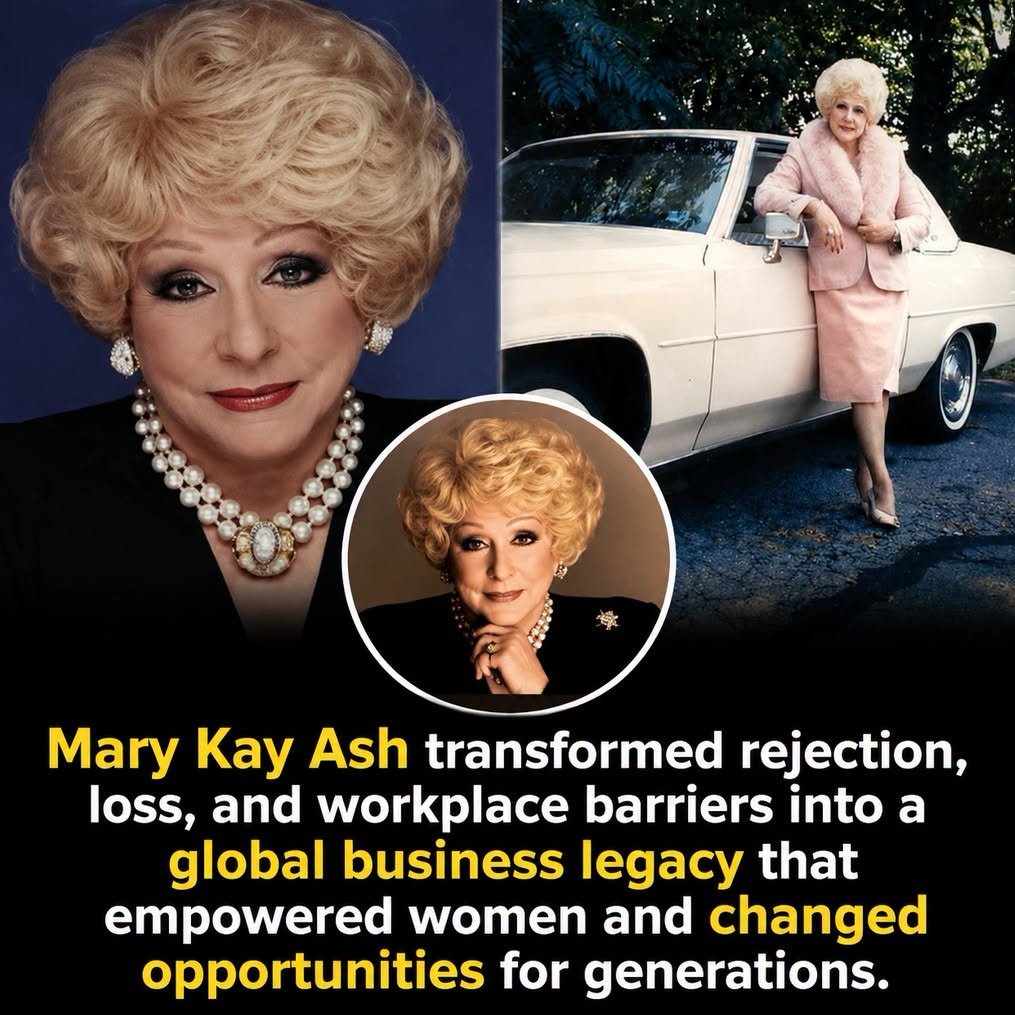
Mary Kay Ash: The Woman Who Turned Rejection Into a Business Empire
A few weeks before opening the company she had dreamed of building, Mary Kay Ash lost the person who was supposed to help build it with her.
The loss came at the worst possible moment. She had already left behind a career that had repeatedly overlooked her, invested nearly everything she had, and prepared to take one of the biggest risks of her life. Then, just one month before the planned launch, her husband and business partner, George Ash, died suddenly after suffering a heart attack.
Mary Kay was 45 years old.
She could have walked away.
Instead, she opened the doors.
Her decision would eventually help create one of the most recognizable direct-selling companies in the world and give generations of women an opportunity to pursue financial independence on their own terms.
In 1963, Mary Kay Ash stood at a crossroads. She had spent decades building her career in sales, but she had learned a painful lesson about how difficult it could be for a woman to advance in corporate America.
At World Gift Company, Mary Kay was a talented and respected sales leader. She trained representatives, expanded territories, developed sales strategies, and helped other people become successful.
But despite her accomplishments, the promotions she deserved repeatedly went to men she had trained herself.
On one occasion, a man she had personally trained was promoted over her. Then it happened again.
The second time, the difference was especially difficult to ignore. The man who received the promotion earned $50,000 a year, while Mary Kay was making only $25,000.
It was not simply a matter of money.
It was the realization that her experience and achievements were not being valued in the same way because she was a woman.
Rather than allowing the experience to destroy her confidence, Mary Kay began thinking about how she could build something different.
She asked herself a powerful question:
What would a company look like if it truly valued the people who worked for it?
After leaving World Gift Company, Mary Kay returned home to Dallas and began writing.
Her original intention was not necessarily to build a cosmetics empire. She wanted to write a book that would help women succeed in business and avoid some of the obstacles she had encountered throughout her career.
At her kitchen table, she began organizing her ideas.
On one side, she wrote down everything she believed was wrong with the traditional corporate system.
On the other, she wrote what she believed a successful company should look like.
The second list gradually became more than an idea.
It became a blueprint.
Mary Kay realized she could stop writing about the kind of company she wished existed and actually create one.
Her philosophy was simple but powerful: people should have the opportunity to succeed based on their effort, determination, character, and ability—not simply because of their gender or position.
But an idea needed a product.
Mary Kay eventually discovered a skincare formula associated with J.W. Morris, an Arkansas tanner whose family had preserved the recipe for generations. She recognized the potential of the product and saw it as the foundation for the business she was imagining.
Then came another important piece of the puzzle: her husband, George Ash.
George believed in Mary Kay’s vision and was preparing to help her with the practical side of launching the company. Together, they invested nearly everything they had.
Their starting capital was only $5,000.
They selected September 13, 1963, as the opening date for their new business, Beauty by Mary Kay.
But before they could open the doors, tragedy struck.
On August 13, 1963, exactly one month before the planned opening, George died after suffering a heart attack while reviewing the company’s final preparations.
The man who had believed in her dream and was supposed to help build the business was suddenly gone.
Mary Kay was left facing an impossible situation.
She was grieving the loss of her husband while simultaneously trying to launch a business that had no guarantee of success.
People around her questioned whether she should continue.
It would have been understandable to stop.
But Mary Kay had already spent years being told—directly and indirectly—that certain opportunities were not meant for her.
She knew what it felt like to have someone else decide the limits of her future.
This time, she decided to make the decision herself.
On September 13, 1963, Beauty by Mary Kay opened its doors in Dallas.
The company began in a small storefront of roughly 500 square feet with a very small team of nine beauty consultants.
There was nothing about the beginning that suggested the enormous company it would eventually become.
But Mary Kay had something more valuable than a large budget.
She had a different idea about how business could work.
She did not want her company to simply sell cosmetics.
She wanted to create opportunities.
Instead of relying entirely on traditional retail stores, Mary Kay developed a system based around independent beauty consultants. These women could work in their own communities, manage their schedules, develop relationships with customers, and build their businesses according to their own efforts.
At a time when many women had limited opportunities for financial independence, the concept was especially meaningful.
Mary Kay wanted women to see themselves as capable business owners—not merely employees waiting for someone else to recognize their potential.
She also understood something that many companies overlooked.
People do not work only for money.
They want appreciation.
They want recognition.
They want to feel that their efforts matter.
Mary Kay built a culture around encouragement, recognition, and personal achievement.
Her famous “Cinderella Gifts” rewarded successful consultants with jewelry, vacations, and other prizes. These rewards were not simply material possessions. They represented milestones.
They told women that their hard work had produced something real.
Then came one of the most recognizable symbols associated with the company.
In 1967, Mary Kay visited a car dealership and experienced the kind of treatment she had become familiar with throughout her career. She was treated as though a woman could not make an important purchase without a man’s approval.
Instead of becoming discouraged, she responded in her own way.
She purchased a Cadillac and had it painted pink.
The pink Cadillac became a symbol of Mary Kay’s philosophy.
It represented achievement.
It represented independence.
And, perhaps most importantly, it represented the idea that success could belong to women.
In 1969, Mary Kay began awarding pink Cadillacs to top-performing consultants.
Over time, the pink car became one of the most recognizable symbols in direct-selling history.
Mary Kay also embraced the image of the bumblebee.
The bumblebee represented determination and the idea that people sometimes accept limitations simply because they have been told something is impossible.
For Mary Kay, the lesson was clear:
Do not let other people’s expectations determine what you believe you can accomplish.
The company continued to grow.
What began with a $5,000 investment, a small storefront, and nine beauty consultants eventually became an international organization with millions of independent beauty consultants around the world.
But Mary Kay’s greatest accomplishment was not simply building a successful company.
It was transforming personal disappointment into opportunity for others.
She had experienced what it felt like to train people who were later promoted above her.
She had experienced being undervalued.
She had experienced losing the person who was supposed to help her build her dream.
Yet none of those experiences stopped her.
Mary Kay Ash died on Thanksgiving Day in 2001, but the philosophy she created continued through the company and the countless people influenced by her story.
Her legacy is larger than cosmetics.
It is about resilience.
It is about refusing to allow rejection to become the final chapter of your life.
Mary Kay could have looked at everything that happened to her and decided that the world had already told her what she was worth.
Instead, she built something of her own.
She took the experience of being overlooked and created opportunities for people who had often been overlooked themselves.
Her story remains powerful because history is filled with talented people who were dismissed before they were recognized.
Sometimes the door that closes in front of you is not the end of your journey.
Sometimes it forces you to build your own door.
And sometimes, the greatest legacy begins with one person deciding that if the opportunity does not exist, they will create it themselves.