When Sheree Psaila was born, doctors warned her family that she might not survive her first year of life.
They could see the challenges ahead.
Her arms and legs were severely affected by arthrogryposis multiplex congenita, a rare congenital condition that limits the movement and development of joints and muscles. From the beginning, doctors weren’t sure how much mobility she would ever have—or how long she would live.
But Sheree’s life would become a story that went far beyond those early predictions.
At around five years old, she learned to walk.
It wasn’t easy. Walking was something she had to work toward while growing up with a body that didn’t move the way most people’s bodies did. She underwent more than 20 surgeries and spent years learning different ways to complete everyday tasks.
But the physical challenges weren’t the only obstacles she faced.
Growing up, Sheree experienced bullying and misunderstanding. Because she looked different and moved differently, people sometimes assumed that she also had an intellectual disability.
They were wrong.
Sheree knew exactly who she was and what she wanted from life.
As a young woman, she continued her education at TAFE. It was there that she met Chris, a man who also lived with a spinal condition.
They fell in love.
They married in March 2015 and eventually began dreaming about something many couples hope for—a family of their own.
Their journey toward parenthood wasn’t easy.
Their first pregnancy ended in miscarriage, bringing heartbreak to a couple who had already faced so many challenges together.
But they didn’t give up.
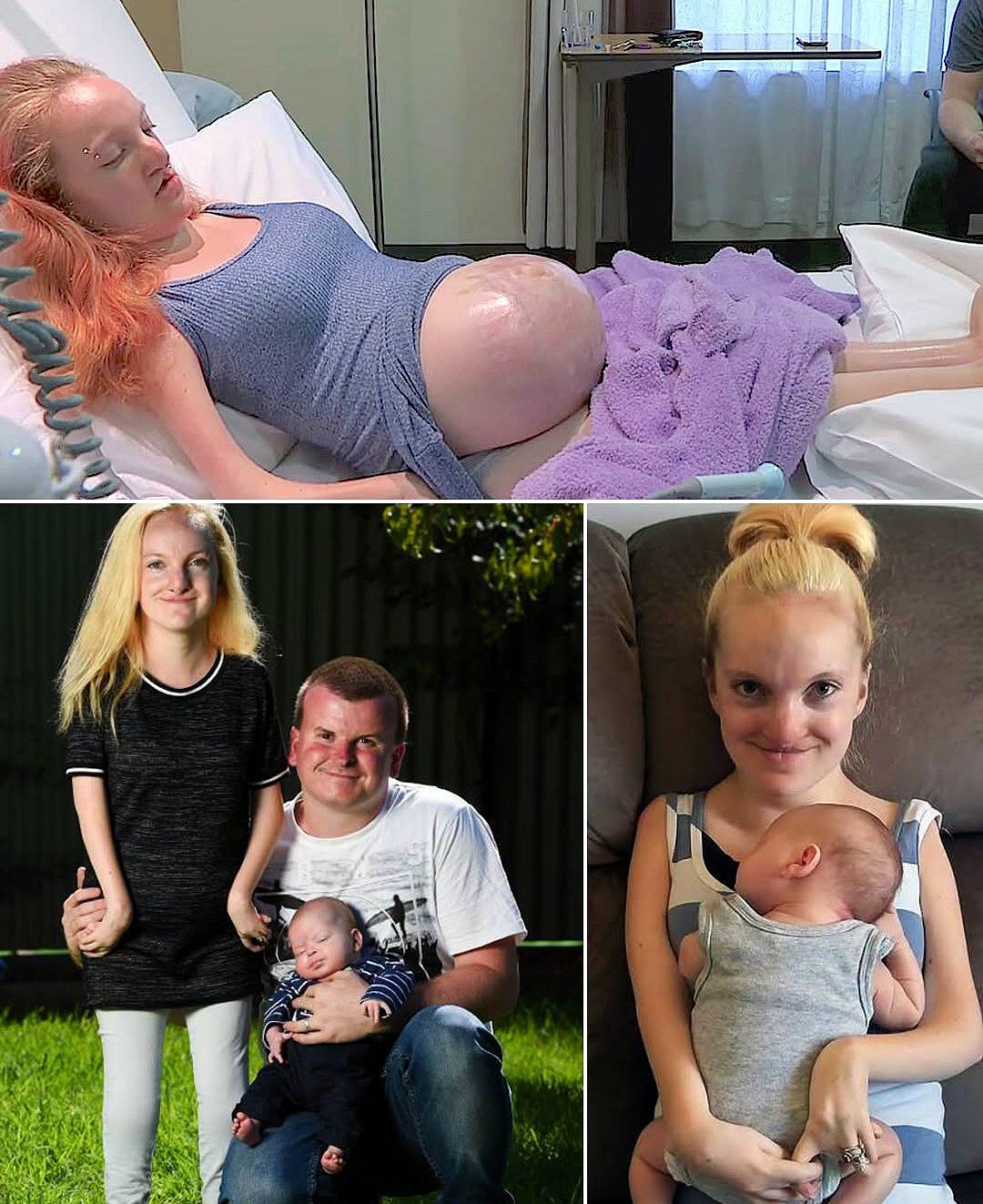
When Sheree became pregnant again, her pregnancy required careful medical supervision. At only about 122 centimeters tall, doctors had concerns about whether her body would have enough room for a growing baby.
The pregnancy was closely monitored.
At 29 weeks, Sheree and Chris moved closer to Melbourne so she could remain near the specialist medical care she might need.
Then, at 36 weeks, their son was delivered by Caesarean section.
His name was Hayden.
He weighed around 2.5 kilograms.
And most importantly, he was healthy.
For Sheree, becoming a mother didn’t suddenly make the physical challenges disappear.
They simply became part of a new chapter.
She couldn’t always pick Hayden up when he cried. Changing him could take extra time. Bathing him sometimes required assistance. She depended on Chris and a carer for certain physical tasks.
But none of that made her love for her son smaller.
None of it made her less of a mother.
Sheree could feed Hayden. She could comfort him. She could cuddle him. She could be there when he needed her. And she could give him something no measurement of physical strength could define—a mother’s love.
At the time, she summed up her situation in a remarkably simple way:
“I’m just a disabled mum who has to lower the handlebar on the pram. That’s it.”
There was something powerful in that statement.
She wasn’t asking the world to pretend her disability didn’t exist.
She was simply refusing to let her disability become the definition of her motherhood.
Even after becoming a mother, strangers sometimes continued to make assumptions about her. Her short stature sometimes caused people to mistake her for a child. Others spoke to her as though her physical disability meant she couldn’t understand what was being said.
But Sheree had spent her entire life proving that appearances don’t tell the whole story.
The little girl doctors once feared might not survive her first year grew up.
The child who faced more than 20 surgeries learned to walk.
The young woman who endured bullying continued her education.
And the woman who had once been surrounded by uncertainty became a wife and a mother.
Hayden was born in 2016—years after Sheree’s parents had once been warned that their daughter herself might not make it through infancy.
Her story is a reminder that sometimes the limits placed on a person come not from their body, but from other people’s assumptions about what that body means.
A disability can change the way someone accomplishes something.
It doesn’t automatically determine whether they can accomplish it.
Sheree’s path to motherhood looked different from what many people might consider “normal.” She needed adaptations, assistance and support.
But parenting has never been about doing everything alone.
It’s about loving, protecting, teaching, comforting and showing up.
And Sheree did exactly that.
Sometimes, the most powerful thing a person can do is simply refuse to let someone else’s expectations become their future.
Because before someone gets the chance to show the world what they can do, the world shouldn’t decide what they can’t.