
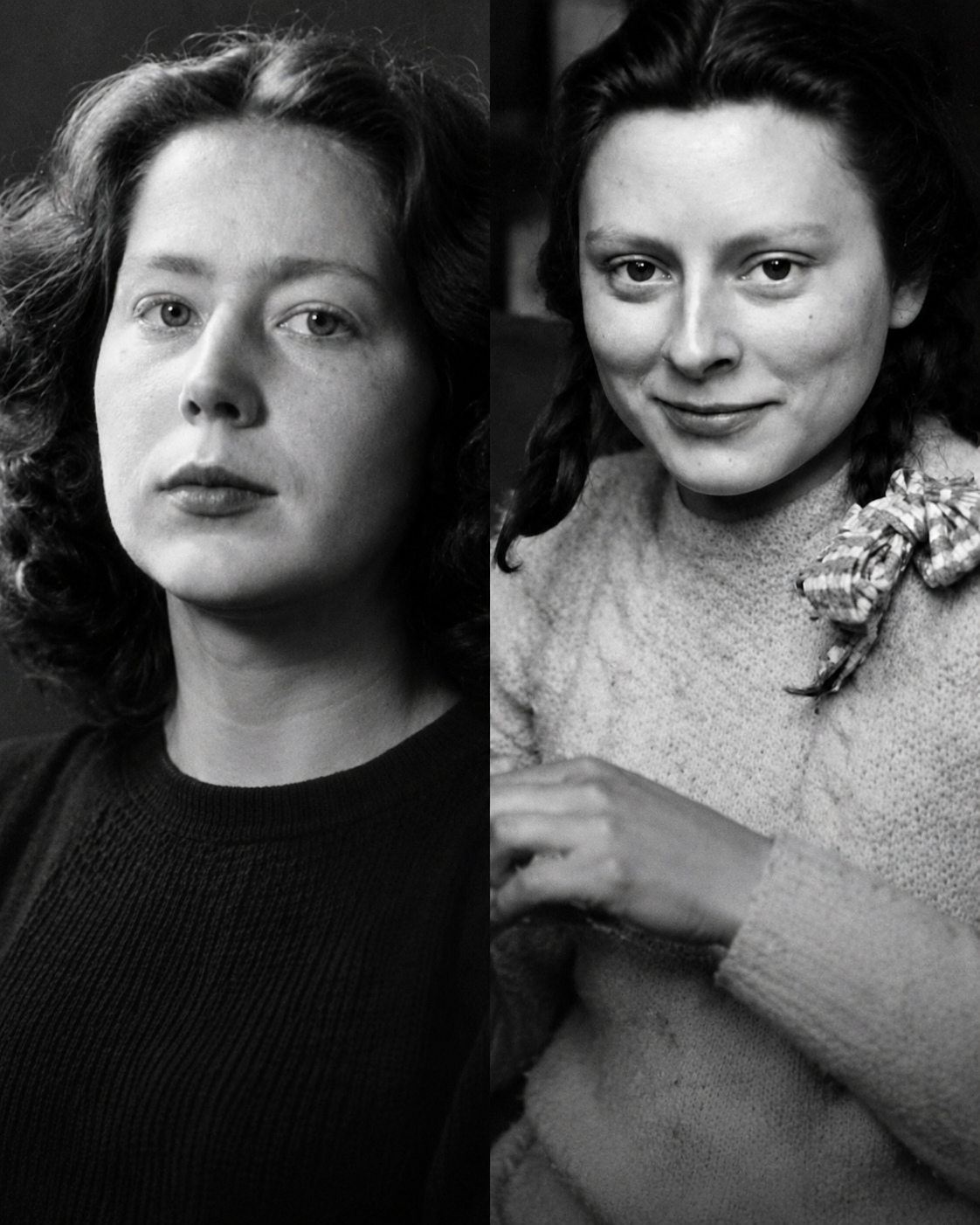
Autumn 1943 came early to the forest east of the river, and with it came the cold that made the birches shiver and drop their leaves like coins into the mud. Marta was seventeen. Her sister Halina was fifteen, though she told anyone who asked that she was seventeen too, since the year had taught her to grow up fast. Their village had been half-burned in the spring, their father taken in a roundup nobody spoke of anymore, and their mother had gone quiet in the particular way that meant she had decided grief was a luxury for after the war, if there was an after.
The partisans who moved through the tree line at night did not recruit children. But they took what help was offered, and what the sisters offered was something the men in the camp could not do themselves: they could walk into the checkpoint at the crossroads and smile.
It started small. Marta would carry eggs to the sentries, two boys not much older than she was, homesick and bored and grateful for a kind face in a country that hated them. She learned their names. She learned which one missed his mother’s dumplings and which one wrote letters he never sent. She was careful never to ask questions that mattered, only questions that made a lonely young man feel remembered.
Halina had a different gift. She could laugh at exactly the right moment, tilt her head, let a soldier believe for the length of an afternoon that the world was still a place where a girl might like him. It cost her something each time — she told Marta so, once, in the dark, in a voice with no laughter in it at all — but she did it anyway, because the men who came back from the woods with her were men who did not come back at all.
The arrangement the sisters made with the unit commander, a former schoolteacher named Wiktor who now went by a forest name nobody used twice, was simple and was never written down. Two nights a week, Halina would walk with a soldier along the tree line, toward the old charcoal-burner’s clearing where the moonlight came down clean through a gap in the canopy, because she had told him it was pretty there, and because young men eighteen years old and far from home will believe almost anything a fifteen-year-old girl tells them if she says it softly enough. And in the clearing, the forest would be waiting.
Marta never went to the clearing. Her part ended at the crossroads, with the eggs and the small talk and the walk that pointed a boy toward his own dusk. She told herself this made a difference, that there was a moral arithmetic in it, though she stopped trying to solve the equation somewhere around the fourth week, when she understood that the sum never balanced no matter how she added it.
Only once did Halina come back to the dugout unable to stop shaking, not from the cold. He had shown her a photograph, she said. Of a woman who might have been his sister, or might not have been; he had said the word for sister in his own language and then, embarrassed, tried it clumsily in Polish, as if the word itself might build a bridge nobody had asked him to build. Halina had smiled and said nothing and walked him the rest of the way to the clearing anyway, because the unit needed his rifle and his boots and the report he carried in his coat, and because if she stopped now, she was certain she would never be able to start again, and then what would any of it have been for.
Wiktor did not thank the sisters, not in words. He was not a man who believed in comfortable things. But he made sure their mother’s hut got the extra ration when there was one, and when the frost came hard in November he found, from somewhere, a coat for Halina that actually fit, and this was as close as the forest came to gratitude.
They did this for eleven months. Historians, when the war ended and the counting began, would argue about the number — some said six confirmed, some said more, and the sisters themselves never gave a figure, because Marta, at least, had stopped counting somewhere in the summer of 1944, on the theory that a number was a kind of monument, and she did not want a monument, she wanted it to be over.
It ended the way these things end, without ceremony. The front moved, the checkpoint emptied, the unit dissolved into the general chaos of a collapsing occupation, and the sisters walked home one gray March morning to a village that no longer entirely recognized them. Halina married young, a quiet man from two towns over who never asked what she had done in the forest and to whom she never told. Marta did not marry. She taught school for forty years and was, by every account of her students, exactingly kind, the sort of teacher who noticed the lonely child in the back row before anyone else did, and made sure that child was walked to the right door.
Neither sister ever used the word hero. When a journalist came looking, decades later, for the girls of the pine wood, Marta gave him tea and told him, gently, that he had the wrong idea entirely — that there had been no cleverness in it, no adventure, only a war that made monsters of children and asked them to be very good at it. He did not print that part. Most of them never do.
Read Next
- She had lost both of her front paws. She was living among garbage, surrounded by dirt, discarded plastic and the harsh reality of survival.
- María José Cristerna: The Woman Behind the Vampire-Like Appearance and Her Journey to Reclaim Her Life
- “To Me, You Are the Most Beautiful Creature on This Planet, Zeddy” ❤️🐶