Sometimes, compassion doesn’t need a long explanation.
It doesn’t need complicated words, years of experience or an understanding of everything happening around us.
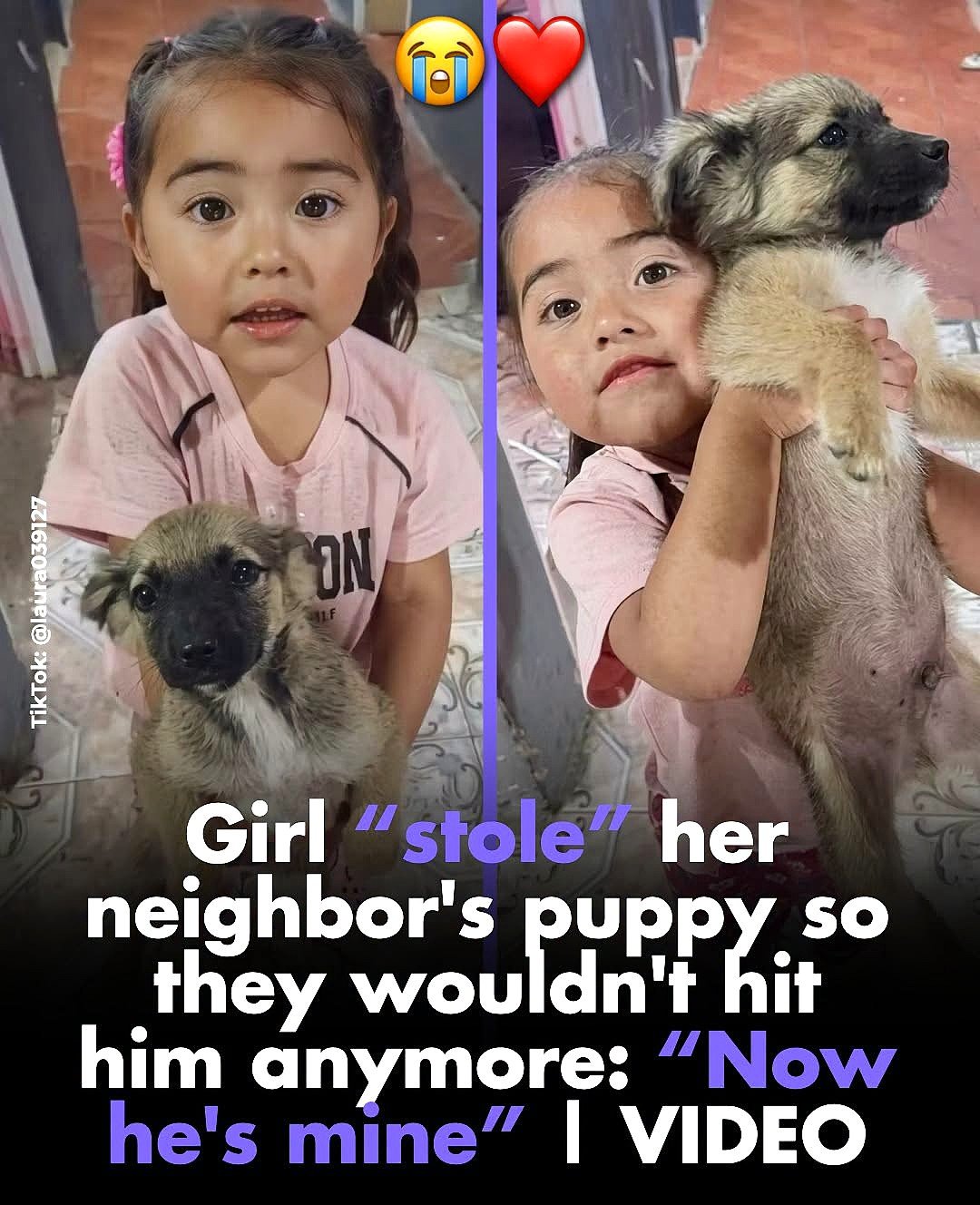
Sometimes, it looks like a little girl walking through the door with a small puppy held tightly in her arms.
When her mother noticed what she was carrying, she naturally wanted to know what had happened.
Why had her daughter brought a dog home?
Where had she found him?
And perhaps most importantly, why was she carrying someone else’s puppy as though she had already decided he belonged with her?
The little girl didn’t hesitate.
Her answer was simple.
“Because they hit him.”
Those few words were enough to explain why she believed she had to act.
According to the girl’s account, the puppy belonged to a neighbor who was not treating him well. Whether the allegation was true was never independently confirmed, but in that moment, the little girl clearly believed that the animal was frightened and needed someone to protect him.
And that belief seemed to matter more to her than anything else.
Her mother, who was filming the interaction, tried to explain the situation.
The puppy wasn’t theirs.
He had an owner.
They couldn’t simply keep someone else’s dog.
Eventually, they would have to figure out what to do and, if appropriate, return the puppy to his home.
But the little girl wasn’t thinking about ownership.
She was thinking about safety.
She held the puppy close to her chest and gently stroked his fur.
There was no dramatic speech.
No complicated argument.
No attempt to make herself look heroic.
She simply stayed close to the animal.
For a child, the situation appeared remarkably straightforward.
If someone is being hurt, you help them.
If someone is scared, you comfort them.
If someone cannot protect themselves, you try to protect them.
That was apparently all she needed to know.
The puppy rested in her arms while she continued petting him with a mixture of tenderness and concern.
Perhaps she didn’t understand all the responsibilities that come with owning an animal.
Perhaps she didn’t know about veterinary care, legal ownership or what adults would eventually need to decide.
But she seemed to understand something much more basic.
The puppy was small.
She believed he was vulnerable.
And she didn’t want to walk away.
Her mother was placed in an uncomfortable position.
On one hand, she knew the puppy belonged to someone else.
On the other hand, her daughter was standing in front of her with an animal she believed had been hurt.
According to a media report, the mother ultimately had little choice but to accept what had happened and deal with the situation.
The moment was later shared online, where it quickly attracted attention.
Thousands of people reacted to the video, while hundreds of comments praised the little girl’s compassion.
Many viewers were touched by the fact that she didn’t seem to be thinking about herself.
She wasn’t asking what she would receive in return.
She wasn’t trying to impress anyone.
She simply saw what she believed was a vulnerable animal and decided that leaving him behind wasn’t an option.
That kind of empathy can be powerful.
Children often see the world differently from adults.
Adults may immediately begin thinking about rules, ownership, consequences and complicated circumstances.
Children sometimes begin with a much simpler question:
“Is someone hurting?”
If the answer is yes, their instinct may be to help.
Of course, there is an important part of this story that should not be overlooked.
The claim that the puppy had been abused came solely from what the little girl reportedly said. There is no independent verification presented in the story confirming that the neighbor actually harmed the puppy.
It is also unclear what ultimately happened to the dog or whether he was returned to his owner.
Those details matter.
Compassion does not require us to assume that every allegation is proven.
We can appreciate the little girl’s concern while still acknowledging what remains unknown.
And perhaps that is another lesson hidden inside this small moment.
Kindness and careful judgment can exist together.
We can teach children to protect animals while also teaching them to seek help from trusted adults when they believe an animal is being mistreated.
A child should never have to confront an unsafe situation alone.
If an animal really is being abused or neglected, the safest response is usually to involve a responsible adult, animal welfare organization, veterinarian or appropriate local authority rather than putting the child in danger.
But what makes this story memorable is the emotion behind the girl’s actions.
She didn’t see a neighbor’s property.
She saw a living creature.
She didn’t see a complicated problem.
She saw a puppy who, in her mind, needed help.
And instead of ignoring what she believed she had witnessed, she acted.
There is something deeply moving about that instinct.
Animals cannot explain their pain in words.
They cannot tell us exactly what happened.
They cannot call for help when they are frightened.
They depend on humans to notice the signs.
A frightened animal may hide.
A neglected animal may become unusually quiet.
A hurt animal may simply look toward someone and hope that person will understand.
That is why empathy matters.
Not only for animals, but for everything vulnerable.
The little girl’s reaction may have been impulsive, but it also reflected a quality that many adults spend years trying to develop: the willingness to care about someone else’s suffering.
Imagine if more children grew up believing that kindness was a responsibility rather than an optional quality.
Imagine if they learned that animals are not toys that can be discarded when they become inconvenient.
Imagine if they understood that having power over a smaller creature comes with an obligation to treat that creature gently.
Perhaps moments like this can become teaching opportunities.
Parents can explain the importance of treating animals with patience.
They can teach children never to hurt a pet, never to provoke a frightened animal and never to approach a potentially dangerous situation without adult help.
Most importantly, they can teach them that noticing suffering is the beginning of compassion—not the end of responsibility.
The little girl’s story may never give us every answer.
We may never know exactly what happened before she picked up that puppy.
We may never know what happened after the video ended.
But one thing is clear from the moment that captured people’s attention.
She cared.
She saw a small animal she believed was in trouble, and her first instinct wasn’t to look away.
It was to hold him.
Sometimes, that’s where kindness begins.
Not with grand gestures.
Not with perfect solutions.
But with one simple decision:
“I won’t leave you alone.”
And perhaps the most important lesson adults can take from this little girl’s reaction is that empathy is something worth protecting, too.
Because the world doesn’t need children who learn to ignore suffering.
It needs children who notice.
Children who care.
Children who ask questions.
And, with the guidance of responsible adults, children who grow into people willing to speak up when something vulnerable needs a voice.
Her arms may have been small.
But for one frightened little puppy, they were exactly where she believed he needed to be.
Read Next
- Thaba Nchu community says fear of alleged dog attacks has left residents feeling trapped
- For Lalo, his puppy is not simply a pet. He is his best friend.His little companion.And someone Lalo feels responsible for protecting. 🐾❤️
- Somewhere near Trenton, Georgia, a heavily pregnant dog was left to fend for herself in the woods. She had no warm bed, no safe place to rest, and no one to turn to as the temperatures began to fall. Her puppies were about to arrive, and she was facing one of the most vulnerable moments of her life completely alone. 💔🐾