They were larger than hers.
Darker than hers.
They even had more hair.
But to Shreya, none of that mattered.
Because after losing both of her arms, those hands gave her something she had desperately wanted back—the ability to live independently. ❤️
In September 2016, Shreya was only 18 years old and studying engineering in India.
She was traveling on a bus when everything suddenly went wrong.
The vehicle overturned, leaving Shreya with devastating injuries to both arms.
Doctors fought to save them.
But eventually, there was no other choice.
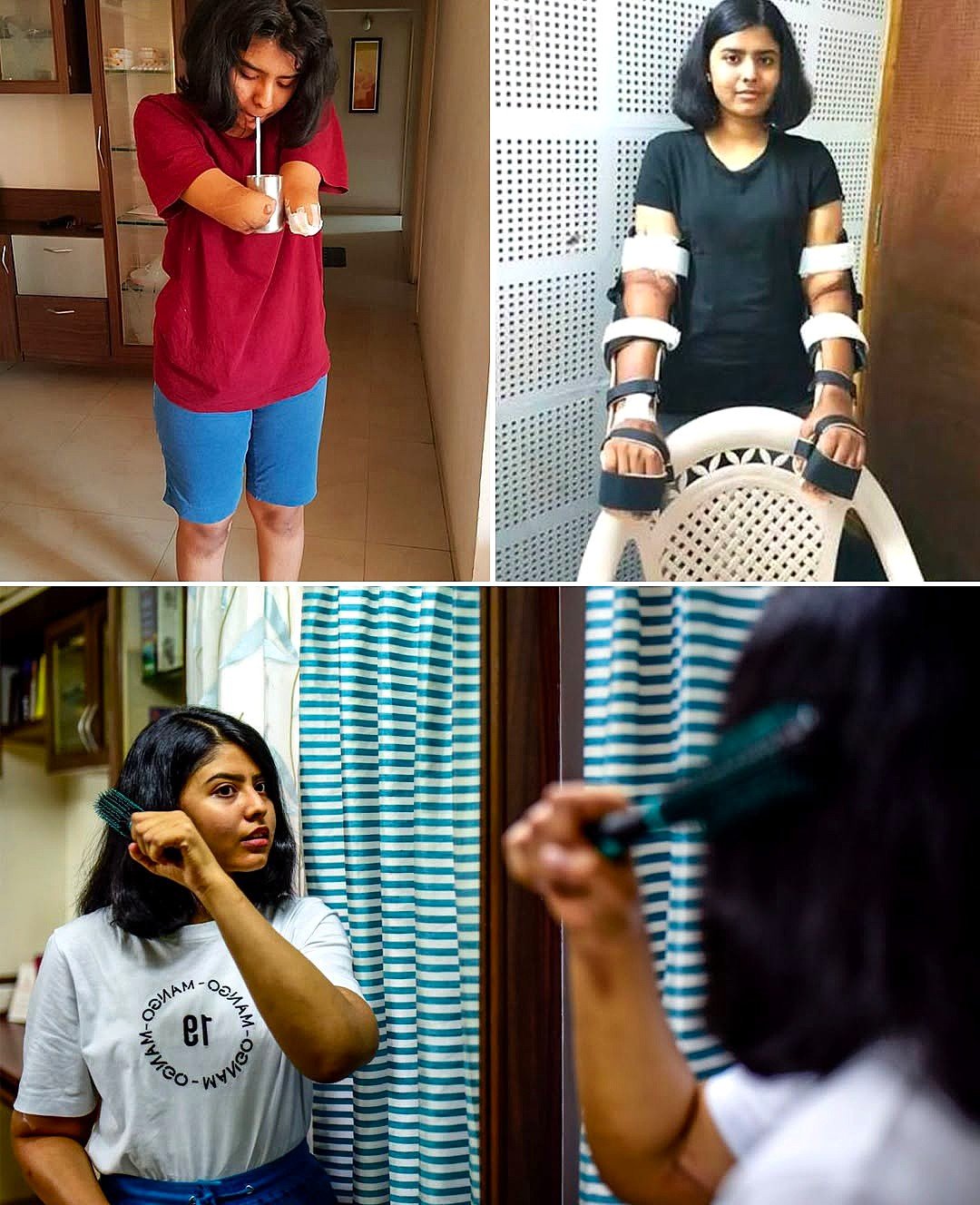
Both of Shreya’s arms had to be amputated near the elbows.
In an instant, ordinary things became extraordinary challenges.
Getting dressed.
Writing.
Brushing her hair.
Holding something in her hands.
Doing the small tasks most people never stop to appreciate.
Shreya tried prosthetic limbs, hoping they would help her regain some of the independence she had lost.
But they couldn’t give her the freedom she wanted.
Then, almost a year after the accident, an extraordinary possibility appeared.
In 2017, a 20-year-old student named Sachin died after a motorcycle accident and was declared brain dead.
His family made an incredibly difficult decision.
They agreed to donate his organs.
Among those donations were both of his hands.
Shreya was a compatible recipient.
For the first time since the accident, there was a possibility that she could have hands again.
But a hand transplant is nothing like simply attaching a pair of hands.
It requires an extraordinary amount of precision.
A team of around 20 surgeons worked for approximately 13 hours.
They connected bones.
Arteries.
Veins.
Muscles.
Tendons.
And nerves.
Every tiny connection mattered.
When Shreya eventually woke up, she had something she had thought she might never have again.
Hands.
But they didn’t look like hers.
Sachin had been a young man, and the donated hands were noticeably larger and darker than Shreya’s. They were also hairier.
For someone else, the difference might have been difficult to accept.
For Shreya, there was only gratitude.
“I am just happy that I have hands now.”
That was what mattered.
But something remarkable began happening over the months that followed.
The hands began to change.
Slowly, they became slimmer.
Their appearance became less obviously different from Shreya’s own arms.
The skin gradually became lighter, moving closer to her natural complexion.
Even the amount of hair decreased.
Doctors observed these changes, but the precise biological reasons behind the transformation were not fully understood.
It was one of the most fascinating aspects of Shreya’s recovery.
Yet the changes that mattered most couldn’t be seen from the outside.
Deep beneath the skin, her nerves were slowly reconnecting.
Her muscles were learning to respond.
Her brain was beginning to communicate with the transplanted hands.
And Shreya had to teach herself how to use them all over again.
The process was not quick.
It required months of intensive rehabilitation, repeated exercises, patience and determination.
Every tiny movement was a victory.
A finger moving.
A hand responding.
An object being held.
A task that once seemed impossible becoming possible again.
After more than a year of rehabilitation, Shreya had regained enough control to perform many everyday activities independently.
She could write.
She could brush her hair.
She could handle objects.
She could begin rebuilding the ordinary life that had been interrupted by one terrible accident.
And then came a moment that carried an especially powerful meaning.
Shreya sat for a college examination using the hands that had once belonged to someone else.
Think about that for a moment.
The same young woman who had once wondered whether she would ever be able to use her hands again was sitting in an examination hall, holding a pen and writing her answers.
The hands had belonged to a stranger.
But now they were helping Shreya write her own future.
Sachin’s family had made a decision that gave another person a chance at independence.
And Shreya turned that gift into a second beginning.
Her story is not simply about a medical procedure.
It is about what can happen when loss, generosity, science and extraordinary human determination meet.
A tragic accident took away something Shreya had always taken for granted.
A young man’s final gift helped return part of it.
And over time, the hands themselves began to change in ways that surprised even the doctors caring for her.
Perhaps the most beautiful part is that Shreya never needed those hands to look exactly like the ones she had lost.
She only needed them to work.
To hold a pen.
To brush her hair.
To reach for something.
To live.
Today, her transplanted hands carry two stories at once.
They carry the memory of the young donor whose family chose organ donation.
And they carry the story of a young woman who refused to let one devastating day define the rest of her life.
Sometimes, a second chance doesn’t arrive looking exactly the way we imagined.
Sometimes, it arrives through the generosity of strangers.
And sometimes, the simplest things—holding a pen, brushing your hair, reaching out and touching the world—become the greatest gifts of all. ❤️
If you suddenly regained the use of your hands after losing them for a year, what ordinary thing would you want to do first?