For most children, looking up at the sky, watching someone walk toward them, or simply meeting another person’s eyes is something they never have to think about.
For Mahendra Ahirwar, those simple moments were almost impossible.
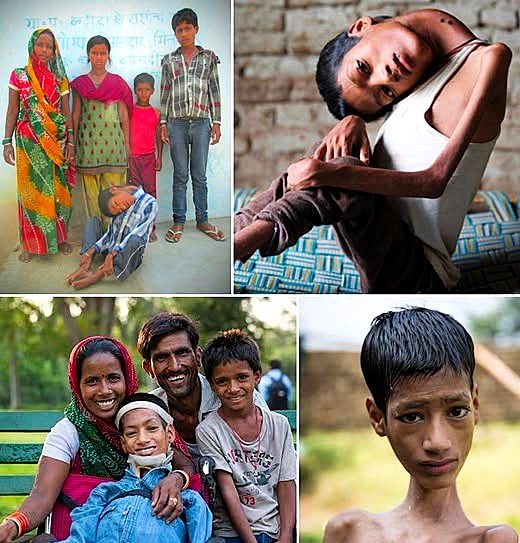
At just 13 years old, Mahendra lived in Madhya Pradesh, India, with a condition that left the muscles in his neck far too weak to support his head. His head remained severely bent forward, making even the smallest daily activities incredibly difficult.
Eating was a struggle.
Getting dressed required help.
Spending time and playing with other children was not easy.
His mother became his constant support, helping him through routines that most children could do without assistance. While she cared for him every day, his family continued searching for an answer—some treatment that might give their son a chance to hold his head upright.
Then, thousands of miles away in Liverpool, England, a woman named Julie Jones learned about Mahendra’s situation.
Julie was a mother herself. After reading about the young boy and seeing how dramatically his condition had affected his life, she decided she could not simply look away.
She began a crowdfunding campaign to help raise money for Mahendra’s treatment.
People responded.
Approximately £12,000 was eventually raised, giving Mahendra’s family an opportunity they had almost stopped believing was possible.
He was taken to Apollo Hospital in New Delhi, where spine surgeon Dr. Rajagopalan Krishnan and his team prepared for an extremely complicated operation.
The surgery reportedly lasted around ten hours.
Doctors used bone taken from Mahendra’s pelvis along with a metal plate to straighten and stabilize his neck. It was a major procedure, and there was no guarantee that life afterward would suddenly become easy.
But when Mahendra emerged from the operation, something remarkable had changed.
For the first time in years, he could hold his head in a much more natural position.
He could look straight ahead.
That simple ability represented something enormous.
It meant he could see the world from a different angle—not constantly facing downward, but finally able to look toward the people around him.
His recovery brought other small victories.
Reports said Mahendra began learning to write. He spent time playing with friends. Another supporter donated an electric wheelchair, giving him greater freedom to move around.
Things that many people might consider ordinary suddenly carried enormous meaning.
Mahendra could participate more.
He could interact with friends.
He could begin thinking beyond the limitations that had shaped so much of his childhood.
And his family began dreaming, too.
His mother said Mahendra hoped to open a small shop one day with his family’s help.
It was a modest dream, but perhaps that was what made it so beautiful.
He wasn’t asking for fame or extraordinary success.
He simply wanted a chance to build a life of his own.
Sadly, that future did not last as long as anyone hoped.
Only a few months after the surgery, in November 2016, Mahendra unexpectedly died at home.
The news shocked his surgeon and everyone who had followed his journey. The operation had successfully corrected the position of his neck, but it could not cure the underlying muscle condition that had affected his life.
His story ended far too soon.
But his final months were filled with experiences that had once seemed almost unimaginable.
He was able to look forward.
He was able to spend time with friends.
He began learning new things.
He received a wheelchair that gave him greater independence.
And most importantly, he was able to make plans for his own future.
A woman thousands of miles away had read about a boy struggling to hold his head upright and decided that his story mattered.
She reached out.
Others followed.
Doctors operated.
Supporters donated.
And for a brief but meaningful period, Mahendra experienced a world that looked different from the one he had known for years.
His life was heartbreakingly short, but the kindness shown to him crossed borders, cultures and oceans.
Sometimes, we never know how far one act of compassion can travel.
For Mahendra, it traveled thousands of miles—and helped give him something incredibly precious: the chance to look straight ahead.