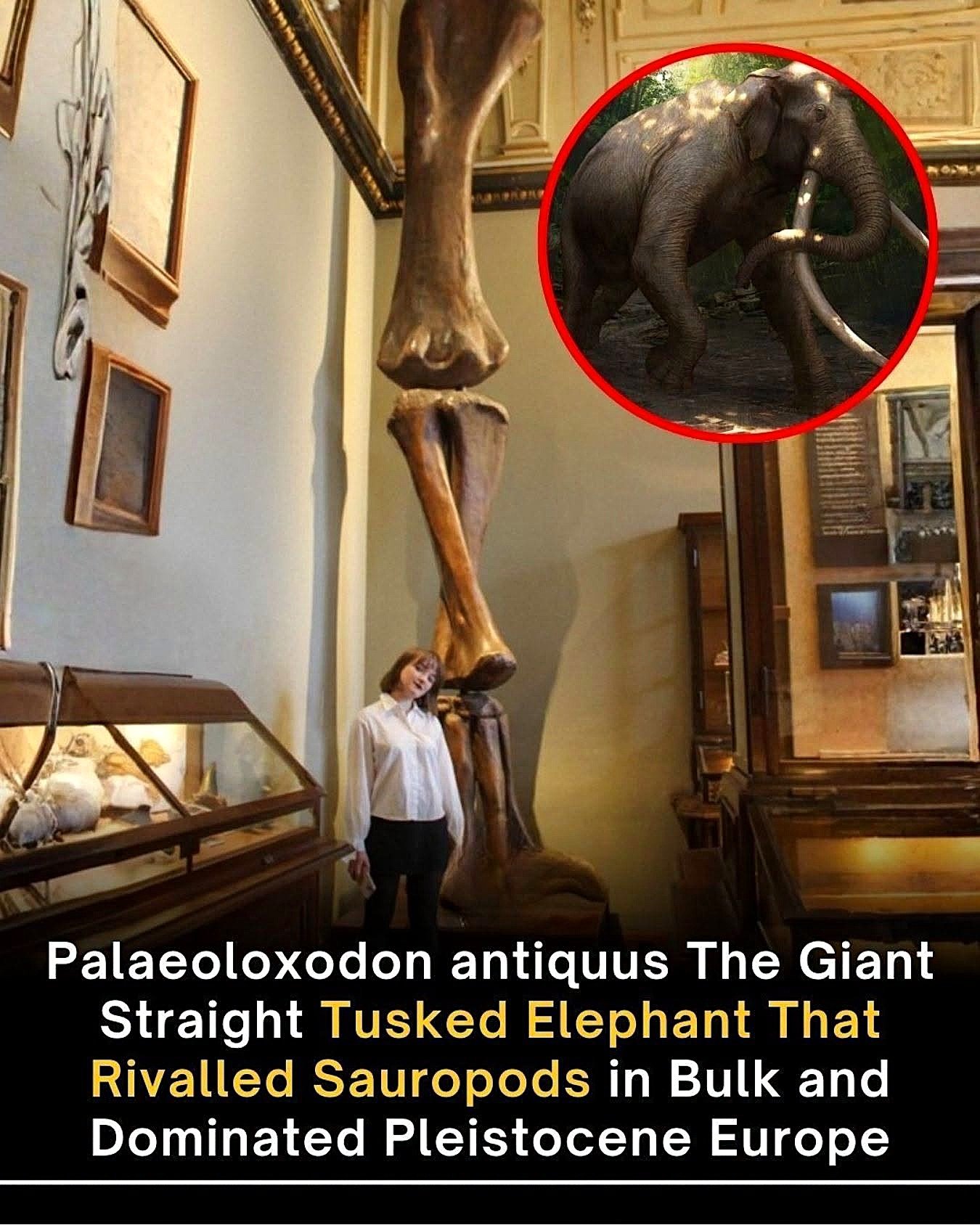
Imagine walking through the forests of prehistoric Europe and suddenly encountering an elephant standing nearly four metres tall at the shoulder. Now imagine that this enormous animal weighed more than 10 tonnes and carried tusks stretching several metres from its face.
This was not a creature from a fantasy movie or a dinosaur reconstruction. It was Palaeoloxodon antiquus, better known as the straight-tusked elephant—a gigantic relative of modern elephants that once dominated parts of Europe and western Asia.
For hundreds of thousands of years, these colossal animals wandered across ancient landscapes, surviving dramatic changes in climate and sharing their world with some of humanity’s earliest ancestors. Their extraordinary size was so impressive that palaeontologists sometimes compare the largest individuals with the smaller sauropod dinosaurs in terms of overall mass.
A True Giant of the Ice Age
Palaeoloxodon antiquus lived during the Pleistocene, a period marked by repeated cycles of ice ages and warmer interglacial periods. Its range covered large portions of Europe and extended into western Asia.
Adult straight-tusked elephants could reach approximately 4 metres at the shoulder, while exceptionally large individuals may have been even taller. Average body weights have been estimated at roughly 11 to 15 tonnes, placing them among the heaviest land mammals ever to walk on Earth.
To put that into perspective, these elephants were several times heavier than many modern elephants.
Their enormous bodies required huge quantities of food and water, meaning they needed access to productive environments capable of supporting such a massive herbivore.
But size was only one remarkable feature of this prehistoric giant.
The Straight Tusks That Gave It Its Name
One of the most recognizable features of Palaeoloxodon antiquus was its enormous tusks.
Unlike the strongly curved tusks associated with many mammoths, the tusks of straight-tusked elephants were generally long, thick and relatively straight. Some fossil specimens indicate that tusks could reach around 3.5 to 4 metres or more in exceptional cases.
These tusks were not simply decorative weapons.
Like the tusks of living elephants, they may have been used for fighting, displaying strength, competing for mates, manipulating vegetation and defending themselves against threats.
For males, enormous tusks may also have played an important role in competition with other males. A large male with impressive tusks could have been a formidable rival during contests for access to females.
Males Were Much Larger Than Females
Just as modern elephants show significant differences between males and females, Palaeoloxodon antiquus appears to have displayed strong sexual dimorphism.
Males could grow substantially larger than females, with some males reaching truly extraordinary dimensions.
Evidence suggests that males may have continued growing for much of their lives. This pattern is also seen in living elephants, where older males can become dramatically larger than younger individuals.
Such continued growth would have given older males enormous physical advantages, particularly when competing with younger males.
It also means that the largest individuals encountered by humans in the ancient world may have looked almost unbelievably huge compared with today’s elephants.
Masters of Changing Environments
Despite their enormous size, straight-tusked elephants were not restricted to one particular type of landscape.
Fossil evidence indicates that they occupied a variety of environments, including temperate woodlands, forests and Mediterranean-type landscapes.
Their distribution changed as the climate changed.
During warmer interglacial periods, populations could expand farther north into regions that became too cold during later glacial phases. When ice sheets and colder conditions returned, their range contracted toward more suitable southern environments.
This ability to move across changing landscapes was crucial for survival during the unstable climate of the Pleistocene.
For hundreds of thousands of years, these giant elephants successfully endured environmental changes that eliminated many other species.
A Giant That Met Early Humans
Perhaps one of the most fascinating parts of the story is that Palaeoloxodon antiquus did not live in an empty prehistoric world.
Early human populations shared parts of Europe with these enormous elephants.
Archaeological sites have produced evidence connecting straight-tusked elephants with ancient hominins, including populations related to the predecessors of Neanderthals. Stone tools and signs of animal processing at some sites suggest that these giant elephants could become targets of human activity.
Hunting an animal weighing more than 10 tonnes would have been extraordinarily dangerous.
For early humans, however, successfully exploiting such an animal could provide an enormous amount of meat and other useful resources. Even a single carcass could potentially represent a valuable food source for a group.
The relationship between humans and these elephants was therefore complicated. They may have been prey, valuable resources, competitors for food, or simply enormous animals that humans learned to exploit when opportunities arose.
A Species With a Complicated Scientific History
The scientific story of the straight-tusked elephant is almost as interesting as its biological history.
When the species was first described during the 19th century, it was placed within the genus Elephas and given the name Elephas antiquus.
As scientists studied more fossils and compared the anatomy of different elephant relatives, it became clear that these animals possessed characteristics distinguishing them from mammoths and modern elephants.
The species was eventually reassigned to the genus Palaeoloxodon.
This change reflects an important part of palaeontology: scientific classifications are not fixed forever. As new fossils are discovered and researchers gain a better understanding of anatomy, evolution and relationships between species, scientific names and classifications can change.
How Did Such a Giant Become Extinct?
Despite surviving for an immense period of Earth’s history, Palaeoloxodon antiquus eventually disappeared.
Its extinction occurred roughly between 50,000 and 30,000 years ago, although the exact timing and causes varied across different regions.
Scientists believe there was probably no single explanation.
Climate change played an important role. The Pleistocene was characterized by repeated environmental transformations, and the expansion and retreat of ice dramatically altered ecosystems.
But climate may not have been the only pressure.
Human populations were also becoming increasingly widespread and capable of exploiting large animals. Hunting, competition for resources and changes to habitats could have placed additional pressure on already vulnerable populations.
The disappearance of straight-tusked elephants was therefore likely part of a much larger pattern of megafaunal decline that occurred during the late Pleistocene.
Across different parts of the world, numerous large mammals disappeared during this broad period of environmental and ecological change.
The Strange Fact About This Prehistoric Elephant
One of the most astonishing details about Palaeoloxodon antiquus is its potential body mass.
Some individuals may have approached or exceeded 15 tonnes, making the largest specimens extraordinarily heavy even by elephant standards.
In fact, certain estimates suggest that the biggest straight-tusked elephants may have weighed nearly three times as much as some of the largest modern African elephants.
Their tusks were equally impressive.
Rare fossil evidence indicates that some tusks could exceed 4 metres in length, creating an image of an animal that would have looked almost impossible to believe if it were not preserved in the fossil record.
A Giant Lost to Time
Today, elephants are among the largest animals living on land. But Palaeoloxodon antiquus reminds us that Earth’s past contained giants that pushed the limits of terrestrial body size.
For hundreds of thousands of years, these straight-tusked elephants moved through European forests and open landscapes, adapting to changing climates and encountering generations of early humans.
They were enormous, powerful and remarkably successful.
Yet even a creature of such extraordinary size could not escape the combination of environmental change and increasing human pressure that transformed ecosystems near the end of the Pleistocene.
Their bones and tusks are now silent reminders of a world that no longer exists—a world where enormous elephants walked across Europe and western Asia, sometimes reaching dimensions that make today’s largest land mammals look surprisingly small.
Palaeoloxodon antiquus was more than just a giant elephant. It was one of the most spectacular land mammals ever to inhabit prehistoric Europe—and its fossil remains offer a remarkable glimpse into a lost age of giants.