
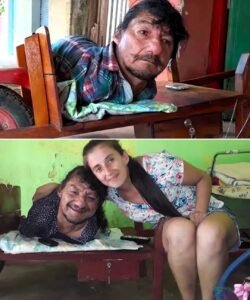
Sometimes, the greatest expression of love is not found in expensive gifts, grand celebrations, or beautiful words. Sometimes, it is found in a daughter who leaves behind the life she has built in another country because her father needs her.
For Élida Acuña, the decision to return from Argentina to Paraguay was deeply personal. She wanted to care for her father, Pablo Acuña, the man she described as “the best dad in the world.”
Her decision carried a powerful message: the man who had spent years caring for his daughters deserved to feel that same love when he needed help himself.
Pablo’s life had never been easy. He was born without arms, and his legs did not develop fully. Many everyday activities that other people could perform without thinking required assistance, patience, and creative solutions for him.
But Pablo’s physical limitations did not prevent him from becoming an important part of his daughters’ lives.
His story is not simply about a father living with a disability. It is about a parent who raised his children with love, a grandmother who helped hold the family together, and a daughter who eventually returned home to care for the people who had cared for her.
According to the family’s account, the girls’ mother left when the older daughter was just three years old and Élida was only four months old.
That meant Pablo faced the enormous responsibility of raising two young daughters while navigating his own daily challenges.
He could not do everything a parent might ordinarily do without assistance. Yet he remained determined to be present in his children’s lives.
His mother, Ignacia del Valle, became an essential part of that journey. Together, the father and grandmother helped raise the girls, finding ways to manage everyday responsibilities and provide the children with a family environment.
Their home became a place where love was demonstrated through practical actions.
It meant helping with daily tasks, making adjustments when something seemed difficult, and working together to ensure that the family could move forward.
For Élida and her sister, their childhood was shaped by this shared care. They had a father who remained central to their lives and a grandmother who helped make the family’s daily routine possible.
Pablo’s circumstances required him to approach ordinary activities differently.
He learned to use his nose to operate his mobile phone and television remote. Tasks that many people take for granted demanded ingenuity and practice.
For getting around, he relied on a wooden cart that became a familiar part of his everyday life. Someone would help move him when he needed to travel from one place to another.
The cart was more than a practical solution. Over the years, it became part of the family’s routine, a familiar object associated with the life they had built together.
Behind these everyday adaptations was a family that learned to find solutions rather than allow difficulties to define their relationships.
Pablo’s story reminds us that being a parent is not measured by physical ability alone. Children need affection, protection, guidance, and the feeling that someone cares about their future.
And those are things Pablo helped give his daughters.
Years passed, and the family entered another stage of life.
The grandmother who had supported Pablo and helped raise the girls grew older herself. Eventually, caring for him became increasingly difficult for Ignacia.
The woman who had spent so many years helping her son now needed support with the responsibilities she had carried for so long.
That was when Élida made a decision that spoke volumes about the relationship she shared with her father.
She returned from Argentina to Paraguay to help care for Pablo and her grandmother.
Moving back meant placing family responsibilities at the center of her life. Rather than seeing her father’s needs as someone else’s problem, she chose to be present.
Her explanation was simple and heartfelt: he was the best dad in the world.
Those words reveal something beautiful about their relationship. Élida did not describe her father by focusing on what he could not do. She remembered him for the love he had given her.
She remembered the parent who had remained part of her life despite the challenges he faced.
Now, she had the opportunity to give something back.
Love within a family often changes its form over time. Parents carry their children when they are young, and children may eventually find themselves helping their parents as they grow older.
The roles can change, but the bond does not have to disappear.
For Élida, returning home was a way to honor that bond.
Yet the family’s journey also involved another important hope: having a home that better suited Pablo’s needs.
For a long time, the family hoped to have a place of their own where daily life could become more manageable.
In January 2026, Paraguayan broadcaster Telefuturo reported that charitable support had made an adapted house possible.
The news represented an important development for the family. A home designed with Pablo’s circumstances in mind offered the possibility of greater comfort and a living environment better suited to his needs.
Sometimes, the difference between simply getting through the day and living with greater comfort comes down to whether a person’s surroundings accommodate them.
Accessible housing can make everyday routines easier, support caregivers, and help people with disabilities live with greater dignity.
For Pablo and his family, the new house was a meaningful step toward a more suitable living arrangement.
But there was another detail in the report that made his story especially touching.
Even with the possibility of a new home, Pablo reportedly continued to prefer his familiar wooden cart, which was described as his home on wheels.
After years of using it as part of his daily life, the cart had become something familiar to him.
That small detail offers a glimpse into how deeply our routines and surroundings can become connected to our sense of comfort. What looks unusual to someone else may represent familiarity, independence, or a lifetime of memories to the person who uses it.
Pablo’s story is therefore about much more than hardship.
It is about a father who raised two daughters with the help of his mother. It is about a grandmother who gave years of care to her family. And it is about a daughter who returned from another country when the people she loved needed her.
Three generations, each contributing in a different way.
The grandmother helped care for Pablo and his daughters. Pablo raised his children and gave them a father who mattered deeply in their lives. Later, Élida returned to help care for her father and grandmother as their circumstances changed.
Their lives remind us that family love is not always expressed through dramatic gestures.
Sometimes, it means showing up every morning. Sometimes, it means helping someone complete an ordinary task. Sometimes, it means adjusting your plans because another person needs you.
And sometimes, it means crossing borders to return to the place where your story began.
Élida’s decision is especially moving because she did not describe her father as a burden or frame her return as a sacrifice she wanted recognition for. She spoke about him with gratitude and affection.
To her, he was the best dad in the world.
That is a powerful reminder that a person’s value as a parent cannot be measured by physical ability, financial success, or the things they can provide.
It can be measured in the love their children carry long after childhood ends.
Pablo’s life also reminds us that families who live with disability often need more than affection. They may need accessible housing, practical assistance, community support, and people willing to help make everyday life easier.
The charitable support that helped make an adapted house possible shows how a community can contribute to a family’s well-being.
Compassion becomes even more meaningful when it leads to practical change.
At the heart of this story, however, is a daughter who remembers what her father gave her and chooses to be there for him in return.
One day, the little girl who depended on her father grew into a woman who could help care for him. Life had changed, but the love connecting them remained.
And perhaps that is one of the most beautiful things about family: the people who once held our hands may eventually need us to hold theirs.
Because sometimes, the greatest way to say “thank you” is simply to come home. ❤️
If you have a parent, grandparent, or loved one who stood beside you during the hardest moments of your life, take a moment to appreciate them. A phone call, a visit, a helping hand, or a few minutes of genuine attention can mean more than we realize.
Who in your family taught you what it truly means to be there for someone? ❤️