
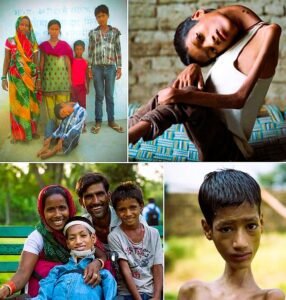
For 13 years, Mahendra Ahirwar lived with a condition that made something most people never think about feel almost impossible: holding his head upright.
While other children could look toward the sky, watch their friends play, or turn their faces toward someone calling their names, Mahendra struggled with the weight of his own head. His neck muscles were too weak to support it, leaving his head severely bent forward.
He lived with his family in Madhya Pradesh, India, where everyday activities came with challenges most children his age could hardly imagine.
Eating required assistance. Getting dressed was difficult. Even spending time with other children could be complicated by a condition he had never chosen and could not control.
His mother stood beside him, helping him through daily routines and doing what she could to make his life more comfortable. Like any parent watching a child struggle, she wanted him to have the opportunity to live with greater independence.
But finding the right medical treatment was not easy. His family faced uncertainty, and the possibility of an operation that could improve his condition seemed increasingly difficult to reach.
Then, thousands of miles away, someone learned about his struggle.
Her name was Julie Jones, a mother of two living in Liverpool, England.
Julie was not a member of Mahendra’s family. She had never watched him grow up or experienced the daily challenges he faced. Yet, when she came across his story, she was moved enough to take action.
Instead of simply feeling sad and moving on, she decided to help.
Julie launched a crowdfunding campaign to raise money for Mahendra’s treatment. Through the generosity of people who contributed, approximately £12,000 was raised to help make medical care possible.
Think about what that meant for his family.
A boy who had spent years living with his head bent forward was finally getting a chance to receive the treatment they had struggled to secure.
And that chance came from someone who lived in a completely different country.
At Apollo Hospital in New Delhi, spine surgeon Dr. Rajagopalan Krishnan and his medical team took on the challenging operation.
The surgery was reported to have lasted around ten hours.
Doctors used bone taken from Mahendra’s pelvis, together with a metal plate, to straighten and stabilize his neck. It was a complex procedure intended to correct the position of his head and give him a better chance at everyday independence.
For Mahendra, the operation represented far more than a medical procedure.
It represented the possibility of seeing the world from a different position.
After years of struggling to lift his head, he could finally look straight ahead.
Imagine how extraordinary that moment must have felt. Looking forward is something most people do without even noticing. We look at the people we love, watch birds moving across the sky, and follow our friends as they walk past us.
For Mahendra, that simple freedom had been out of reach for much of his young life.
Now, the world in front of him was no longer viewed in quite the same way.
But the most meaningful changes were not limited to how he held his head.
In the months following surgery, reports described Mahendra making progress with everyday activities. He began learning to write and was able to spend more time playing with friends.
An electric wheelchair, donated by another supporter, also helped him move around more easily.
These were the kinds of improvements that could transform an ordinary day into something special.
Learning to write meant gaining another way to express himself. Playing with friends meant opportunities to share laughter and experiences with other children. Greater mobility offered the possibility of exploring more of the world around him.
For his family, each step forward carried hope.
His mother had spent years caring for him and helping him navigate activities that many people take for granted. Now, she could begin imagining possibilities that had once seemed painfully distant.
Mahendra also had dreams of his own.
According to reports, he hoped to open a small shop with his family’s help.
It was a modest ambition, but that was part of what made it so meaningful. He was thinking about a future in which he could participate, contribute, and build something for himself.
He was no longer simply the boy whose medical condition had captured people’s attention. He was a young person with interests, ideas, and plans.
For Julie, the medical team, and the people who contributed to his treatment, those developments offered a reason to believe that their efforts had made a real difference.
But Mahendra’s story took a heartbreaking turn.
In November 2016, only months after his operation, Mahendra died unexpectedly at home.
The news shocked the people who had followed his journey, including his surgeon.
He had undergone an operation that corrected the position of his neck, but the procedure could not cure his underlying muscle condition. The surgery addressed one serious physical problem; it could not eliminate every risk associated with his health.
His death was a devastating reminder that medical progress does not always mean a person will have the future everyone hopes for.
For his family, the dreams that had begun to feel possible were suddenly cut short.
There would be no long years ahead to watch him develop his skills, pursue his plans, or perhaps open the little shop he had imagined.
There would be no opportunity to see how much more independent he might become.
And for those who had helped him, the loss must have made the story especially difficult to carry.
They had come together hoping to give a young boy a better chance at life. They had helped make a complicated operation possible, and for a time, there were signs of progress and new possibilities.
Then came the news no one wanted.
Yet, Mahendra’s story should not be remembered only for its ending.
For years, he had lived with a physical limitation that affected nearly every part of his daily life. His family had searched for help, and strangers who had never met him chose to care about what happened to him.
A woman in England started a campaign. Donors contributed money. A surgeon and his team undertook a difficult operation. Another supporter provided an electric wheelchair.
Each person played a different role, but together they helped create opportunities that had once seemed beyond reach.
Their actions did not give Mahendra a lifetime of freedom, and they could not protect him from every medical complication. But they helped him experience changes that mattered while he was here.
He could look ahead. He could work on learning to write. He could spend time playing with friends. He could imagine opening a shop one day.
Those experiences were real, even though his life ended far too soon.
Perhaps the most powerful lesson in Mahendra’s story is that kindness is not measured only by how long a person lives afterward or by whether every difficulty can be overcome.
Sometimes, compassion matters because it gives someone an opportunity they might otherwise never have received.
Julie did not know Mahendra personally, but his story reached her heart. She responded by doing something practical, and that action helped bring a family closer to a hope they had almost stopped believing was possible.
Her story reminds us that we do not always need to know someone personally to recognize their suffering or care about their future.
And Mahendra reminds us that behind every medical headline is a human being whose dreams are often beautifully ordinary: learning something new, spending time with friends, becoming more independent, and imagining what tomorrow might bring.
His life was tragically short, but his story continues to remind people what can happen when strangers choose to help.
Sometimes, we cannot change the ending of someone’s story. But we can help make a meaningful chapter possible. ❤️
What stays with you most about Mahendra’s journey: Julie’s kindness in helping a family thousands of miles away, or the everyday freedoms and dreams Mahendra was able to experience after his surgery?
Share your thoughts, and pass his story along to remind others that even one person’s kindness can make a difference.