
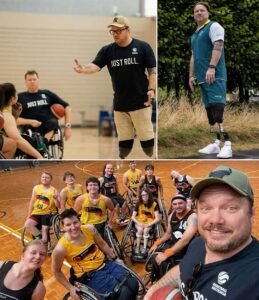
At just 17 years old, Rob Pike was standing on the edge of adulthood. He was in his final year of high school, dreaming about the future and imagining the life he wanted to build. Like many teenagers, he had plans, ambitions, and possibilities that seemed almost endless.
He dreamed of playing Australian rules football. He also considered joining the Defence Force. His future was still unwritten, and there were so many things he hoped to experience.
But one rain-soaked road in Western Australia changed everything.
In 1999, Rob was involved in a devastating car crash that claimed the lives of three of his closest friends. The vehicle aquaplaned on the wet road and struck a tree. Rob survived, but the accident left him with life-changing injuries. Both of his legs were amputated below the knees.
In a single moment, the future he had imagined looked completely different.
He was alive, but the world he returned to was no longer the same. He had to confront the physical challenges of losing both legs while carrying the emotional weight of losing three friends whose lives had ended far too soon.
For a teenager who had barely begun his adult life, the road ahead would demand a kind of courage he had never expected to need.
When survival comes with heartbreak
Surviving a serious accident is often described as a second chance at life. But for someone who loses close friends in the same tragedy, survival can also bring painful questions that are difficult to answer.
Why did I survive when they did not?
Could anything have been different?
How do you move forward when the people you expected to grow older with are suddenly gone?
These are the kinds of questions that can accompany survivor’s guilt, a deeply distressing experience in which someone who survives a traumatic event struggles with feelings of guilt or responsibility for having lived.
Rob had to process the loss of his friends while learning how to live with a body that had been permanently changed.
His injuries affected more than his ability to walk. They also disrupted the sporting ambitions and career possibilities he had imagined for himself.
At 17, he was suddenly facing challenges that many people do not encounter until much later in life, if they ever do.
Recovery was not simply about healing physically. It also meant finding a way to live with grief, rebuilding confidence, and discovering that his identity could extend far beyond the injuries he had suffered.
There was no simple way to undo what had happened. His friends could not be brought back, and the accident could not be erased.
But slowly, a different future began to emerge.
The suggestion that changed his direction
During this difficult period, Rob’s father encouraged him to try wheelchair basketball.
At first, it was a new activity in a life that had been turned upside down. But the sport would eventually become much more than a way to stay active.
Wheelchair basketball offered Rob an opportunity to compete, develop new skills, and discover what his body could still accomplish.
The court gave him something to work toward. Training demanded discipline, teamwork, and determination. Every practice offered another opportunity to improve.
Instead of focusing exclusively on what the accident had taken away, he could begin exploring what remained possible.
The sport did not erase his grief, and it could not replace the friends he had lost. But it gave him a new direction at a time when he desperately needed one.
In 2001, Rob began his national league career with the Perth Wheelcats, taking his first major steps toward becoming an accomplished wheelchair basketball player.
What started with his father’s encouragement developed into a serious sporting career.
Rob had found a place where determination mattered, where teamwork created opportunities, and where his future could be shaped by his effort rather than defined entirely by his injuries.
From athlete to leader
Rob continued developing as a player and eventually represented Australia in wheelchair basketball.
Competing at a high level requires much more than physical strength. Athletes must learn to read the game, anticipate opponents’ movements, communicate with teammates, and make decisions under pressure.
Wheelchair basketball brings its own unique technical demands. Players must coordinate their chairs while dribbling, passing, shooting, defending, and positioning themselves around the court.
For Rob, the sport became a way to channel his competitive instincts into a new pursuit.
Over time, his experience also created opportunities to help others.
He moved into coaching, passing on the lessons he had learned through years of training and competition. Working with younger athletes allowed him to contribute to a new generation of players, helping them develop their skills and confidence.
His journey had come full circle in an unexpected way. As a teenager, he had dreamed of a future in sport. After the crash, that dream appeared to have disappeared. Through wheelchair basketball, he found another path that allowed him to remain connected to competition and eventually guide others.
In June 2025, Basketball Australia appointed Rob head coach of the Australian Wombats 3×3 wheelchair basketball program.
It was a significant milestone, reflecting how far he had travelled since the accident that changed his life.
The teenager who once faced an uncertain future had become a leader responsible for helping athletes grow, compete, and pursue their own ambitions.
Yet his most important work would extend beyond the basketball court.
Returning to the memory he could never leave behind
Some people find healing by avoiding reminders of painful experiences. Others discover that speaking about what happened can help them make something meaningful out of their suffering.
For Rob, road safety became an important part of his life beyond sport.
He began sharing his experience with young people, particularly students approaching the age he was when the crash occurred.
His message carries a different weight because he is not speaking about an accident as an abstract possibility. He knows what it means to lose friends, survive catastrophic injuries, and rebuild a life after a single moment changes everything.
According to RAC reporting in March 2026, Rob speaks to more than 14,000 Western Australian students each year through the bstreetsmart road-safety event.
These presentations ask young people to think seriously about the decisions they make behind the wheel and the consequences those decisions can have.
For teenagers preparing to drive, it can be tempting to believe that serious accidents happen to other people. A familiar road may feel safe. A short journey may seem too ordinary to carry much risk. Friends in the car may create distractions, while confidence can sometimes become carelessness.
But road accidents do not announce themselves in advance.
Wet surfaces, excessive speed, poor decisions, distraction, and a failure to adjust driving to the conditions can turn an ordinary trip into a tragedy.
Rob’s story puts a human face on those risks.
Behind every road-safety statistic are people with families, friendships, ambitions, and plans for the future.
When a crash happens, the consequences can reach far beyond the person holding the steering wheel.
A message delivered to the next generation
On October 14, 2026, Rob was sharing his road-safety message with students in Geraldton, Western Australia.
Speaking about the crash means revisiting a devastating chapter of his life. Each time he tells the story, he must confront memories of his friends and the future that disappeared on that rainy road.
Yet he continues because the message may matter to someone listening.
Perhaps a student will think twice before speeding in bad weather. Perhaps a new driver will put their phone away instead of checking a notification. Perhaps someone will refuse to get into a car with a driver who has been drinking.
No speaker can guarantee that every listener will change their behavior. But a personal story can make a risk feel real in a way that warnings alone sometimes cannot.
Rob cannot change what happened in 1999. He cannot give his friends another chance at life, and he cannot return to the teenager he was before the crash.
What he can do is use his experience to encourage others to make safer choices.
His work is a reminder that road safety is not only about rules, penalties, or statistics. It is also about protecting the people we love and recognizing that our decisions can affect lives far beyond our own.
The future he never expected
Rob’s life did not follow the path he imagined at 17.
The football dreams, the possibility of military service, and the ordinary experiences of growing into adulthood were interrupted by an unimaginable tragedy.
But his story did not end at the crash site.
He rebuilt his life through sport, represented his country, developed into a coach, and took on the responsibility of guiding younger athletes. Alongside those achievements, he chose to return repeatedly to one of the most painful memories of his life to help protect people he may never meet.
That does not mean the loss of his friends has become unimportant. It means he has found a way to carry that loss while continuing to contribute to the world around him.
Sometimes, courage is visible in sporting victories and professional achievements. At other times, it appears in the decision to speak about something painful because someone else might learn from it.
Rob’s journey reflects both.
His story is not simply about surviving a crash or overcoming physical adversity. It is about the difficult work of moving forward after loss, finding a new purpose, and choosing to turn a personal tragedy into a warning that could save another family from experiencing the same heartbreak.
A few seconds on a wet road changed his life forever. Today, he uses the lessons of that moment to remind young drivers that the choices they make can have consequences that last a lifetime.