
Graduation ceremonies are usually filled with familiar sights.
Students walk across the stage wearing carefully pressed gowns and caps. Families cheer from the audience. Cameras flash as diplomas are handed over. For many young people, it is the moment when years of studying, late nights, difficult exams and countless sacrifices finally come together.
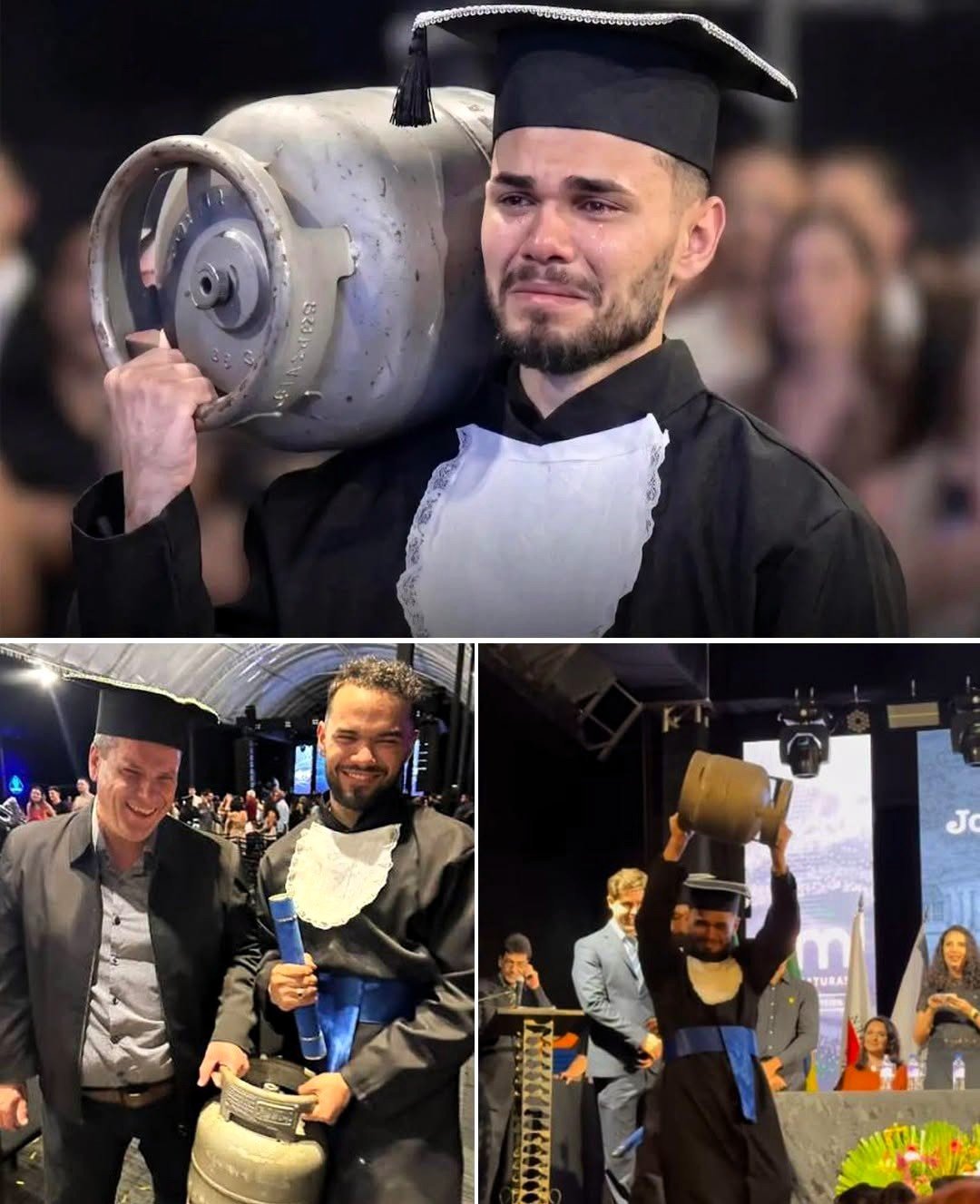
But when 22-year-old Brazilian student Lorenzo Monfardini stepped onto the graduation stage, he carried something that made his achievement impossible to forget.
It wasn’t another academic award.
It wasn’t a bouquet of flowers.
And it certainly wasn’t something most people would expect to see at a university graduation.
Across his shoulders, Lorenzo carried a gas cylinder.
At first glance, it may have looked like an unusual choice.
But for Lorenzo, that cylinder was much more than a piece of equipment.
It represented his father’s life.
It represented 26 years of hard work, responsibility and sacrifice.
And, most importantly, it represented the person Lorenzo believed deserved to share the achievement just as much as he did.
Lorenzo had just completed his studies in Production Engineering at the Federal University of Ouro Preto in Brazil. It was a proud moment for him and his family—a moment that marked the end of years of education and the beginning of a new chapter.
Yet Lorenzo understood something that is easy to forget when someone receives a diploma:
No achievement happens completely alone.
Behind every graduation photograph, there can be years of unseen effort.
Someone may have worked extra hours.
Someone may have skipped personal comforts.
Someone may have worried about bills while quietly making sure their child had what they needed.
And in Lorenzo’s case, much of that invisible effort belonged to his father, Jefferson.
For more than two decades, Jefferson had worked in the gas business. Day after day, year after year, he did the kind of work that often happens far away from university classrooms and graduation ceremonies.
His job helped provide for his family.
His work helped create opportunities for his children.
And while Lorenzo spent years studying engineering, his father spent those same years continuing to work so that the family could keep moving forward.
Twenty-six years is a long time.
It is long enough to contain thousands of working days, early mornings, difficult moments and countless decisions to keep going even when life becomes exhausting.
Lorenzo never forgot that.
So when his graduation day arrived, he wanted to make sure his father was not merely sitting somewhere in the audience watching his son receive a diploma.
He wanted to carry his father’s story with him.
That’s why the gas cylinder came onto the stage.
As Lorenzo walked forward, the object resting across his shoulders became a powerful symbol of everything that had happened before that moment.
The engineering degree represented Lorenzo’s years of education.
The gas cylinder represented Jefferson’s years of labor.
Together, they told one story.
A father worked so his son could study.
A son studied so he could build a future.
And on graduation day, the son made sure everyone knew that the two journeys were connected.
Lorenzo later explained the meaning behind his unusual graduation gesture. To him, the cylinder symbolized his father’s dedication, effort and sacrifices throughout those 26 years.
It wasn’t about making a spectacle.
It wasn’t about getting attention.
It was about saying thank you in a way that words alone could never fully express.
The moment was captured on video and quickly attracted attention online.
People who saw Lorenzo carrying the cylinder could immediately sense that there was something deeper behind the unusual image.
A young engineer was celebrating his success while carrying a reminder of the work that helped make that success possible.
There was something beautifully symbolic about the contrast.
Lorenzo’s father worked with gas cylinders.
Lorenzo worked toward an engineering degree.
One profession helped keep the household running.
The other represented a young man’s dreams for the future.
But neither was more important than the other.
Because families are often built through different kinds of work.
One person may spend years earning money.
Another may spend years studying.
Someone else may take care of the home.
Someone may offer encouragement when everything feels impossible.
And sometimes, the person whose name never appears on the diploma is one of the biggest reasons that diploma exists at all.
That is what makes Lorenzo’s graduation moment so powerful.
He could have walked across the stage carrying only his diploma.
He could have smiled for the cameras, taken photographs and celebrated with his classmates.
And there would have been nothing wrong with that.
He had earned his achievement.
But instead, he chose to acknowledge the person who had helped him reach that stage.
He turned his father’s everyday tool into a symbol of love.
The gas cylinder was no longer simply something connected to his father’s occupation.
For that moment, it became a medal of sacrifice.
It carried the weight of 26 years of work.
It carried the memories of a father doing whatever he could to support his family.
And when Lorenzo lifted it above his head, it was almost as if he was lifting his father’s contribution into the spotlight too.
His diploma said, I graduated.
The cylinder seemed to say, We made it.
That small difference is what touched so many people.
Because parents often make sacrifices without expecting recognition.
They don’t always talk about the overtime.
They don’t always mention the things they gave up.
They may never tell their children how worried they were about money or how tired they felt after a long day.
They simply keep working.
They keep providing.
They keep believing that one day their children will have opportunities they may not have had themselves.
And then, years later, they watch those children walk across a stage.
For a parent, that moment can feel like a reward for every difficult day that came before it.
For Lorenzo, however, the graduation wasn’t just about reaching the finish line.
It was about remembering who helped him get there.
His story offers a simple but powerful reminder: success is rarely the product of one person’s effort alone.
Behind many degrees are parents who sacrificed.
Behind many careers are families who believed.
Behind many dreams are people who quietly worked so someone else could chase theirs.
Lorenzo’s gas cylinder became a symbol of that truth.
It showed that an ordinary object can carry extraordinary meaning when it is connected to love, family and sacrifice.
And perhaps that’s why the image stayed with so many people.
Because most of us have something similar in our own lives.
Maybe it is an old pair of work shoes worn by a parent.
Maybe it is a sewing machine.
A lunchbox.
A delivery bag.
A toolbox.
A bus driver’s uniform.
A farmer’s hat.
Or simply a pair of tired hands that spent years working so their child could have a better future.
These objects may look ordinary to the world.
But to a family, they can represent an entire lifetime.
Lorenzo walked onto that graduation stage carrying a gas cylinder.
But in a deeper sense, he was carrying his father’s sacrifices, his family’s hopes and 26 years of love.
And perhaps that is the most beautiful part of his story.
He didn’t treat his success as something that belonged only to him.
He made sure his father stood beside him—even if it was through a simple gas cylinder carried across a university stage.
Because sometimes the most important thing we receive on graduation day isn’t the diploma in our hands.
It’s the realization that we didn’t get there alone.
And sometimes the best way to honor the people who helped us reach our dreams is simply to let the world know:
“This achievement is yours, too.”
If you could carry one object across your graduation stage to represent everything your parents or family sacrificed for you, what would you carry?