For Copper, the world had never depended on sight alone.
He knew life through sounds, smells, textures, familiar footsteps, gentle voices, and the reassuring presence of people he trusted. A bowl placed in the same place. A wall that was always there. A familiar doorway. The sound of someone approaching him.
Those ordinary things became his map.
Then, somehow, that map disappeared.
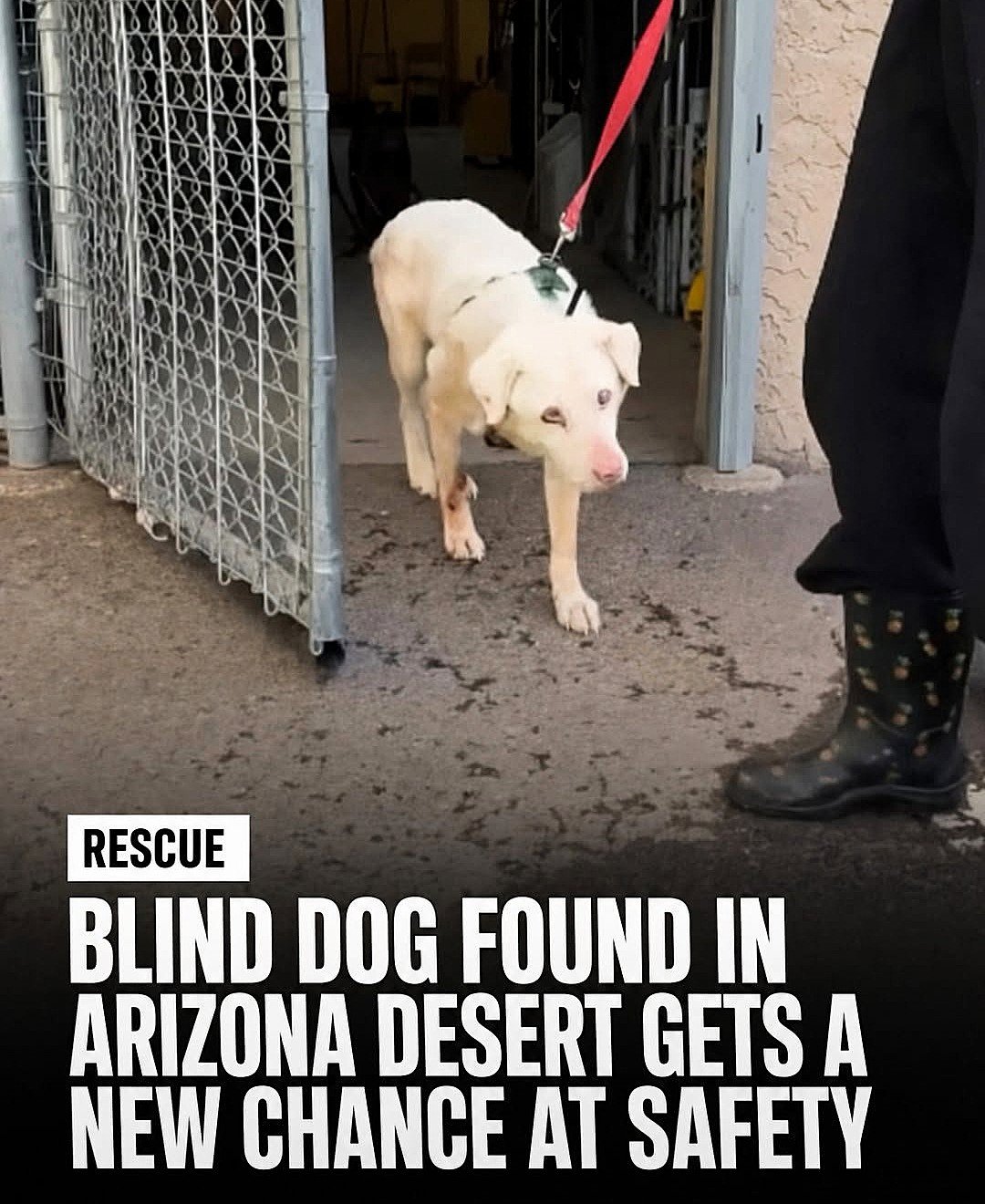
Copper, a blind dog, found himself alone near Buckeye, Arizona, surrounded by an environment he could not understand. There were no familiar walls to guide him. No trusted voice telling him where he was. No way for him to see where shade might be, where water could be found, or where danger might come from.
He was simply there, trying to navigate a world he could no longer see.
And the timing could not have been more frightening.
Arizona’s desert heat can become brutally intense, especially during the hottest parts of the day. For a blind dog already vulnerable and frightened, being outside in such conditions could quickly become dangerous.
Copper did not know where safety was.
But fortunately, someone noticed him.
A passerby found the frightened dog before the desert heat became even more dangerous. That single decision to stop and help changed everything.
Copper was eventually brought to the attention of Desert Tails Rescue, where rescuers began working to understand what he needed.
But bringing him indoors was only the beginning.
Copper’s eyes were in poor condition and required significant veterinary attention. He needed examinations, testing, treatment, and supportive care. More importantly, he needed something that could not be provided by medicine alone.
He needed to feel safe again.
For a blind dog, the world can be built from sounds.
A gentle voice can tell him that someone is nearby. Footsteps can become familiar landmarks. A hand resting carefully against his body can tell him he is not alone. Even the simple routine of being fed in the same place can slowly help a frightened animal understand that he has reached somewhere safe.
That is why Copper’s rescuers understood that his recovery would have to be about more than treating his physical problems.
They had to help him rebuild his sense of security.
“To Copper, a calm voice can be a landmark,” rescuers explained.
It is a simple idea, but it says so much about the lives of animals who depend on humans for protection.
Copper could not look around a room and understand that he was safe.
Someone had to help him understand it through patience.
Someone had to become part of his new map.
And Copper’s story was especially heartbreaking for the rescue because it reminded them of another dog they had encountered only months earlier.
A 12-year-old Great Dane who could neither hear nor see had been found tied outside the rescue’s entrance at around 3 a.m.
Imagine being an elderly dog without the ability to hear or see, waking up in complete uncertainty, tied to a place you do not understand.
There would be no familiar voice.
No visual reassurance.
No way to know whether someone was coming back.
For rescuers who dedicate their lives to animals in crisis, cases like these can be difficult to forget.
They reveal how vulnerable older, disabled, abandoned, or medically fragile dogs can become when they suddenly lose the people or environment they once depended on.
And Copper’s situation carries another difficult reality.
Animal shelters and rescue organizations are often overwhelmed. Kennels fill quickly. Foster homes can be difficult to find. Veterinary expenses continue to rise. Every new emergency places additional pressure on organizations already caring for animals with nowhere else to go.
That is why Desert Tails Rescue has encouraged families who are trying to help animals in crisis to begin reaching out early.
Instead of contacting only one organization and waiting, families can contact several shelters and rescues. They can ask about courtesy listings, foster opportunities, community referrals, and other available resources.
Sometimes the answer does not come from the first phone call.
Sometimes it takes several messages, several conversations, and several people working together.
But that does not mean there is no hope.
Copper’s story is still being written.
He has already survived the terrifying experience of being alone in the desert. He has been found. He has been brought to people who understand his needs. And now, step by step, he is being given the opportunity to discover what safety feels like again.
For a sighted dog, a room might simply be a room.
For Copper, it may become something much more meaningful.
A soft bed can become a landmark.
The sound of a familiar caregiver can become reassurance.
The smell of food can tell him where to go.
A gentle hand can tell him that someone is there.
And eventually, perhaps, a loving home can become the new map he has been searching for.
There is something powerful about stories like Copper’s because they remind us that rescue does not always begin with a perfect solution.
Sometimes it begins with one person stopping.
One person noticing.
One person deciding that an animal in distress deserves help.
The passerby who found Copper could not solve everything that day. They could not immediately repair his eyes, erase his fear, or guarantee what would happen next.
But they did something incredibly important.
They refused to leave him alone.
That first act of compassion created the possibility for everything that followed.
Copper’s future may still contain uncertainty. His medical care may take time. Finding the right environment for a blind dog can require patience and understanding. But uncertainty is not the same thing as hopelessness.
Sometimes a life changes because one person chooses to care before they know exactly how the story will end.
Copper cannot see the people working to help him.
But he can hear them.
He can feel their presence.
And little by little, those voices may become his new landmarks.
His world once disappeared.
Now, people are helping him build another one.
A safer one.
A gentler one.
A world where he does not have to know exactly where he is to know that he is not alone.
And perhaps that is the most important part of Copper’s story.
He was found frightened and vulnerable in a place where he had almost no way to protect himself.
But someone saw him.
Someone stopped.
Someone cared.
And sometimes, for an animal who has lost almost every familiar landmark, that is where hope begins.
Read Next
- Somewhere near Trenton, Georgia, a heavily pregnant dog was left to fend for herself in the woods. She had no warm bed, no safe place to rest, and no one to turn to as the temperatures began to fall. Her puppies were about to arrive, and she was facing one of the most vulnerable moments of her life completely alone. 💔🐾
- For 72 Days, a Blind Man Refused to Stop Searching for His Stolen Dog
- He Came to the Shelter With Old Towels — And Left With a Dog