Imagine waking up each day hoping to live a normal life, only to find that your own body is making even the simplest tasks increasingly difficult. For Abul Bajandar, a man from Bangladesh who became known around the world as the “Tree Man,” this was not merely a nightmare. It was the reality he faced for years as a rare medical condition caused thick, bark-like growths to develop on his hands and feet.
His story captured international attention, bringing both hope and concern to millions of people who learned about his extraordinary medical journey. Behind the headlines, however, was a man who wanted something many people take for granted: the ability to use his hands, walk comfortably, work, and live without the constant burden of a debilitating disease.
A rare condition that changed his life
Abul Bajandar, a Bangladeshi man whose case attracted worldwide attention, developed an unusual skin condition associated with a rare inherited disorder called epidermodysplasia verruciformis. The disorder can make a person’s skin unusually susceptible to certain types of human papillomavirus, commonly known as HPV.
In affected individuals, these viral infections can trigger the development of persistent, wart-like lesions. In severe cases, the growths may become thick, extensive, and resemble the rough surface of tree bark.
Although the condition is exceptionally rare, it can have devastating consequences for the people who experience its most severe forms. What might initially appear to be an ordinary skin problem can gradually develop into a medical challenge requiring specialized treatment and long-term care.
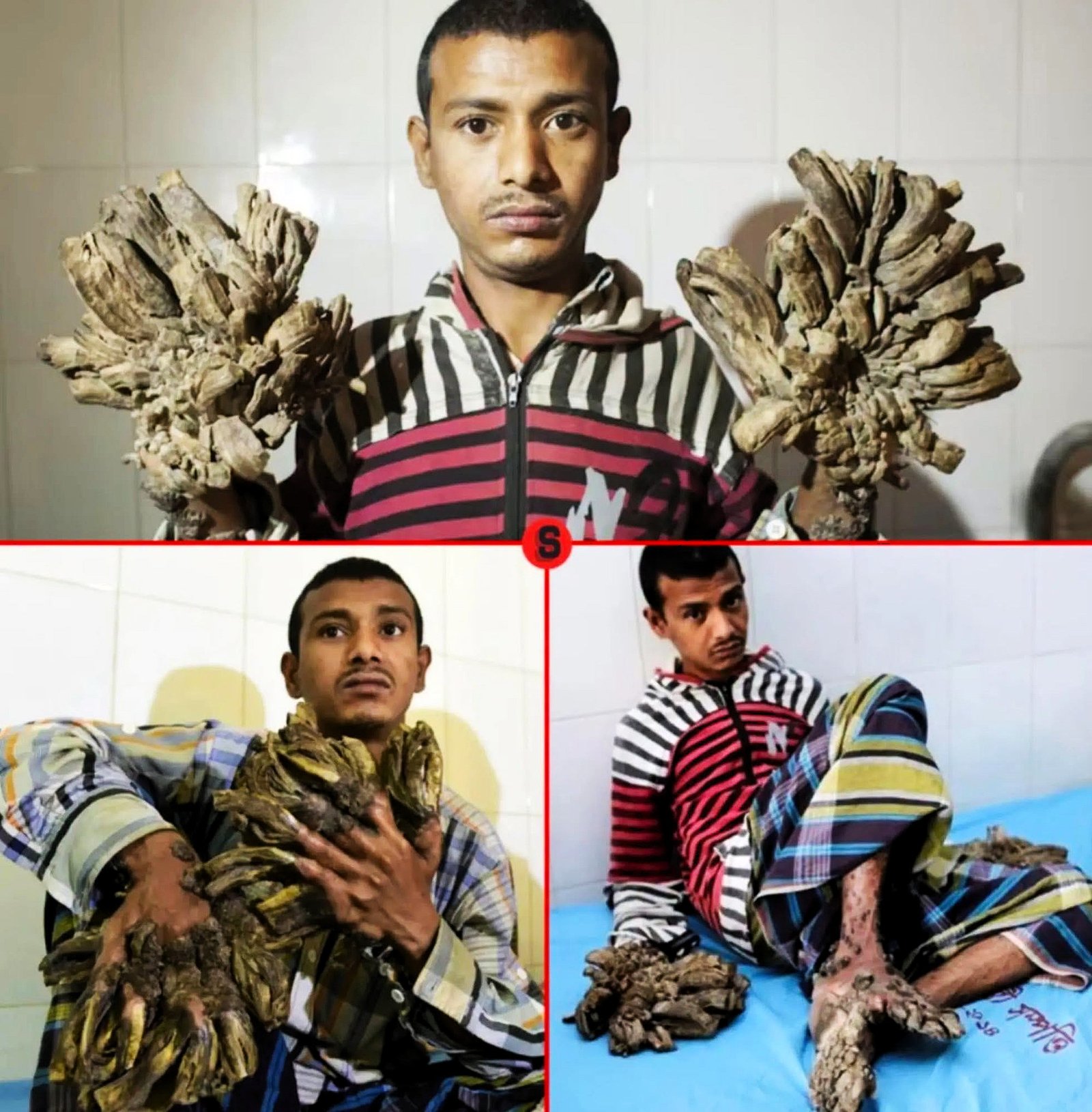
For Abul, the growths became so extensive that they covered significant portions of his hands and feet. As the abnormal tissue accumulated, his ability to perform ordinary activities became increasingly restricted.
His hands, which should have allowed him to hold objects, earn a living, and care for himself, became the very parts of his body that caused him the greatest difficulties.
When everyday activities become difficult
Most people rarely think about how much they depend on their hands. We use them to eat, dress, write, work, carry groceries, and perform countless other tasks throughout the day.
For someone living with severe growths on their hands, those familiar actions can become exhausting challenges.
Abul’s condition affected his ability to use his fingers normally. The thick, irregular growths interfered with movement and made routine activities difficult. His feet were also affected, adding another layer of hardship to his daily life.
The physical burden was only part of the struggle. A condition that visibly changes a person’s appearance can also bring unwanted attention, misunderstanding, and emotional distress.
When photographs of Abul began circulating internationally, many people were shocked by the unusual appearance of his hands. Yet behind those images was a human being whose life could not be fully understood through photographs alone.
He was not simply a medical curiosity. He was a person facing a complicated health problem, with hopes, fears, and the desire to regain some independence.
His story reminded people that rare diseases can affect far more than the physical body. They can influence employment, relationships, confidence, and the freedom to participate in everyday life.
A medical case that attracted worldwide attention
As Abul’s condition became more widely known, his case attracted the attention of doctors, journalists, and people around the world.
For many observers, the appearance of his hands seemed almost unbelievable. For medical professionals, however, his condition represented a serious challenge requiring careful examination, treatment planning, and continued monitoring.
His case also helped draw attention to epidermodysplasia verruciformis, a rare disorder that many people had never heard of before.
The condition is sometimes associated with extensive HPV-related skin lesions, but it is important to understand that HPV includes many different types. Not every type causes warts, and the particular types associated with epidermodysplasia verruciformis are not the same as all HPV infections.
The disorder is generally linked to inherited genetic changes that affect the body’s ability to control certain viral infections in the skin. It is not simply a matter of poor hygiene, and people living with the condition deserve medical support rather than judgment.
Abul’s case demonstrated why rare diseases require specialized knowledge. Treatments that work for ordinary warts may not be sufficient when growths become unusually extensive and continue to return.
The hope offered by surgery
One of the most significant chapters in Abul’s story began when he received medical treatment in Bangladesh.
Doctors undertook a series of operations to remove the excessive wart-like tissue covering his hands and other affected areas. The procedures were complex and required considerable care because the growths had become so extensive.
Reports about his treatment described the removal of several kilograms of abnormal tissue over multiple operations.
For Abul, these procedures offered something that had seemed increasingly distant: the possibility of using his hands more effectively and recovering some of his independence.
The treatment attracted considerable international interest because of the scale of the growths and the challenges involved in removing them.
Surgery can sometimes make an enormous difference for people with severe skin conditions. By removing excessive tissue, doctors may improve movement, reduce discomfort, and make daily activities more manageable.
In Abul’s case, the operations brought periods of improvement and renewed hope. Images showing changes in his hands helped people understand what medical intervention could achieve, even in an extraordinarily difficult situation.
But the journey was not as simple as removing the growths and declaring the problem solved.
Why the growths can return
Epidermodysplasia verruciformis is a chronic condition. Although surgery may remove visible lesions, it does not correct the underlying genetic susceptibility that allows certain HPV infections to cause extensive skin growths.
As a result, new lesions can develop even after apparently successful operations.
This is one of the most difficult aspects of managing the disorder. A patient may undergo painful procedures, experience meaningful improvements, and still face the possibility that the growths will return.
Abul’s subsequent medical difficulties highlighted the limits of surgery when an underlying disease remains active. Reports over the years have described the recurrence of lesions and the continuing challenges surrounding his treatment.
For patients and their families, recurrence can be emotionally exhausting. Each improvement brings hope, but the possibility of another setback makes the future uncertain.
Long-term management may require repeated medical assessments, treatment of individual lesions, and monitoring for complications. Some lesions associated with epidermodysplasia verruciformis can also carry an increased risk of skin cancer, making professional follow-up particularly important.
The appropriate treatment depends on the individual patient, the location and severity of the lesions, and the advice of specialists familiar with the condition.
Abul’s experience illustrates why rare genetic disorders often require more than a single operation. They demand continuing medical attention, resources, and a treatment plan that can adapt as the disease changes.
More than a headline
For a long time, Abul became known primarily through the striking appearance of his hands. His nickname made the medical condition easy for international audiences to recognize, but it also risked reducing his identity to his illness.
His story deserves to be understood more fully.
Behind the dramatic photographs was a person whose daily life had been transformed by a rare disease. The difficulties he experienced were not chosen, and the recurrence of his symptoms was not a personal failure.
His journey also raises important questions about access to specialized healthcare, especially for people living in countries and communities where rare-disease treatment can be difficult to obtain.
Complex medical care may involve multiple surgeries, experienced specialists, repeated hospital visits, and long-term monitoring. These demands can place enormous pressure on patients and their families.
Public attention can help bring resources and awareness to unusual medical cases, but sustained support matters just as much after the headlines disappear.
People living with rare conditions need access to appropriate treatment, reliable medical information, rehabilitation when necessary, and compassionate care that respects their dignity.
They also deserve to be seen as individuals rather than defined entirely by their physical appearance.
A story of hope, uncertainty, and human dignity
Abul Bajandar’s story is both remarkable and heartbreaking. It shows how a rare genetic disorder can interfere with the most ordinary parts of life, turning simple tasks into daily struggles.
It also demonstrates what medical treatment can accomplish. Surgery provided opportunities for improvement and showed that even severe manifestations of a rare disease may sometimes be treated with meaningful results.
At the same time, his experience reminds us that medical progress does not always mean a permanent cure. When an underlying condition remains, the road to better health can involve setbacks, repeated procedures, and difficult decisions.
There is no single moment that captures the entirety of Abul’s journey. His story is not just about the growths on his hands, the operations he underwent, or the worldwide attention he received. It is about the continuing struggle to live with a condition that changed his life in profound ways.
Perhaps the most important lesson is the simplest one: compassion should come before curiosity.
When we encounter someone living with an unusual medical condition, our first response should not be to stare, judge, or reduce that person to a shocking image. It should be to remember their humanity.
Abul’s experience has helped bring attention to a rare disease that many people might otherwise never have encountered. His journey highlights the importance of medical research, specialized treatment, public awareness, and long-term support for patients whose conditions are not easily cured.
His story remains a powerful reminder that behind every extraordinary medical case is an ordinary human desire: to live with dignity, to find relief from suffering, and to have the chance to experience life beyond the limits imposed by illness.