
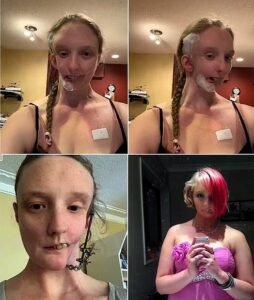
At just eight years old, Brittany Kremers faced a diagnosis that would change the course of her life forever.
She had stage 3 alveolar rhabdomyosarcoma, an aggressive form of cancer that required extensive treatment. Saving her life meant making devastating sacrifices. Doctors removed her jaw and part of the base of her skull as part of the treatment she needed to survive.
For a child, the journey was unimaginable. For Brittany and her family, it became a reality they had to face one day at a time.
Surviving cancer was an enormous victory, but it did not mean that her medical journey was over.
As the years passed, Brittany began preparing for facial reconstruction. The goal was to rebuild what the cancer treatment had taken away and help her move toward a better quality of life.
But reconstruction would not be a simple operation.
For approximately 14 months, she wore an external metal device designed to gradually realign her jaw in preparation for a planned prosthetic implant. It was a long, demanding process that required patience and the hope that each difficult step would bring her closer to the treatment she needed.
Then, in December 2021, when Brittany was 25, she expected to receive information about the next stage of her reconstruction.
Instead, according to her family’s fundraising account, she was told that funding was unavailable.
After everything she had already endured, another obstacle stood between Brittany and the care she was waiting for.
Her family faced a painful question: What could they do when the next stage of treatment depended on money they could not easily find?
That was when a remarkable wave of public generosity began.
A family friend, Anna Meyer, created a Givealittle fundraising campaign to help Brittany obtain the reconstruction she needed.
The appeal reached people far beyond Brittany’s immediate circle. Strangers began contributing, each donation becoming part of a collective effort to help one woman continue her journey toward recovery.
Some people could give more than others. Some could offer only a small amount. But thousands of people chose to help.
Eventually, the campaign raised an extraordinary NZ$282,989 from 4,271 donors.
Behind that number were thousands of individual decisions to support someone they might never meet. People who had never known Brittany personally were moved to contribute toward her future.
For Brittany and her family, the response brought financial support and renewed hope. After years of medical challenges, it seemed that the generosity of strangers might finally help move her reconstruction forward.
But reaching the fundraising target did not mean that the entire journey had been paid for.
And that is the part of Brittany’s story that makes it especially important to understand.
By November 2023, the campaign organizer reported that Brittany was still waiting. The money raised could cover the initial operations, but additional procedures and long-term specialist care required further financial support.
A second fundraiser followed.
The donations had made a meaningful difference, but the complexity of her treatment meant that one successful fundraising campaign could not necessarily cover everything she would need.
Facial reconstruction after extensive cancer treatment can involve multiple stages, careful planning, specialist teams, and continuing follow-up. The medical journey may stretch across years, with each stage depending on the patient’s progress and individual needs.
For patients like Brittany, the challenge is not simply finding enough money for one operation. It is finding a reliable path through the entire process.
Every additional procedure can bring new questions about funding, scheduling, recovery, and access to the specialists involved in care.
And when a patient has already spent years enduring difficult treatment, uncertainty about the next step can be another heavy burden.
Brittany’s experience also highlights an important distinction between public generosity and a healthcare system’s responsibility to patients.
The thousands of people who donated demonstrated extraordinary compassion. Their contributions helped provide resources that might otherwise have been difficult to obtain.
But crowdfunding cannot always replace a dependable system for funding complex, long-term medical care.
Not every patient has a family friend who can organize a successful campaign. Not everyone has access to a large online audience. And not every family can spend months asking strangers for help while trying to navigate an already exhausting medical journey.
Patients whose treatment requires several operations and years of specialist follow-up need more than the possibility of another fundraiser.
They need clear information about which treatments are covered, who is responsible for coordinating their care, and what happens when the initial funding runs out.
Better coordination between hospitals, specialists, funding agencies, and community support organizations could help reduce the uncertainty patients face. Transparent treatment plans and clear explanations of funding arrangements could also help families prepare for the road ahead.
Most importantly, patients should not have to interpret a fundraising target as a guarantee that every stage of treatment has been secured.
Brittany’s story deserves to be told with both hope and honesty.
The generosity of 4,271 donors was real. The NZ$282,989 they contributed was significant. The hope that their support brought to Brittany and her family mattered.
So did the continuing wait described in the November 2023 update.
Her experience reminds us that surviving a life-threatening illness is sometimes only one part of a much longer journey. For some people, recovery means years of rebuilding, adapting, and seeking treatment that remains essential long after the original diagnosis.
Brittany was diagnosed with cancer as a child. As a young adult, she was still navigating the consequences of the treatment that saved her life.
She deserved to have her courage recognized, her needs taken seriously, and her future approached with compassion.
Her story is not just about the power of strangers coming together to raise money. It is also about the importance of ensuring that patients with complex medical needs are not left facing an uncertain future once the first wave of support has passed.
Because compassion should not end when a fundraising campaign reaches its goal.
How can healthcare systems better support patients whose reconstruction requires years of follow-up care?
Share your thoughts. Every patient deserves a chance to move forward with dignity, reliable care, and hope for the future.