
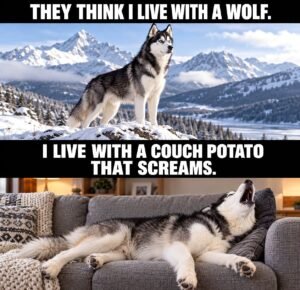
At first glance, a Siberian Husky looks like an animal straight out of the wilderness. With its thick coat, icy blue eyes, pointed ears, and wolf-like appearance, this beautiful breed can easily make people imagine snowy mountains, wild forests, and the untamed spirit of its ancestors.
But anyone who has ever shared a home with a Husky knows that appearances can be deceiving.
Behind those majestic looks is often a dramatic, stubborn, hilarious companion who can turn an ordinary afternoon into a full-blown performance without even getting off the couch.
And sometimes, the only thing more impressive than a Husky’s appearance is the volume of its voice.
A wolf on the outside, a comedian on the inside
Imagine meeting a dog standing proudly on a snowy mountain, its thick fur blowing in the cold wind. Its eyes are focused on the distance, its ears are alert, and its posture makes it look like the ruler of the wilderness.
You might think this animal is powerful, serious, and ready for an adventure.
Now imagine that same dog several hours later, stretched across a comfortable living-room sofa, with its legs hanging over the cushions and its head tilted backward as it releases a loud, dramatic howl.
The transformation is almost unbelievable.
One moment, the dog looks like a wild wolf. The next, it looks like a furry roommate who has decided that getting comfortable is the most important achievement of the day.
And if someone dares to interrupt its peaceful afternoon, the entire household may hear about it.
That is part of the unforgettable charm of Siberian Huskies. They have a distinctive appearance, expressive personalities, and a remarkable talent for making their feelings known.
They do not always bark like other dogs. Many Huskies prefer howling, whining, grumbling, and producing an astonishing collection of sounds that seem to communicate everything from excitement to frustration.
Sometimes, their vocal performances are so dramatic that people who are unfamiliar with the breed might wonder whether something is wrong.
Meanwhile, the Husky may simply be lying on its favorite cushion, perfectly comfortable and apparently unwilling to move.
The couch potato with a powerful voice
Huskies were originally bred to pull sleds over long distances in cold environments. They are athletic dogs with considerable stamina, and they generally need regular exercise, mental stimulation, and opportunities to explore.
Yet every Husky owner knows that these dogs can also appreciate a comfortable place to relax.
After a satisfying walk or a playful session, a Husky might decide that the sofa is the perfect place to spend the next few hours.
Its fluffy body spreads across the cushions. Its paws point in every direction. Its head rests against a pillow, and its expression suggests that the outside world can wait.
Then, without warning, the soundtrack begins.
A long, high-pitched howl fills the room.
The dog does not stand up. It does not walk toward the door. It does not even bother to change position.
It simply lies there and continues making noise.
Perhaps it wants attention. Perhaps it is responding to a sound outside. Maybe it has learned that vocalizing gets a reaction from the humans nearby.
Or perhaps the dog has discovered that it can express its entire personality while using almost none of its energy.
Of course, we cannot know exactly what a dog is thinking from a photograph alone. But the contrast between a Husky’s powerful voice and its relaxed posture makes the scene irresistibly funny.
It is the canine equivalent of someone shouting about a problem while refusing to leave the comfort of their favorite chair.
Why do Huskies scream instead of bark?
Huskies are famous for their vocal behavior, and there are several reasons they may howl, whine, or make dramatic noises.
First, they are naturally communicative dogs. Vocalizing is one way they interact with people and other dogs. Some Huskies appear to enjoy responding when their owners speak to them, creating the impression that they are having an actual conversation.
Second, Huskies are intelligent and energetic. When they are bored, frustrated, excited, or looking for interaction, they may use their voices to get attention.
Third, some Huskies are particularly expressive by temperament. One dog may quietly communicate through body language, while another seems determined to announce every feeling to the entire neighborhood.
Their behavior can be entertaining, especially when they appear to argue with their owners over something as ordinary as bedtime, bath time, or being asked to leave the sofa.
However, not every howl means the same thing. Dogs may vocalize because of excitement, loneliness, anxiety, discomfort, or environmental triggers. If the behavior suddenly increases or sounds unusual, it is worth paying attention to possible underlying causes.
A Husky that has always been chatty may simply be expressing a familiar personality trait. A dog that suddenly begins crying or howling excessively may need a closer look.
The trick is learning the difference between a harmless dramatic performance and a genuine request for help.
The dramatic roommate every family remembers
Living with a Husky can sometimes feel less like owning a pet and more like sharing a home with a very opinionated roommate.
You might wake up to a series of strange noises because the dog believes it is time for breakfast.
You might try to leave the house only to be greeted by an emotional vocal performance that makes the departure feel like a tragic movie scene.
You might ask your dog to move from the sofa, only to receive a long stare followed by a grumble that sounds suspiciously like a complaint.
And when the dog finally settles down, it may choose the most inconvenient position imaginable, occupying the entire couch while leaving its human with a tiny corner.
Yet these little moments are often what make life with a Husky so memorable.
Their personalities can be wonderfully expressive. Their reactions can be unpredictable. Their dramatic behavior can turn ordinary household routines into stories that families tell for years.
The dog that looks intimidating in photographs may be the same animal that hides behind its owner during a thunderstorm, demands affection with a soft nudge, or falls asleep in a position that seems physically impossible.
That contrast is part of the magic.
A Husky does not need to be doing anything extraordinary to make people smile. Sometimes, simply lying on the sofa and howling at absolutely nothing obvious is enough.
Behind the comedy is a dog that needs understanding
Although the image of a screaming couch potato is hilarious, Huskies also need responsible care.
Their thick coats, athletic backgrounds, and energetic personalities mean they are not always the easiest dogs for first-time owners. Most need daily physical activity, opportunities to sniff and explore, consistent training, and activities that challenge their minds.
A comfortable sofa can be a wonderful resting place, but it should not replace exercise and enrichment.
Owners can help their Huskies by establishing a predictable routine, providing appropriate toys, rewarding calm behavior, and making sure their dogs receive enough attention without encouraging constant demands for it.
It is also important to avoid assuming that every vocal outburst is simply funny. If a dog seems distressed, is struggling to settle, or shows a sudden change in behavior, its needs should come first.
Understanding a Husky means appreciating both sides of its personality: the energetic working dog and the affectionate home companion.
The goal is not to eliminate every howl or grumble. It is to understand what the dog is communicating and provide an environment where it can feel safe, stimulated, and loved.
So, do you live with a wolf?
Technically, a Siberian Husky is a domestic dog, not a wolf. Its wolf-like appearance reflects its ancestry and physical characteristics, but its behavior and needs belong to the world of domestic dogs.
Still, when you see a Husky standing proudly against a snowy mountain backdrop, it is easy to understand why people make the comparison.
Then the same dog rolls onto its back, stretches across the sofa, and begins howling as if the world has personally offended it.
Suddenly, the wilderness seems very far away.
What you actually have is a fluffy, expressive companion with a powerful voice, a sense of humor that humans can only guess at, and a remarkable ability to turn relaxation into a theatrical event.
Perhaps that is the real secret of living with a Husky. You never quite know whether your next moment will involve an impressive display of athleticism, an affectionate cuddle, a stubborn refusal to cooperate, or a concert from the middle of the living room.
And sometimes, the concert happens without the slightest movement from the performer.
The dog looks like a wolf. The voice sounds like an emergency siren. The energy level, at least on that particular afternoon, belongs to a professional couch potato.
And somehow, that combination makes the Husky even more lovable.