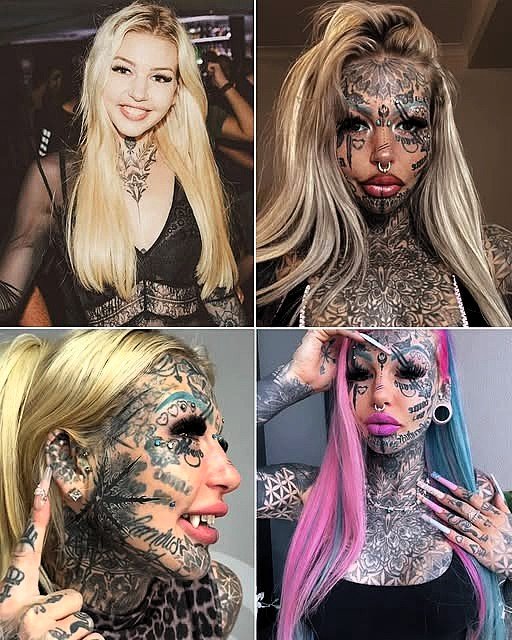
At just 16 years old, Amber Luke got her first three tattoos. At the time, they were only the beginning of a personal journey that would eventually transform nearly every visible part of her appearance and make her one of Australia’s most recognizable tattoo enthusiasts.
Years later, her transformation would include extensive body tattoos, a split tongue, stretched earlobes, multiple piercings, cosmetic procedures, and even tattoos covering the whites of her eyes in blue.
Her appearance became a subject of international fascination. People were captivated by her dramatic before-and-after photographs, wondering what could inspire someone to make such extraordinary changes to their body.
But behind the striking images was a much more personal story, one involving identity, self-image, emotional struggles, and the complicated process of learning to feel comfortable in one’s own skin.
a transformation that began in her teenage years
Amber’s journey started with three tattoos when she was 16. What began as a relatively small form of self-expression gradually developed into something much more extensive.
As she grew older, tattoos became an increasingly important part of how she presented herself to the world. Around the age of 20, she began tattooing her face and throat, taking her appearance in a direction that would eventually attract attention far beyond Australia.
Her modifications continued over the years. She embraced a split tongue, extensive body art, stretched earlobes, piercings, and cosmetic enhancements.
In a 2023 interview, Amber estimated that approximately 99 percent of her body had been tattooed or modified.
For many people, the changes were difficult to imagine making to their own bodies. For Amber, however, they represented a deeply personal relationship with her appearance.
Her transformation was not simply about becoming visually different. According to her own account, it was connected to how she felt about herself long before she became widely known.
the procedure that left her unable to see
Among all her modifications, one procedure stands out for its particularly frightening consequences.
Amber underwent eyeball tattooing, a procedure in which pigment is injected into the outer layer of the eye to change its appearance. In her case, the whites of her eyes were transformed to blue.
The procedure is very different from an ordinary skin tattoo. It carries serious risks, including infection, inflammation, and potentially permanent damage to vision.
Amber later described an alarming experience following the procedure. She said that she was unable to see for three weeks.
Her account brought attention to the risks associated with extreme body modification and the importance of understanding the potential consequences of procedures that permanently alter the body.
Although the blue appearance of her eyes became one of her most recognizable features, the experience also revealed a side of her transformation that photographs could never fully capture: the physical risks that can accompany the pursuit of a particular appearance.
Her story serves as a reminder that procedures that seem visually striking from the outside may involve consequences that are far more serious than people realize.
“i felt trapped in a body that wasn’t mine”
Perhaps the most revealing part of Amber’s story was not the number of tattoos she had or how dramatically her appearance changed.
It was the explanation she gave for her journey.
In an interview with 7NEWS, Amber said, “I felt trapped in a body that wasn’t mine.”
Those words offered a different perspective on the transformation that had attracted so much public attention.
People looking at her photographs might see a collection of tattoos, piercings, and modifications. They might focus on the contrast between her earlier appearance and the person she eventually became.
But Amber’s statement suggested that her experience was about something much more personal than outward appearance.
She described struggling with the way she saw herself long before she became known for her extensive body art.
For someone experiencing deep discomfort with their appearance, the reflection in the mirror can become a source of frustration, confusion, or emotional pain. Other people may see nothing wrong, yet the person looking back may feel disconnected from the image they see.
Amber’s account helps illustrate how complicated that relationship can be.
It would be impossible to understand every aspect of her experience from photographs alone. What matters is that she described a personal struggle that existed beneath the surface, long before the world began paying attention to her transformation.
when changing your appearance becomes part of finding yourself
For some people, tattoos are a way to preserve meaningful memories. For others, they represent creativity, independence, personal milestones, or a desire to challenge conventional expectations.
Body modification can mean different things to different people.
Amber’s journey demonstrates how personal these decisions can become, particularly when they are connected to feelings about identity and self-image.
As her appearance changed, she became increasingly recognizable for her distinctive look. Her photographs circulated widely, and people around the world formed opinions about her choices.
Yet public attention does not necessarily reveal what a person experiences privately.
Someone can attract admiration and criticism at the same time. They can appear confident in photographs while still working through complicated feelings about themselves. They can feel happier with certain aspects of their appearance without finding that every personal struggle disappears.
Amber acknowledged that her difficulties with body image had not simply vanished.
That detail is important because it challenges the assumption that changing the outside automatically resolves everything happening inside.
Physical appearance and emotional well-being are not the same thing. A person may make changes that help them feel more comfortable expressing themselves, but deeper concerns about identity or self-worth can require a different kind of attention.
There is no single explanation that can account for every person’s choices, and it would be unfair to assume that Amber’s experiences represent everyone who chooses extensive body modification.
Her own account, however, makes one thing clear: her story cannot be fully understood by looking at her tattoos alone.
beyond the before-and-after photographs
Before-and-after photographs are powerful because they make change immediately visible.
A person may look almost unrecognizable compared with an earlier photograph. The contrast invites questions, encourages curiosity, and sometimes leads people to make assumptions about the person in the picture.
But photographs capture appearance at particular moments. They cannot tell us everything about someone’s emotions, motivations, fears, or hopes.
They cannot show every difficult day that came before the transformation. They cannot explain what a person felt when looking in the mirror or what they hoped to discover through the choices they made.
In Amber’s case, the images tell the story of a remarkable physical transformation. Her interviews add another layer, revealing her own description of the relationship between her appearance and her sense of identity.
Both are part of the story, but neither should be mistaken for a complete understanding of her life.
It is also important to remember that extreme modifications can carry lasting medical consequences. Respecting someone’s autonomy does not mean ignoring the potential risks of a procedure, just as recognizing those risks does not justify humiliating or dehumanizing the person who underwent it.
Compassion and honest discussion can exist together.
the person behind the appearance
Today, Amber Luke remains a striking example of how dramatically someone can alter their outward appearance over time.
Her journey raises questions about individuality, beauty standards, self-expression, and the complicated ways people relate to their bodies.
But perhaps the most important lesson is not about tattoos at all.
It is about how little we can truly know about another person from the way they look.
A heavily tattooed person may be judged before they have spoken a single word. Someone with a conventional appearance may be carrying struggles that nobody around them can see. A dramatic transformation may inspire endless speculation, while the personal experiences behind it remain largely unknown.
We do not have to make the same choices as someone else to treat them with dignity.
We do not have to understand every decision to recognize that the person making it has a life and experiences beyond what is visible.
Amber’s story also reminds us that feeling comfortable in one’s own skin can be a complicated process. Sometimes, the journey involves visible changes. Sometimes, it involves private reflection and learning to understand oneself in new ways.
And sometimes, it involves both.
Her before-and-after photographs may capture the transformation of her appearance, but her words reveal why a more thoughtful conversation is necessary.
Because behind every face is a human being whose story is more complicated than a photograph can explain.
How much can we really understand about someone from their appearance alone?
Perhaps the next time we see someone whose appearance surprises us, we should pause before making assumptions. There may be a story we have never heard, experiences we cannot see, and feelings we could never discover by looking at them.
We may not know their reasons, their struggles, or the path that brought them to where they are today.
But we can choose to approach them with curiosity instead of cruelty, understanding instead of judgment, and respect instead of assumptions.
Sometimes, the most important thing we can see is not what makes someone look different.
It is the person behind the difference.