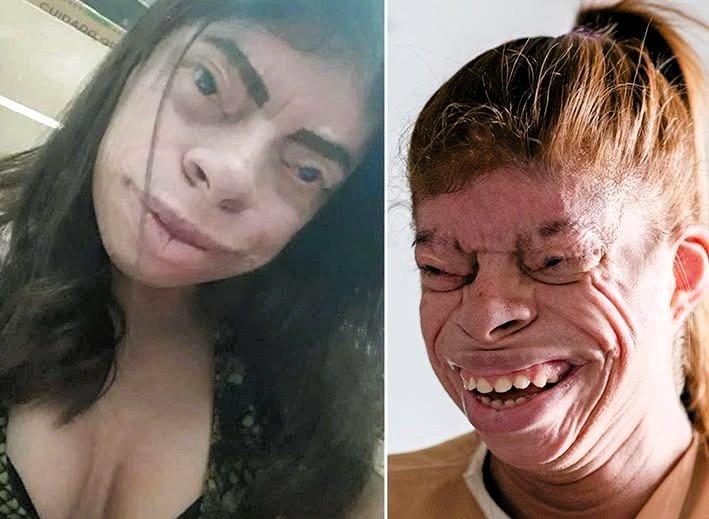
Sometimes, a single photograph or video can change the way someone understands their entire life. For one mother in the United States, discovering Brazilian content creator Dandara Melo online became one of those moments. As she watched Dandara share her experiences, she recognized something familiar in the young woman’s appearance. Her son had the same rare condition, and suddenly, she was looking at someone who might understand what her family was going through.
The mother reached out to Dandara, hoping to learn more about the condition affecting her child. Although they lived in different countries and spoke different languages, Dandara did not allow that barrier to stop her from helping. She turned to Google Translate to communicate with the worried mother and share suggestions about doctors.
For that family, Dandara was more than a person appearing on a screen. She was someone who had lived with the same rare condition, faced many of the same questions, and understood how isolating it could feel to grow up looking different from everyone around you.
Her response demonstrated something powerful: sometimes, the person who offers the greatest comfort is someone who has walked a similar path.
A childhood filled with medical challenges
Dandara Melo grew up with Barber-Say syndrome, an extremely rare genetic condition that can affect the skin, hair, eyelids, and other facial features. Because so few people live with the condition, finding others who share the same experiences can be difficult.
For Dandara, the challenges began early in life.
In an interview published in 2021, she described spending her first four months in the hospital. During that period, she underwent medical treatment and eyelid reconstruction as doctors worked to address some of the physical effects of her condition.
While other children were beginning their lives at home with their families, Dandara’s earliest months involved hospital care, medical procedures, and the uncertainty that can accompany a rare diagnosis.
As she grew older, her journey continued beyond hospital walls. She pursued her education and eventually trained as a nursing technician, developing a professional interest in caring for others.
But while medical treatment could address certain physical challenges, it could not protect her from every difficulty waiting outside.
School and college brought painful experiences that had little to do with her medical condition itself. Instead, they revealed how unkind people can be toward someone who looks different.
The pain of being judged for her appearance
Growing up with a rare condition can mean dealing with questions and stares from strangers. For some people, those reactions become an exhausting part of everyday life.
Dandara experienced bullying during her school years. She also recalled being physically assaulted by fellow students while attending college.
Such experiences can leave emotional wounds that are difficult to explain to anyone who has never experienced them.
A person who is repeatedly mocked for their appearance may begin to wonder whether they will ever be accepted. Ordinary activities, such as walking into a classroom, meeting new people, or making friends, can become stressful when there is always a possibility of being ridiculed.
Dandara had to navigate those challenges while continuing her education and building her future.
Yet, her story did not end with the painful memories of her younger years.
Eventually, she found a way to share her experiences with the world. It began with a simple decision to appear in front of a camera.
She could not have known how many lives that decision would eventually touch.
The videos that introduced her to the world
During the COVID-19 pandemic, Dandara began posting videos on TikTok.
Social media offered her a way to express herself, connect with other people, and show audiences a part of her life that many had never encountered before. Her videos also created an opportunity to challenge the assumptions people sometimes make about physical differences.
However, putting herself in the public eye came with its own difficulties.
Some viewers responded with cruel comments about her appearance. The negativity became so upsetting that she considered giving up on posting altogether.
After experiencing bullying in person for years, facing similar treatment online could easily have reopened old wounds.
Imagine trying to share your life honestly, only to discover that strangers are willing to use your most visible difference as a reason to hurt you.
For a moment, stopping might have seemed like the easiest option.
But Dandara continued.
And as she kept sharing her experiences, another side of social media began to emerge.
Messages arrived from people who appreciated her confidence, wanted to learn about Barber-Say syndrome, or simply felt encouraged by seeing someone living openly with a condition they rarely encountered.
Her audience grew rapidly. By November 2021, she had reportedly attracted more than 485,000 followers, and some of her videos had surpassed seven million views.
Numbers like those are impressive, but the most meaningful part of her growing audience was not the number of people watching.
It was the people who finally felt that someone understood them.
A message from a mother searching for answers
Among the people who discovered Dandara online was a mother in the United States whose son had Barber-Say syndrome.
For that mother, seeing Dandara must have offered something difficult to find when raising a child with an exceptionally rare condition: a person whose lived experience could help make the unfamiliar feel a little less lonely.
Parents of children with rare genetic conditions may spend considerable time searching for medical information, specialists, treatment options, and other families who understand their circumstances.
Even when doctors provide guidance, families can still have questions about everyday life, social experiences, and the future.
Finding someone who shares the same diagnosis can open a different kind of conversation.
The American mother reached out to Dandara, hoping to learn from her experience.
There was one obvious complication. They did not speak the same language.
But Dandara found a practical solution. She used Google Translate to answer the mother’s messages and communicate suggestions about doctors.
Their exchange did not require them to share a country, a first language, or the same daily circumstances. They needed only a way to understand each other and a willingness to connect.
For the mother, Dandara’s willingness to respond offered a personal connection that medical information alone could not necessarily provide.
And for Dandara, the interaction showed how her decision to share her life online could reach far beyond her own community.
Discovering that you are not alone
Dandara’s online presence also helped her connect with another person living with Barber-Say syndrome—a man in India who contacted her after discovering her content.
The two began communicating through video calls.
Their connection was particularly meaningful because rare conditions can create a sense of isolation. When a condition affects only a very small number of people, it may be difficult to meet someone who truly understands what living with it feels like.
Most people around them may never have heard of the syndrome. Some may be curious but unsure how to ask respectful questions. Others may respond with uncomfortable stares or hurtful remarks.
Meeting someone with the same condition can change that experience.
Suddenly, there is another person who may understand the questions, the medical experiences, the unwanted attention, and the emotional challenges that can accompany a visible difference.
There is also an opportunity to share encouragement and practical knowledge without having to explain every detail from the beginning.
For Dandara, these connections demonstrated that the internet could be more than a place where strangers passed judgment. It could also become a meeting point for people who might otherwise never find one another.
Turning visibility into understanding
Dandara’s story is not simply about becoming popular on social media. It is about what can happen when someone who has experienced rejection chooses to make their life visible anyway.
Her videos allowed people to learn about Barber-Say syndrome through the experiences of someone living with it. They also created opportunities for people with the condition and their families to connect across geographical and linguistic boundaries.
That visibility matters because rare conditions are often accompanied by a